Table of Contents
Scroll through Financial Twitter for an hour. You will see charts, macro takes, options strategies, hot stocks, cold stocks, Federal Reserve speculation, and at least three people claiming they saw the last crash coming. What you will almost never see is someone talking about how they refinanced a duplex in Tulsa.
Now open any real estate investing forum. You will find people arguing about property management software, eviction laws, cap rates, tenant screening, and whether a new water heater counts as a repair or an improvement. What you will almost never see is someone tweeting about the yield curve.
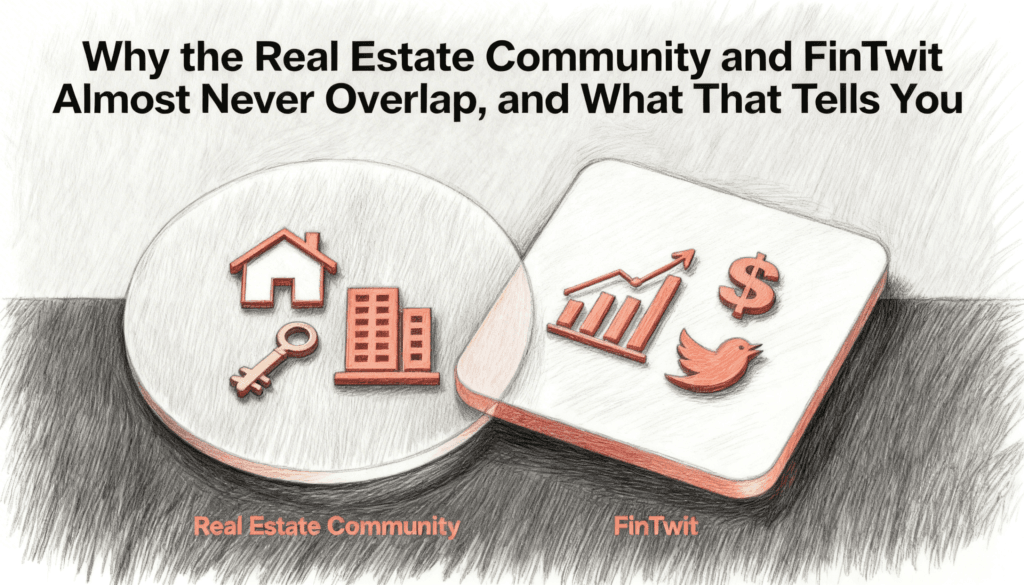
These two groups exist in the same universe. They are both trying to build wealth. They both read books, follow gurus, and argue about strategy. And yet they might as well be on different planets. They do not share audiences. They do not share vocabulary. They rarely even share enemies. The overlap between serious real estate investors and serious FinTwit personalities is so small that when you do find someone who lives in both worlds, they feel like a rare bird.
The question is why. And the answer says something uncomfortable about what each group is actually doing when they think they are investing.
Two Different Relationships With Time
The easiest explanation is the laziest one. People will tell you real estate is slow and FinTwit is fast, so of course they do not mix. That is true, but it does not quite get at the real thing.
The deeper split is that these two groups have fundamentally different relationships with time itself. FinTwit treats time as a stream of events to react to. Every day brings new data, new headlines, new reasons to update your thesis. The job is to stay awake, stay informed, and move with the current. Missing a week feels dangerous. Missing a month feels unforgivable.
Real estate treats time as a substance you pour concrete into. You buy a building. You hold it. You fix things when they break. You raise rent when the lease expires. The idea that you would check your property every day the way a trader checks their positions is almost comic. What would you even be looking at? The paint?
These are not just different strategies. They are different ways of experiencing the passage of time. And people who experience time differently tend not to enjoy each other’s company. It is the same reason farmers and day traders rarely make good roommates.
The Thing You Cannot Tweet
Here is something worth noticing. Real estate is, by far, one of the most talked about ways to build wealth in the history of the world. Books, podcasts, courses, conferences, late night infomercials. Entire television networks exist to show people buying and renovating properties. And yet real estate has never really found a home on FinTwit.
Why? Because the interesting parts of real estate are deeply unphotogenic.
You cannot tweet a screenshot of a good tenant. You cannot post a chart of your property manager doing their job correctly. The best real estate deals are the ones where nothing dramatic happens for ten years. The operator handles the water leak. The bookkeeper files the taxes. The market slowly drifts upward. Rent slowly drifts upward. Debt slowly gets paid down. At the end of the decade, you have meaningfully more money than you started with, and absolutely no story to tell.
FinTwit lives and dies by the story. A ticker, a chart, a thesis, a reveal. The medium rewards narratives that can be compressed into a single screen. Real estate narratives cannot be compressed that way. The whole point is that they unfold over years in ways that would bore anyone watching in real time.
The Locality Problem
There is another reason these groups do not overlap, and it has to do with how the two assets actually behave in the world.
A stock is the same everywhere. If you buy shares of a company from Tokyo and someone else buys them from Toronto, you own the exact same thing. The price is the price. The information is the information. This creates a global conversation where a random trader in one country can have a perfectly useful debate with a random trader in another country.
Real estate is not like that. Real estate is radically, stubbornly local. A fourplex in Cleveland has almost nothing in common with a fourplex in Miami. Different laws, different tenants, different weather, different economies, different contractors, different property taxes, different everything. A real estate investor in Ohio cannot give meaningful tactical advice to a real estate investor in Florida, even though they both own fourplexes. They are, in a real sense, playing different games with the same equipment.
This kills the possibility of a single global conversation. FinTwit works because everyone is arguing about the same Federal Reserve, the same earnings reports, the same ten tickers. Real estate cannot do that. The conversation keeps fragmenting into smaller and smaller local pieces. You do not get one big platform. You get a thousand tiny ones, each full of people who know one city very well and every other city not at all.
What They Actually Think They Are Doing
Strip away the surface differences and something more interesting appears. These two groups are not just investing in different things. They think they are doing different kinds of work.
The real estate investor believes they are operating a small business. They are landlords, managers, owners of a physical thing. When they talk about their returns, they talk about what they did. They found the deal. They negotiated the price. They fixed the roof. They chose the tenant. Every dollar of profit has a story attached to it, and the story is about effort and judgment applied over time.
The FinTwit investor believes they are reading the world. They are analysts, strategists, pattern recognizers. When they talk about their returns, they talk about what they saw. They spotted the trend. They understood the macro picture. They called the turn before anyone else. Every dollar of profit has a story attached to it too, but the story is about insight and attention applied in the moment.
Neither group wants to admit that the other story might also be a legitimate way to make money. Because if it is, then their own story is not the only path. And if it is not the only path, then maybe the effort or the insight they are so proud of was not the actual reason they got paid. Maybe they just happened to be in the right asset at the right time, and all the work they put in was a decorative frame around plain old exposure.
This is uncomfortable for everyone. So the two groups stay apart. They barely read each other. They barely argue with each other. They simply pretend the other side does not exist and continue telling themselves their own preferred story about why their money shows up.
The Quiet Thing Both Sides Miss
There is a counterintuitive lesson buried in all of this, and it is worth saying out loud.
The fact that real estate and FinTwit do not overlap is not evidence that one of them is wrong. It is evidence that financial communities are shaped less by what works and more by what can be talked about. The medium filters the message. The communities that form around an asset are not the communities best at that asset. They are the communities best at discussing that asset in the format available to them.
This means that the most valuable financial insights are probably the ones that do not travel well. Not because they are secret, but because they are shaped wrong for the platforms where most people go looking. Anything that requires ten years of context, three local contractors, and a handshake with a bank loan officer is simply never going to trend. Anything that fits in a screenshot with a bold arrow will trend constantly, whether or not it works.
People who notice this stop asking which community is right. They start asking what each community is structurally incapable of saying. That is usually where the interesting money is hiding.
The real estate investor and the FinTwit personality will probably never share a drink. That is fine. What is worth remembering is that their mutual silence is not evidence of disagreement. It is evidence that they never figured out how to have the same conversation. And somewhere in the gap between their two worlds, there is probably a better investor than either of them, quietly doing both, and not telling anyone about it.
Because the moment you can tweet it, it stops working quite as well.