Table of Contents
There is a word that gets thrown around in finance like it means something universal. That word is responsible. Real estate investors love it. They use it to describe what they do with borrowed money. They say things like responsible leverage, responsible underwriting, and responsible debt coverage ratios. The word does a lot of heavy lifting. It implies maturity, discipline, and a kind of moral seriousness that separates the grown ups from the children.
Meanwhile, over in the corner of the internet where WallStreetBets lives, the word responsible is treated like a curse. It is something your uncle says before he tells you to buy an index fund and stop checking your phone. It is what killed your father’s portfolio. It is, in their view, a polite word for boring.
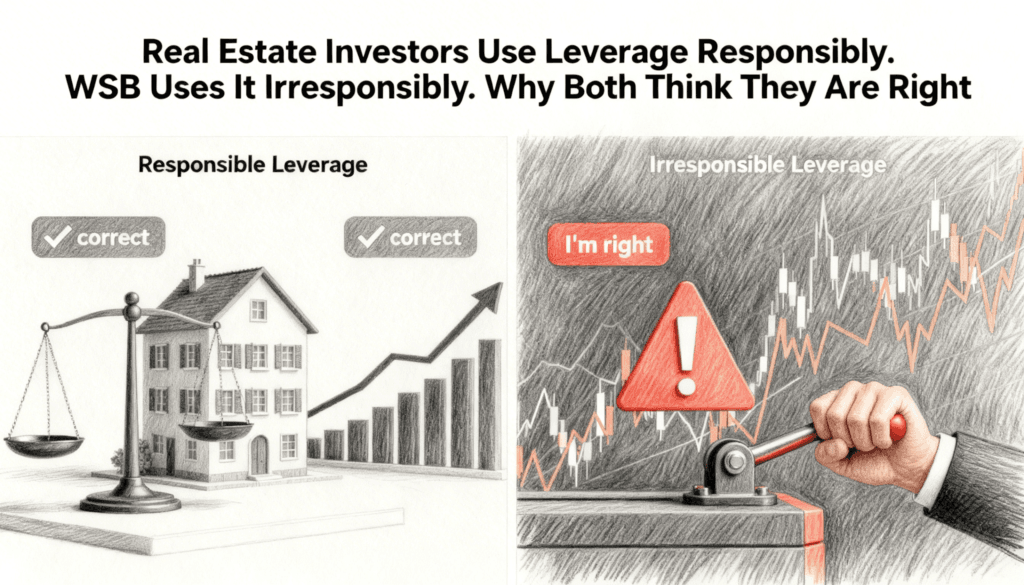
Here is the strange part. Both groups are using leverage. Both groups believe they are using it correctly. And both groups have a completely coherent worldview that justifies what they are doing. The fight is not really about math. It is about what the word responsible even means.
Two Definitions, Same Word
Ask a real estate investor what responsible leverage looks like and you will get a pretty consistent answer. You borrow against an asset that produces income. The income covers the debt. You keep some reserves. You do not bet the farm on any single deal. You assume things will occasionally go wrong and you build a cushion for when they do. The goal is to survive long enough for compounding to do its quiet work.
Ask a WSB trader what responsible leverage looks like and the honest answer, the one nobody says out loud, is something like this. You only risk money you can afford to lose. You size your position so that a total wipeout does not end you. You know the trade is a coin flip at best and you are fine with that because the payoff justifies the risk. The goal is to get lucky a few times and change your life.
Notice something. Both definitions include the idea of survival. Both include the idea of not risking everything. Both include a calculation about what you can afford to lose. The real estate investor and the options trader are using the same skeleton of reasoning. They are just stretching very different skin over it.
The Philosopher Nobody Invited
There is a concept from an old school of thought called stoicism that might be useful here. The stoics had this idea that you cannot control outcomes, only your response to them. What you can control is how prepared you are for bad luck. They spent a lot of time imagining worst case scenarios on purpose, not because they were pessimists, but because they wanted to take the sting out of disaster in advance.
Real estate investors are accidental stoics. The entire culture is built around imagining what happens if the tenant leaves, the roof leaks, the rates rise, and the market softens all in the same quarter. They underwrite the pain before it arrives. That is why they feel responsible. They have mentally lived through the worst case and decided they could take it.
WSB has its own version of this, even if nobody would ever describe it in those terms. The culture of posting loss porn, the screenshots of accounts down ninety percent, the memes about eating crayons and losing the mortgage, all of it is a way of pre accepting the worst. You cannot be humiliated by a loss you have already joked about. It is a crude form of the same stoic trick. Prepare for disaster by rehearsing it.
The difference is that real estate investors rehearse disaster with spreadsheets and WSB rehearses it with memes. But the psychological function is surprisingly similar. Both communities are trying to make peace with the possibility of being wrong.
The Thing Neither Side Will Admit
Here is where it gets uncomfortable for both tribes. Real estate is not as safe as its fans believe, and options trading is not as reckless as its critics claim. The middle ground is messier than either side wants.
A landlord with a fully leveraged portfolio in a single city is not running a responsible operation. They are running a concentrated bet on local rents, local employment, and local policy, financed by debt that must be paid whether or not anything goes right. It looks responsible because it moves slowly and involves a physical object you can touch. The slowness is mistaken for safety. But a slow disaster is still a disaster. It just gives you more time to describe it in a podcast.
A WSB trader who only ever risks a small slice of their income on defined risk trades, while keeping the rest in boring assets, is behaving more responsibly than the landlord. They have simply chosen a louder vehicle. The volume is mistaken for recklessness. But noise is not the same as risk.
What both groups are really arguing about is not leverage at all. It is aesthetics. One aesthetic says responsibility looks like brick walls and thirty year amortization schedules. The other says responsibility looks like position sizing and a willingness to accept total loss on a single bet. Neither is wrong about itself. Both are wrong about each other.
The Borrowed Confidence Problem
There is a quiet danger that stalks both camps, and it has the same name in both places, even though nobody uses the same word for it. Call it borrowed confidence.
The real estate investor borrows confidence from the fact that the asset is physical, that banks were willing to lend against it, and that real estate has historically gone up. None of these are actual proofs that the specific deal will work. They are just comforting stories that happen to be attached to the purchase. The investor feels safe because the environment around the decision feels serious.
The WSB trader borrows confidence from the fact that the trade is quick, that other people on the forum are doing the same thing, and that the potential payoff is enormous. None of these are actual proofs either. The trader feels bold because the environment around the decision feels exciting.
In both cases the confidence is imported from the surroundings, not earned by the analysis. That is the thing neither group wants to look at too closely. The seriousness of a property deal and the thrill of an options trade are both emotional weather, not evidence. And weather, as anyone who has ever underwritten a deal or held a contract through earnings knows, is not the same as climate.
A Short Detour Through Poker
If you have ever watched professional poker, you may have noticed something strange. The best players do not talk about winning hands. They talk about good decisions. A decision can be good and lose. A decision can be bad and win. The whole game is built on separating the quality of the choice from the quality of the outcome.
This is the lens that both real estate investors and WSB traders tend to ignore when they argue with each other. Real estate investors point at WSB losses and say, see, irresponsible. WSB traders point at their occasional wins and say, see, worth it. Both are judging the process by the result, which is exactly what poker players learn not to do on day one.
A responsible leverage decision is one where, if you ran the same situation a thousand times, you would be happy with the average outcome. Most real estate deals probably pass that test, because the downside is bounded and the upside is patient. Most WSB trades probably fail that test, because the upside is huge but the average outcome is a slow bleed. But the test itself is the thing. Neither community runs the test honestly. They run a different test, which is whether the last trade felt serious or fun.
So Who Is Actually Right
The honest answer is that both groups are right about themselves and wrong about each other. Real estate investors have built a culture that genuinely rewards patience and penalizes recklessness, within its own definition of what those words mean. WSB has built a culture that genuinely rewards honesty about risk and penalizes pretending, within its own definition of what honesty looks like. Each group has internalized a version of responsibility that fits its tools.
The mistake is believing that your definition is the only one. The real estate investor who sneers at options traders is not actually defending responsibility. They are defending their aesthetic of it. The options trader who sneers at landlords for being slow is doing the same thing in reverse. Neither is having an argument about leverage. They are having an argument about what a serious life is supposed to look like.
And that argument, it turns out, is the one nobody ever actually wins. You just pick your side, convince yourself it is the adult in the room, and get on with the business of borrowing money to buy something you hope will be worth more tomorrow. Whether that something is a duplex or a weekly call option, the prayer at the end of the day is remarkably similar. Please let this work. Please let me be the responsible one.
Responsible, as it turns out, is not a description of a strategy. It is a story people tell themselves about why they deserve the outcome they are hoping for. Both tribes tell that story. Neither tribe notices they are telling it.