Table of Contents
There is a particular kind of cruelty in being told to trust what you see while someone quietly rearranges the room behind you. In psychology, this is called gaslighting. In financial markets, it is called Tuesday.
Every week, millions of retail investors open their brokerage apps, scan the charts, read the analyst upgrades, and feel a warm sense of confirmation. The trend is up. The rating says “strong buy.” The moving averages have crossed in some magical way that supposedly signals momentum. Everything looks clean. Everything looks safe.
Meanwhile, somewhere in a corporate boardroom or a corner office with a view that costs more than your portfolio, an executive is filing paperwork to sell a block of shares worth more than most people will earn in a decade. And they are doing it on the same day their company’s stock gets a glowing recommendation from a major bank.
This is not a conspiracy theory. This is a pattern. And if you have spent any meaningful time watching how money actually moves through public markets, you already know that the loudest signals are often designed for the people who can least afford to follow them.
The Architecture of Confidence
To understand how retail investors get misled, you first need to understand how confidence is manufactured. Not the personal kind. The market kind. The kind that makes you feel smart for buying something right before it drops 30 percent.
Wall Street runs on a simple but powerful asymmetry: the people who produce the research are not the people who pay for it. Analyst ratings, price targets, and earnings projections do not exist in a vacuum. They exist inside investment banks that also underwrite IPOs, manage corporate relationships, and earn fees from the very companies they cover. This does not mean every analyst is corrupt. It means every analyst operates in a system where the incentives point in one direction, and that direction is almost never “sell.”
Look at the distribution of analyst ratings on any major financial data platform. At any given time, the vast majority of ratings on publicly traded stocks are either “buy” or “hold.” Outright “sell” ratings are rare. Not because most stocks are wonderful investments, but because issuing a sell rating on a company your bank does business with is a career limiting move wrapped in a diplomatic nightmare.
So the recommendation engine stays perpetually optimistic. And retail investors, who do not have access to the private conversations happening behind the curtain, take these ratings at face value. They trust the chart because the chart is dressed up in the language of authority. It has indicators. It has consensus targets. It has the full weight of institutional credibility behind it.
What it does not have is the footnote that says: the person who wrote this report would never put their own money where their mouth is.
What the Insiders Know That You Do Not
Insider selling is legal. This is worth stating clearly, because the phrase itself sounds like it should come with handcuffs. Corporate executives are allowed to sell their own shares, provided they file the appropriate disclosures and do not trade on material nonpublic information. These filings are publicly available. Anyone can read them.
But almost nobody does.
This is the quiet scandal of modern markets. The information is right there, sitting in SEC filings like a confession written in plain sight. And yet the financial media rarely leads with it. When a CEO sells a significant stake in their own company, the story gets buried under a headline about the company’s “strong quarterly results” or “raised guidance.” The framing is always forward looking, always optimistic, always conveniently timed to distract from the fact that the person who knows the business best just reduced their exposure to it.
There is a useful analogy from the restaurant industry. Imagine you walk into a restaurant where the chef is eating a sandwich from the place next door. You might still sit down. But you would probably think twice about ordering the special.
Insider selling is the CEO eating the other restaurant’s sandwich. It does not guarantee the food is bad. But it tells you something about confidence that no earnings report ever will.
The Chart as a Story You Want to Believe
Technical analysis is the astrology of finance. This is not a new criticism, and it is not entirely fair, but it captures something important about the relationship between retail investors and charts. People do not read charts the way scientists read data. They read them the way believers read scripture. They come to the chart looking for confirmation, and the chart, being a mirror of past price action with no opinions of its own, happily provides it.
The problem is not that technical analysis is useless. Some patterns do have statistical validity. The problem is that technical analysis, as consumed by most retail investors, is performative. It is content. It fills YouTube videos and Twitter threads and Substack posts. It gives people the feeling of rigor without the substance of it. And it creates a dangerous illusion: that the future of a stock can be decoded from its past, like reading tea leaves with better graphics.
Meanwhile, the professionals who actually move markets are not staring at candlestick patterns. They are reading order flow. They are modeling liquidity. They are on the phone with management teams getting “color” on the quarter. They operate in a different information ecosystem entirely, one where the chart is a byproduct, not a guide.
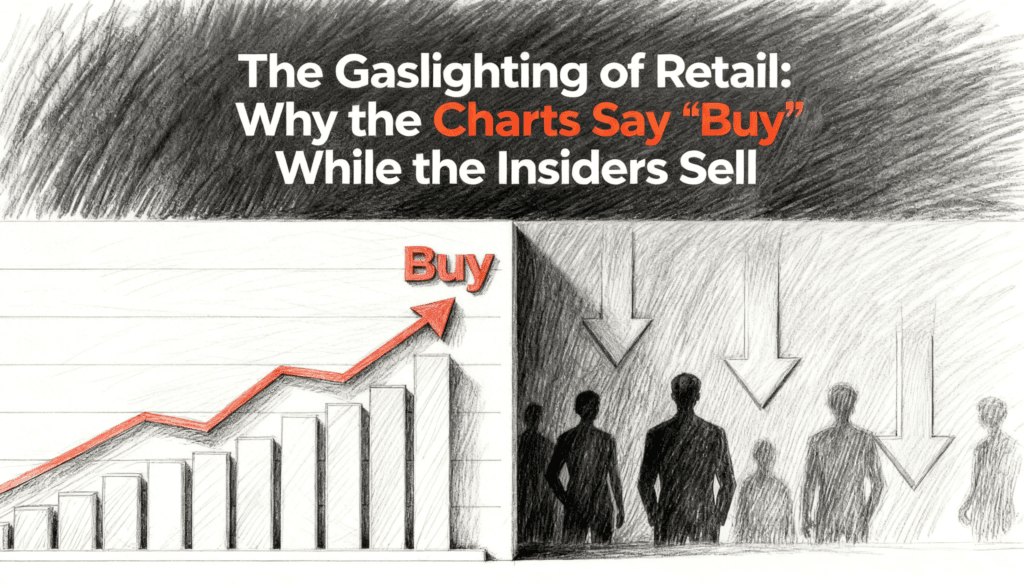
When the chart says “buy” and the insider says “sell,” you are witnessing two different conversations happening in the same room. One is public theater. The other is private strategy. And if you are only listening to the public one, you are making decisions with half the script.
The Sell Side Is Not Your Side
The term “sell side” in finance refers to the institutions that create and distribute research, facilitate trades, and generally serve as the intermediaries of the market. The term is oddly honest if you think about it. They are literally called the sell side. Their job is to sell you things. Products. Ideas. Narratives. And yet, retail investors routinely treat sell side research as though it were independent academic analysis produced for the public good.
It is not.
This does not make it worthless. There are brilliant analysts who produce genuinely insightful work. But their brilliance operates within a machine that has its own priorities. And those priorities are not aligned with yours. The sell side needs volume. It needs activity. It needs you to trade. A market full of patient, disciplined, long term investors who ignore analyst upgrades and sit on index funds is a market that generates very little revenue for the people who run the infrastructure.
So the machine produces noise. Constant, sophisticated, beautifully packaged noise. And the noise always sounds like opportunity. Because opportunity drives transactions. And transactions drive commissions, spreads, and fees.
The Timing Problem
Here is where it gets particularly cruel. Even when retail investors do notice insider selling, they often dismiss it because of timing. The executive sold in January, and the stock did not drop until August. Therefore, the selling must have been routine. Just portfolio rebalancing. Estate planning. Tax optimization. Nothing to see here.
But this misunderstands how information asymmetry works. Insiders do not sell the day before bad news. That would be illegal and, more importantly, obvious. They sell months in advance. They sell slowly, methodically, through prearranged trading plans that give them plausible deniability and legal cover. The gap between the signal and the outcome is a feature, not a bug. It is designed to make the connection invisible to anyone who is not paying close attention over long periods of time.
This is the same dynamic you see in climate science communication, oddly enough. The warnings come years before the consequences. And because the human brain is wired to prioritize immediate experience over abstract future risk, the warnings get ignored. The ocean is rising, but the beach still looks fine today. The insider is selling, but the stock is still going up this week. Same cognitive failure, different domain.
By the time the price catches up to the signal, the narrative has shifted. The same analysts who said “buy” six months ago now say the decline was “unexpected” and “driven by macro headwinds.” Nobody goes back to check whether the insiders saw it coming. Nobody holds the recommendation engine accountable. The cycle simply resets, and a new round of optimistic ratings begins.
What You Can Actually Do About It
The natural response to all of this is cynicism. If the game is rigged, why play? But this framing, while emotionally satisfying, is strategically useless. The market is not rigged in the way a casino is rigged. The house does not always win. The house just has better information, faster execution, and a media apparatus that works in its favor. These are advantages, not guarantees.
The first practical step is to stop treating analyst ratings as investment advice. Treat them as what they are: marketing materials produced by conflicted institutions. They can be useful as one input among many, but they should never be the primary reason you buy or sell anything.
The second step is to actually read insider transaction filings. This data is freely available through the SEC and numerous financial platforms. You do not need a Bloomberg terminal. You need ten minutes and a willingness to look at what the people running the company are doing with their own money. Pay attention to clusters. A single sale means little. Multiple executives selling within a short window means something.
The third step is to develop a healthy skepticism toward narratives that feel too clean. If everyone agrees a stock is a great buy, ask yourself who benefits from that consensus. In markets, unanimity is not a sign of truth. It is often a sign of crowding. And crowded trades unwind in exactly the way you would expect: painfully, quickly, and with retail investors holding the bag.
The fourth step, and perhaps the most important one, is to understand your own psychology. You are not a rational actor. Neither am I. Neither is anyone. We are all susceptible to confirmation bias, recency bias, authority bias, and the deeply human desire to believe that someone out there has the answer. The financial industry knows this about you. It has spent decades studying how to exploit these tendencies. Your best defense is not a better chart or a smarter algorithm. It is self awareness.
The Quiet Truth
Markets are not broken. They are functioning exactly as designed. The design just happens to prioritize the flow of capital toward those who already have the most of it. This is not a moral judgment. It is a structural observation. And once you see the structure clearly, you stop being surprised when the charts say one thing and the insiders do another.
The real gaslighting is not that they tell you to buy while they sell. The real gaslighting is that they have built an entire information ecosystem that makes you feel foolish for questioning it. The data looks so professional. The analysis sounds so confident. The consensus is so broad. Surely, all these smart people cannot be wrong.
They can. They have been. They will be again.
The difference between retail investors who survive and those who do not is not intelligence or access. It is the willingness to sit with discomfort. To look at a chart that says “buy,” notice that every insider is heading for the exit, and trust the contradiction instead of resolving it in favor of the prettier story.
That is not cynicism. That is literacy. And in a market that profits from your confusion, literacy might be the most contrarian position of all.