Table of Contents
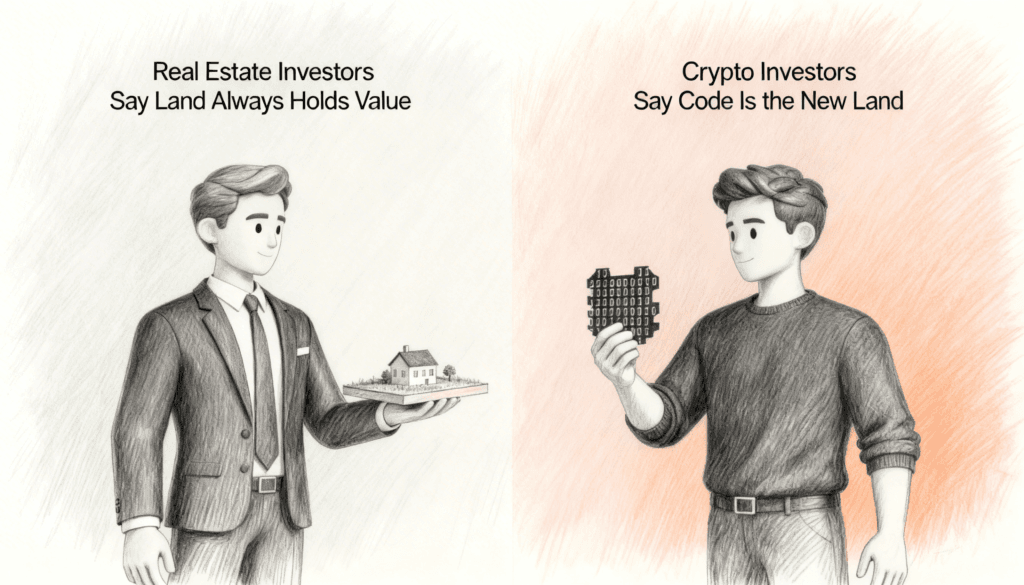
There is an old joke about real estate. They are not making any more of it. It is supposed to explain, in one line, why buying dirt has been a reliable path to wealth for about ten thousand years. Land is finite. People are not. Therefore land wins. Case closed, pour the concrete, collect the rent.
Then the crypto people showed up and said something strange. They said the same thing, but about code. They said the blockchain is the new frontier, that digital scarcity is just as real as physical scarcity, and that a few lines of software can create something as durable and valuable as a beachfront lot in Malibu. The real estate crowd laughed. Then Bitcoin hit numbers that were hard to laugh at. Then they stopped laughing and started arguing.
This is not really an argument about returns. It is an argument about what value even is. And that makes it one of the most interesting fights in modern finance, because underneath the memes and the property tours, both sides are making a philosophical claim about reality itself.
The Oldest Asset Class Meets the Newest One
Land is the original investment. Before there were stocks, before there were bonds, before anyone thought to securitize a mortgage, there was dirt, and the people who owned the dirt were the people who ran everything. Empires rose and fell over it. Wars were fought for it. Entire legal systems exist mostly to clarify who gets to stand on which parts of it.
Real estate investors inherit this long memory. When they say land holds value, they are not making a prediction. They are citing history. They are pointing at ten thousand years of human behavior and saying look, we have tried a lot of things, and the one that has never gone to zero is the ground. You cannot hack it. You cannot delete it. You cannot have a software update corrupt it. It just sits there, doing what land does, which is mostly being there.
Crypto is the opposite of this in every possible way. It is barely older than a teenager. It has no physical form. It exists because enough computers agree that it does, and if those computers stopped agreeing tomorrow, it would vanish like a dream. For the real estate investor, this is absurd. For the crypto investor, this is the point.
What Counts as Scarce
The real argument between these two tribes is about the definition of scarcity.
To the real estate investor, scarcity means something you can touch. A piece of land in a good neighborhood is scarce because the Earth is a sphere and neighborhoods have edges. You cannot print more of it. You cannot will it into existence. If you want it, you have to buy it from someone else, and if they do not want to sell, you are out of luck. This is the kind of scarcity that feels real in the deepest sense of the word. You can walk on it.
To the crypto investor, scarcity means something enforced by rules that nobody can break. Bitcoin is capped at twenty one million coins not because the Earth ran out, but because the code says so, and the code is distributed across so many machines that changing it is effectively impossible. This is, they argue, a purer form of scarcity than land. After all, governments have seized land before. They have redrawn borders, nationalized estates, and rewritten deeds. Land is only as scarce as the authority protecting your claim to it. Code, they say, needs no authority. The math is the authority.
Both sides have a point, and both sides have a blind spot. The real estate crowd forgets that their scarcity depends on institutions that can fail. The crypto crowd forgets that their scarcity depends on belief networks that can evaporate. A title deed and a private key are both just promises. One is written on paper and backed by a government. The other is written in code and backed by consensus. Neither is as eternal as its fans pretend.
The Philosophy Hiding in the Argument
This is where the fight gets genuinely interesting, because it touches on a question that philosophers have been chewing on for centuries. What makes something real?
If you are a materialist, you think reality is stuff. Atoms, molecules, land, buildings, things you can stub your toe on. Under this view, real estate is the serious asset and crypto is a mass hallucination with a price chart attached.
If you are more of an idealist, you think reality is shaped by shared agreement. Money itself is an agreement. Countries are agreements. Corporations are agreements. Marriage is an agreement. None of these things would survive if people stopped believing in them. Under this view, crypto is not stranger than traditional assets. It is just more honest about what it is. A house has value because people agree it does. Bitcoin has value because people agree it does. The only difference is that crypto admits it.
This is why the argument between these two camps never ends. They are not disagreeing about numbers. They are disagreeing about metaphysics. And metaphysics has a bad track record for producing consensus.
There is a strange parallel here to the art world, of all places. For centuries, people argued about whether a painting was valuable because of the physical object or because of the idea behind it. When Marcel Duchamp put a urinal in a gallery and called it art, he was making the same argument the crypto people are making now. The value is not in the thing. The value is in the agreement about the thing. Real estate investors are the classicists of finance. Crypto investors are the conceptual artists. Both sides sell their work for millions.
The Yield Problem
Here is where the crypto camp runs into trouble, and where the real estate camp quietly smiles.
Land does something. It grows crops. It hosts buildings. It shelters people. Even when it just sits there, it can be rented, farmed, drilled, or developed. Real estate produces yield in the most literal sense of the word. You can live in it. You can run a business from it. You can extract something useful from it beyond the hope that someone will pay more for it later.
Most crypto does not do this. Bitcoin does not generate anything. It does not house anyone. It does not pay a dividend or produce a crop. Its value comes almost entirely from the belief that its value will continue. The crypto world has tried to fix this with things like staking and decentralized finance, but these are still young, still fragile, and still mostly built on top of the same speculative base.
This is the real estate investor’s strongest card. Whatever you think about price charts, land does things for you while you own it. Most crypto does not. It just sits there on a blockchain, waiting for someone to decide it is worth more.
The crypto investor has a response, and it is not a bad one. They say that gold does not do anything either, and humans have treated it as a store of value for thousands of years. The question is not whether an asset produces yield. The question is whether it holds purchasing power across time. Gold does. Maybe Bitcoin will. Maybe it will not. The bet is about durability, not utility.
Who Is Right
The honest answer is that both sides are describing real things that matter, and both sides are overstating their case.
Land will probably keep holding value because humans will probably keep needing somewhere to stand. Real estate is not a sure thing, though. Cities decline. Climates shift. Whole regions become uninsurable. The idea that land is eternal is a comforting story that stops being true the moment the story around the land changes.
Code might keep holding value because humans might keep agreeing that digital scarcity matters. Crypto is not a sure thing either. Networks can split. Competitors can emerge. A technology that looks permanent in 2026 might look quaint in 2056. The idea that code is the new land is a bold claim that depends entirely on whether the belief network survives long enough to become tradition.
The counterintuitive truth is that these two asset classes are more similar than their fans want to admit. Both depend on collective belief. Both can be taken from you under the right circumstances. Both reward patience and punish panic. Both attract a certain kind of person who wants to believe they have found the one true answer. And both are, at the end of the day, bets on what future humans will care about.
The Quiet Lesson
If you zoom out far enough, the fight between these two tribes starts to look less like a disagreement and more like a conversation the species has been having with itself for a very long time. Every generation discovers a new thing that feels permanent. Gold. Land. Stocks. Bonds. Code. Each time, people insist this one is different, and each time, the next generation decides something else is. The assets that survive are not the ones that promise eternity. They are the ones that adapt to whatever the next generation decides matters.
So maybe the real estate investor and the crypto investor are both asking the wrong question. The question is not which one will hold value forever. Nothing holds value forever. The question is which one will still be valued in the specific future you are planning for. That is a much harder question, and it has no satisfying answer, which is probably why both camps prefer to argue about certainty instead.
The dirt people and the code people will keep yelling at each other online. The rest of us can watch and take notes. Because somewhere in the noise, there is a useful reminder. Value is not a property of things.
It is a property of agreements. And agreements, like everything else in finance, are subject to change without notice.