The Strange Economy of Bad Moods
Table of Contents
There is a peculiar industry that most investors never think about. It does not manufacture anything. It does not ship products or file patents. But it moves trillions of dollars every year. That industry is collective emotion.
When people talk about “the market,” they often speak as if it were a machine. Inputs go in, outputs come out, and rational actors weigh evidence before making decisions. This is a polite fiction. Markets are more like a theater full of people who occasionally remember they came to watch a play but spend most of their time watching each other’s faces. And when someone in the front row panics, the rest of the audience does not calmly evaluate the situation. They run for the exits.
Sentiment analysis, in its simplest form, is the attempt to measure this collective emotion and then do something useful with it. In investing, “useful” usually means figuring out when the crowd has become so unreasonably afraid that good assets are being sold at garage sale prices. The idea is old. The math behind it is newer. And the psychology that makes it work is as old as human civilization itself.
What Sentiment Actually Measures
Before getting into the mechanics, it is worth understanding what we mean by sentiment. In the financial world, sentiment refers to the overall attitude of investors toward a particular market or asset. It is the vibe, if you will, except with money attached.
There are formal ways to measure it.
- Surveys like the American Association of Individual Investors (AAII) poll ask people directly whether they feel bullish, bearish, or neutral.
- The VIX index, sometimes called the “fear gauge,” measures expected volatility based on options pricing.
- Put/call ratios track whether more people are betting on prices falling versus rising.
- Consumer confidence reports capture how ordinary people feel about the economy.
- And increasingly, algorithms scrape millions of social media posts, news articles, and earnings call transcripts to quantify the mood of the market in real time.
Each of these tools captures something slightly different. A survey tells you what people say they believe. Options data tells you what they are actually paying money to protect against. Social media tells you what they are shouting about. Together, they form a mosaic of collective feeling that turns out to be surprisingly informative, though not in the way most people expect.
The Paradox at the Heart of Crowd Emotion
Here is the thing that makes sentiment analysis so interesting and so counterintuitive. The crowd is usually right. Until it is not. And it tends to be most catastrophically wrong at exactly the moments when it feels most certain.
This is not some fringe observation. It is one of the most well documented patterns in financial history. Extreme pessimism tends to cluster around market bottoms. Extreme optimism tends to cluster around market tops. The relationship is not perfect, and timing it precisely is nearly impossible. But as a directional signal, the intensity of collective emotion has a strange inverse relationship with what happens next.
Think of it like a spring. The further you compress it, the more energy it stores. When everyone is complaining, when headlines are apocalyptic, when your neighbor who bought crypto in 2021 tells you he is “done with investing forever,” a tremendous amount of potential energy has been stored in the form of depressed prices and sidelined cash. That energy has to go somewhere.
The opposite is equally true. When everyone is euphoric, when cab drivers are giving stock tips (to use the classic cliché), when people start using the word “forever” to describe a market trend, the spring is fully extended. There is no stored energy left. Every available dollar has already been deployed. The only direction that spring can go is back.
Why Complaining Is Expensive
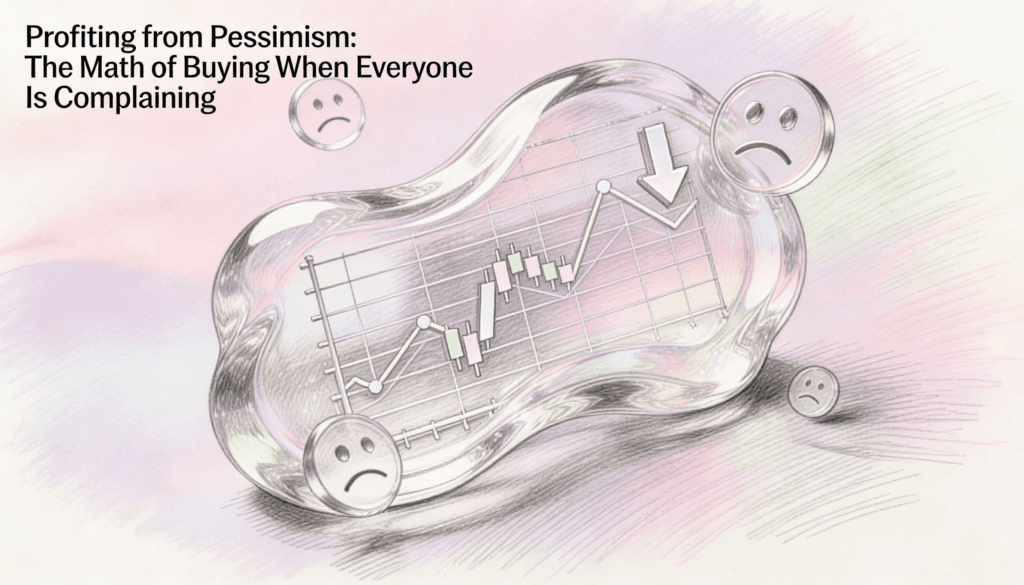
There is a real cost to pessimism, and it is not metaphorical. When investors become fearful, they sell. When they sell in large numbers, prices fall below what the underlying assets are actually worth. This gap between price and value is the opportunity that contrarian investors are looking for.
But here is what makes this more than just a simple buy low sell high story. The gap is not random. It is created by a specific psychological mechanism that behavioral economists have spent decades studying. Loss aversion, the tendency to feel losses roughly twice as intensely as equivalent gains, means that fear is a stronger motivator than greed. People will accept terrible prices to escape the feeling of watching their portfolio decline further.
This asymmetry is the engine of the entire strategy. If human beings experienced gains and losses with equal emotional intensity, pessimistic sell offs would be more measured, the discounts would be smaller, and there would be far less profit available for anyone willing to buy during periods of widespread complaint.
In a sense, the profits from buying during pessimism are a tax on human irrationality. Or more precisely, they are a tax on the gap between how we experience financial pain and how we experience financial pleasure. Every dollar of excess return earned by a contrarian investor was, in a very real sense, left on the table by someone whose emotions overpowered their analysis.
The Grocery Store Analogy (And Why It Breaks Down)
People love to say that buying stocks during a downturn is like buying groceries on sale. This analogy is useful but incomplete. When soup goes on sale at the grocery store, you do not have to worry that soup as a concept might be going extinct. You do not wonder if the store is running a sale because soup has been permanently impaired. You just buy more soup.
With financial assets, the question is always harder. Prices might be low because people are irrationally afraid. Or prices might be low because something is genuinely broken. Sentiment analysis does not tell you which case you are in. It tells you that emotions are running high, which increases the probability that prices have overshot to the downside. But probability is not certainty.
This is where the intellectual honesty of the strategy matters. Buying when everyone is complaining works, on average, over time, across many decisions. It does not work every single time. The companies that went to zero during the 2008 financial crisis were also surrounded by extreme pessimism. If you had bought them because sentiment was negative, you would have lost everything. The pessimism was warranted. The complaints were accurate.
So the strategy is not really “buy when people are complaining.” It is more like “when people are complaining, start paying very close attention, because the best opportunities of your lifetime tend to appear during periods when nobody wants to look.”
Borrowing from Epidemiology
There is a useful parallel between how sentiment spreads through financial markets and how diseases spread through populations. Epidemiologists use a concept called the basic reproduction number, or R0, to describe how contagious a pathogen is. If R0 is above one, the disease spreads exponentially. Below one, it fades out.
Financial sentiment behaves similarly. Fear is contagious. When one investor sells, it pushes prices down, which scares another investor into selling, which pushes prices down further. In the language of epidemiology, panic has a very high R0 in financial markets. The transmission mechanism is not a virus but a price chart. Every tick downward is a new infection vector.
But here is the interesting part. Just like biological epidemics, sentiment epidemics are self limiting. They burn through the susceptible population and eventually run out of new hosts. In market terms, this means that panic selling eventually exhausts itself because eventually everyone who was going to sell has already sold. The people still holding are the ones least susceptible to the fear. They are the financially immune, if you like.
This is why the darkest moment of a sell off, the point of maximum pessimism, is also often the turning point. Not because anything fundamental has changed, but because the epidemic has run its course. There is simply no one left to infect.
The Measurement Problem
If you accept that extreme sentiment can signal opportunity, the next question is practical. How do you actually measure it?
This turns out to be harder than it sounds. Human emotion is messy and contradictory. Someone can be bearish on the economy but bullish on gold. Someone can feel terrible about the world while still holding their stocks because they are too paralyzed to sell. The gap between what people feel, what they say they feel, and what they actually do with their money can be enormous.
Modern sentiment analysis tries to close this gap by casting a wider net. Natural language processing algorithms can now read millions of social media posts and assign emotional scores to them. They can detect sarcasm (sometimes). They can distinguish between genuine panic and performative outrage (sometimes). They can track the emotional temperature of specific sectors, geographies, and even individual companies in something close to real time.
But the measurement itself introduces a philosophical wrinkle. If everyone knows that extreme pessimism is a buying signal, and everyone has access to the same sentiment data, does the signal destroy itself? This is a version of the efficient market hypothesis applied specifically to behavioral anomalies. If enough people try to profit from pessimism, their buying during fearful periods should, in theory, prevent prices from falling as far as they otherwise would, which should reduce the profitability of the strategy.
In practice, this self correction is incomplete. Partly because not everyone believes in sentiment analysis. Partly because even people who do believe in it find it psychologically excruciating to act on. Knowing that you should buy when everyone is complaining is very different from actually buying when everyone is complaining. The knowledge and the action are separated by a wall of genuine emotional discomfort that no algorithm can climb for you.
The Philosopher’s Contribution
There is an idea from Søren Kierkegaard that maps surprisingly well onto this territory. Kierkegaard wrote about the concept of “anxiety” not as a disorder but as a fundamental feature of human freedom. Anxiety, he argued, arises from the awareness of possibility. We are anxious because we can choose, and choice implies the possibility of being wrong.
Investors experience this acutely during periods of market stress. The anxiety is not irrational. It is a perfectly reasonable response to genuine uncertainty. The question is what you do with it. Most people resolve their anxiety by eliminating the source, which means selling. A smaller number resolve it by accepting the uncertainty and acting anyway, which means buying. The profits from pessimism flow from the second group, and toward them, not because they are smarter, but because they have a different relationship with discomfort.
This is worth pausing on because it reframes the entire discussion. The edge in sentiment based investing is not primarily analytical. It is temperamental. The math helps you identify when conditions are favorable. But the ability to act on that math when your body is telling you to run is a human capacity that no spreadsheet can provide.
When Pessimism Is Right
Any honest discussion of this topic has to acknowledge that sometimes the complainers are correct. Sometimes pessimism is not an emotional overreaction but an accurate assessment of deteriorating conditions.
The trick is that pessimism being correct and pessimism creating opportunity are not mutually exclusive. During the early stages of the 2008 financial crisis, the pessimists were absolutely right about the fragility of the housing market and the banking system. But the pessimism eventually became so extreme that it priced in outcomes far worse than what actually occurred. The recession was severe. But the market priced in something closer to civilizational collapse.
This is the nuance that gets lost in simplistic “buy the dip” advice. The question is never whether the pessimists are right about the problem. They often are. The question is whether the pessimism in the price already exceeds the pessimism that is warranted by the problem. When the emotional response overshoots the fundamental reality, the gap is your opportunity.
The Asymmetry of Regret
There is one more psychological dimension worth exploring. People experience regret asymmetrically depending on whether they acted or failed to act.
- Buying during a pessimistic period and being wrong feels terrible in a specific, acute way. You made a choice, it went against you, and you can point to the exact moment of your mistake.
- Failing to buy during a pessimistic period and watching the market recover feels different. It is a duller, more diffuse regret. You did not lose money. You just missed an opportunity. And missing an opportunity is much easier to rationalize than losing money.
This asymmetry of regret is another reason why pessimistic periods produce opportunities. Most investors, when facing the choice between the sharp regret of acting and being wrong versus the dull regret of not acting and missing out, will choose the dull regret every time. They will watch from the sidelines, wait for “more clarity,” and by the time they feel comfortable enough to buy, most of the recovery has already happened.
Putting It Together
Sentiment analysis in investing is not a crystal ball. It does not tell you when to buy and sell with precision. What it does, at its best, is provide a framework for understanding the emotional landscape in which prices are formed. It tells you when the crowd is scared, when it is greedy, and when the gap between emotion and reality has grown wide enough to be interesting.
The math of buying when everyone is complaining rests on a few durable insights.
- Human beings feel losses more intensely than gains.
- Fear is more contagious than greed. Emotional extremes tend to be self correcting.
- And the psychological barriers to acting during pessimistic periods are high enough that the opportunities they create do not get immediately arbitraged away.
None of this makes the strategy easy. Buying when the world feels like it is ending requires a kind of disciplined detachment that is genuinely uncomfortable. It requires trusting the process over the feeling, the long term pattern over the immediate experience. And it requires accepting that you will sometimes be wrong, that sometimes the pessimism is justified and prices have further to fall.
But the historical record is clear. The best returns in investing have disproportionately gone to those who were willing to act when others were frozen by fear. Not because they knew something others did not. But because they were willing to sit with a discomfort that others were not.
In the end, the math of pessimism is simple. The psychology of acting on it is anything but.
And that gap, between what is mathematically obvious and what is psychologically possible, is where the profit lives.