Table of Contents
There is a certain kind of investor who walks into every stock analysis like a shopper at a clearance sale. They scan for the lowest price tag, grab it, and feel clever. In the stock market, that price tag is the P/E ratio. And for decades, it has been the first number people learn, the first number they trust, and often the first number that misleads them.
The Price to Earnings ratio is not a bad metric. Let us be clear about that. It tells you how much the market is willing to pay for every dollar a company earns. A stock trading at a P/E of 10 means investors are paying ten dollars for each dollar of earnings. A stock at a P/E of 40 means they are paying forty. Simple enough. And the instinct that follows is equally simple: lower is better. Pay less, get more.
But here is the problem with simple instincts. They work beautifully in grocery stores and terribly in financial markets. A dozen eggs at half price is a great deal. A company at half the market P/E might be a great deal, or it might be half price for a very good reason.
The Trap of Cheapness
Value investing has a noble intellectual history. Benjamin Graham wrote about buying stocks below their intrinsic value. Warren Buffett turned that into a fortune. But somewhere along the way, the nuance got lost in translation. What survived in popular investing culture was not the deep analytical framework. What survived was the bumper sticker version: buy low P/E stocks.
The trouble is that a low P/E ratio, on its own, is a statement without context. It is like knowing someone is 30 years old without knowing if they are a human or a tortoise. Age means something different depending on the species. A P/E of 8 means something different for a declining coal company than it does for a growing software firm.
Companies can have low P/E ratios for perfectly rational reasons. Their industry might be shrinking. Their competitive advantage might be eroding. Their earnings might have temporarily spiked due to a one time event that will not repeat. The market is not always right, but it is not always stupid either. When a stock is cheap, the first question should not be “what a bargain” but rather “what does the market know that I might be missing?”
This is where the obsession with low P/E ratios becomes almost religious. People defend it with the fervor of someone who has confused a tool with a truth. The P/E ratio is a tool. A useful one. But a hammer does not know the difference between a nail and a thumb.
Enter the PEG Ratio
The PEG ratio was popularized by Peter Lynch, the legendary manager of Fidelity’s Magellan Fund, who turned it into one of the most successful funds in history. Lynch did not invent the concept, but he gave it a name and a philosophy. His argument was elegant: you should not just ask how much you are paying for earnings. You should ask how much you are paying for the growth of those earnings.
The math is disarmingly simple. Take the P/E ratio and divide it by the expected annual earnings growth rate. If a stock has a P/E of 30 and is growing earnings at 30% per year, the PEG ratio is 1. If a stock has a P/E of 15 and is growing at 5% per year, the PEG ratio is 3.
Now pause on that for a moment. The stock with the lower P/E ratio, the one that looks cheaper by traditional standards, is actually three times more expensive when you account for growth. The “expensive” stock is the better deal. This is the kind of counter intuitive result that makes finance interesting and makes simple rules dangerous.
A PEG ratio below 1 is generally considered attractive. It suggests you are getting growth at a discount. A PEG above 2 suggests you might be overpaying relative to the growth you are receiving. But like any ratio, the number is a starting point for thinking, not a substitute for it.
Why Growth Efficiency Matters More Than Sticker Price
Think of it this way. You are looking at two restaurants to invest in. Restaurant A earns $100,000 a year and has been flat for five years. Restaurant B earns $60,000 a year but has been doubling every two years. If someone showed you only the current earnings, Restaurant A looks like the obvious choice. But nobody invests in what a company earned yesterday. They invest in what it will earn tomorrow.
The PEG ratio captures this forward looking dimension that the P/E ratio ignores. It asks a more intelligent question. Not “is this stock cheap?” but “is this stock cheap relative to how fast it is becoming more valuable?”
This distinction matters enormously because of how compounding works. A company growing earnings at 25% annually will roughly double its earnings in three years. A company growing at 5% will take about 14 years to do the same thing. When you buy high growth at a reasonable PEG, you are harnessing the most powerful force in investing. When you buy low P/E with no growth, you are collecting a coupon on a depreciating asset and calling it wisdom.
There is a concept in ecology called carrying capacity. It describes the maximum population an environment can support. Growth in biological systems follows predictable patterns: rapid expansion, then gradual slowing, then a plateau. Companies follow roughly the same arc. What the PEG ratio helps you evaluate is where a company sits on that curve and whether you are paying an appropriate price for its position.
A company early in its growth phase with a PEG of 0.8 is potentially offering you access to the steepest part of the curve at a discount. A mature company with a PEG of 2.5 is asking you to pay a premium for a curve that has already flattened. The P/E ratio alone cannot tell you any of this.
The Assumptions You Need to Watch
Now, before anyone rushes off to screen for PEG ratios under 1 and considers the job done, there are important caveats that separate serious investors from hopeful ones.
The most critical input in the PEG calculation is the growth rate, and here is the uncomfortable truth: it is an estimate. Sometimes it is based on analyst forecasts. Sometimes it is based on trailing growth. Sometimes it is based on management guidance, which is a polite way of saying “what the people running the company hope will happen.”
Estimates are not facts. They are educated guesses wearing suits. And they can be wildly wrong. A company projecting 20% earnings growth might deliver 8% or 35%. The PEG ratio is only as good as the growth assumption you feed into it. Garbage in, garbage out, as the saying goes in computer science and, apparently, in valuation.
This is why it matters enormously which growth rate you use. Forward estimates from analysts tend to be optimistic. Trailing five year growth rates can be distorted by one exceptional year. The most rigorous approach is to look at multiple time frames, compare analyst estimates to the company’s own track record, and then exercise judgment. Yes, judgment. The thing that no formula can replace.
There is also the question of quality of growth. Not all earnings growth is created equal. A company can grow earnings by taking on enormous debt, by cutting research spending, by slashing workforce, or by engaging in aggressive accounting. This kind of growth is the financial equivalent of a runner sprinting faster by injecting stimulants. Impressive briefly. Unsustainable structurally.
The PEG ratio does not distinguish between organic, healthy growth and manufactured, fragile growth. That part is your job.
Where the P/E Ratio Still Has Its Place
It would be intellectually dishonest to pretend the P/E ratio is useless. It is not. For mature, stable companies with predictable earnings and modest growth, the P/E ratio works perfectly well. Utilities, consumer staples, established banks. These are businesses where growth is not the primary story. Stability is. Dividends are. Predictability is.
If you are evaluating a company that has grown earnings at 3% a year for the past decade and is likely to keep doing so, the PEG ratio adds limited insight. You already know the growth story. What you want to know is whether you are paying a fair price for that steady stream. The P/E ratio, compared to the industry average and the company’s own historical range, tells you that just fine.
The PEG ratio shines brightest in the messy middle ground. Companies growing at 10 to 40 percent per year. Companies transitioning from one phase to another. Companies where the market is aggressively pricing in future growth and you need to know if that pricing makes sense or if it has become detached from reality.
In other words, the PEG ratio is most valuable precisely where the P/E ratio is most misleading.
The Behavioral Dimension
There is a fascinating psychological angle to all of this. Humans have a deeply wired preference for tangible, present rewards over abstract, future ones. Behavioral economists call this hyperbolic discounting. We would rather have a dollar today than a dollar and fifty cents next year, even when the math says we should wait.
This bias shows up directly in how people use the P/E ratio. A low P/E feels concrete. It feels like you are getting something right now. The stock is cheap today. The earnings are real today. The value is visible today.
Growth, on the other hand, is a promise. It lives in the future. It is uncertain. And our brains do not like uncertainty. So we discount it. We undervalue it. We reach for the bird in hand and ignore the two in the bush, even when the bush is clearly full of birds and someone reliable is pointing right at them.
This behavioral tendency creates a systematic opportunity. If most investors gravitate toward low P/E stocks because of a psychological bias, then growth efficient stocks with reasonable PEG ratios may be consistently undervalued by the crowd. Not because the information is hidden, but because processing it requires a kind of thinking that feels uncomfortable.
The best investments often feel uncomfortable at the time you make them. If it felt obvious and safe, the price would already reflect that.
How to Use the PEG Ratio in Practice
If you want to incorporate PEG analysis into your investing process, here is a practical framework that avoids both oversimplification and paralysis by analysis.
First, use the PEG ratio as a filter, not a verdict. Screen for stocks with PEG ratios below 1.5. This gives you a universe of potentially growth efficient companies to investigate further. It does not tell you what to buy. It tells you where to look.
Second, verify the growth input. Look at trailing three year and five year earnings growth. Compare it to analyst consensus estimates for the next two years. If there is a massive gap between historical growth and projected growth, investigate why. Is the company entering a new market? Did it just lose a major contract? Context determines whether the projection is reasonable.
Third, examine the quality of growth. Is revenue growing alongside earnings, or are earnings growing faster than revenue? The former suggests genuine business expansion. The latter might suggest cost cutting or financial engineering, which has natural limits.
Fourth, compare PEG ratios within the same industry. A PEG of 1.2 in the technology sector means something different from a PEG of 1.2 in the utilities sector. Industries have different baseline growth rates, capital structures, and risk profiles. The comparison only makes sense among peers.
Fifth, combine PEG analysis with other metrics. Look at return on equity, debt levels, free cash flow, and competitive positioning. No single ratio, no matter how elegant, captures the full picture. The PEG ratio is a lens, not a telescope. It sharpens one part of the view.
The Bigger Point
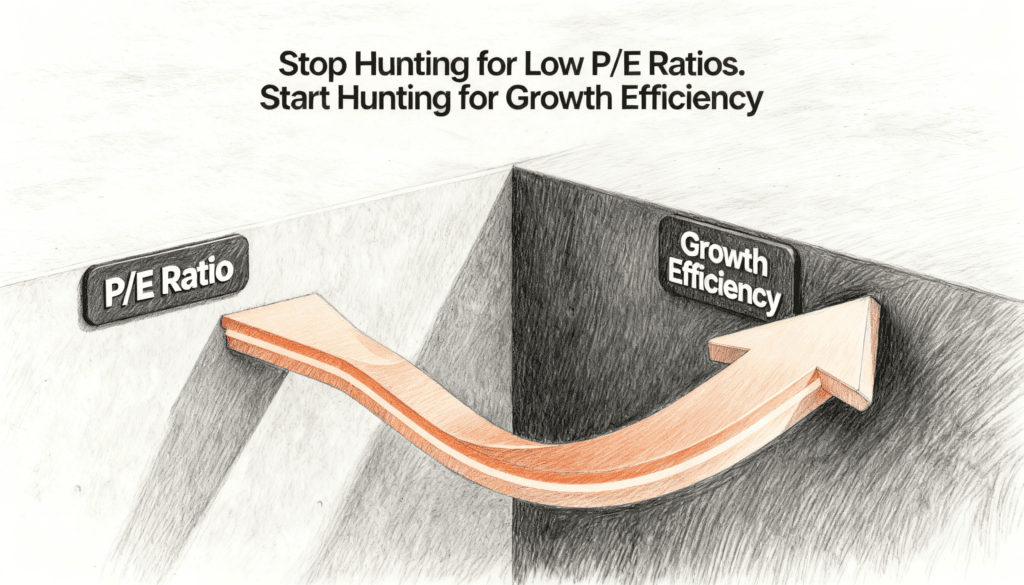
At its core, the shift from P/E to PEG thinking represents something more fundamental than a change in metrics. It represents a change in philosophy. The P/E ratio asks a backward looking question: what are you paying for what exists? The PEG ratio asks a forward looking question: what are you paying for what is becoming?
This difference in orientation matters beyond finance. In hiring, the equivalent of P/E thinking is hiring based on credentials and experience alone. PEG thinking is hiring based on trajectory and learning speed. In relationships, P/E thinking is evaluating someone by where they are. PEG thinking is evaluating them by the direction and pace of their growth.
The instinct to buy cheap things is not wrong. The instinct to stop there is. Price matters. But price relative to growth potential matters more. The PEG ratio is not perfect. No metric is. But it asks a better question than the P/E ratio, and in investing, asking better questions is more than half the battle.
The next time you find yourself drawn to a stock because the P/E ratio looks like a bargain, take one more step. Divide by the growth rate. What looks cheap might turn out to be expensive. And what looks expensive might be the best deal you will find all year.
That is the quiet irony of markets. The bargain bin is often the most expensive aisle in the store.