Table of Contents
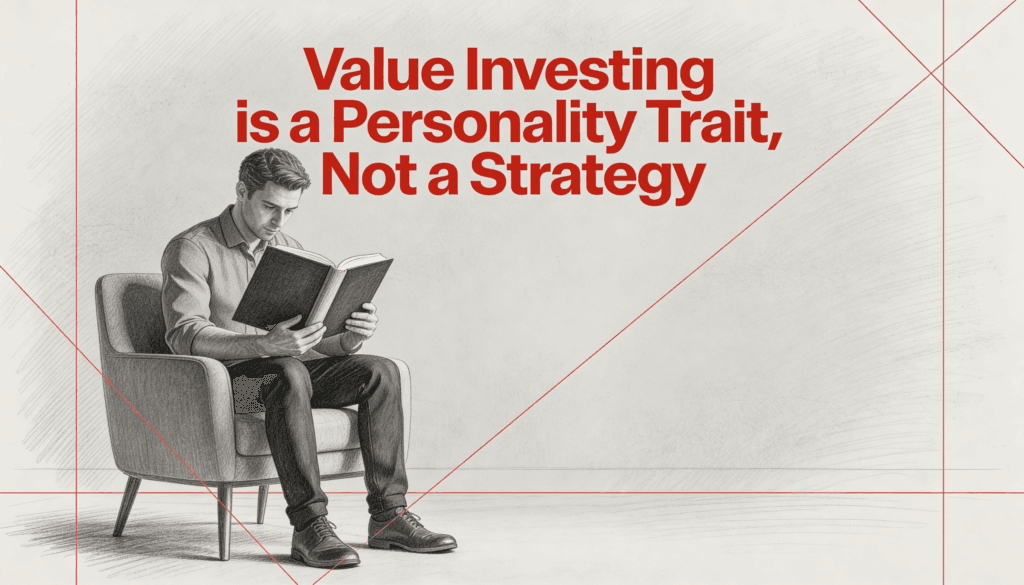
There is a quiet joke inside the investing world that nobody likes to say out loud. Most people who claim to be value investors are not actually value investors. They are people who read a book about Warren Buffett on a flight to Miami and came back convinced they had found their calling. Within six weeks they are buying a momentum stock because a friend at dinner mentioned it, and within six months they are explaining why this particular situation is different.
The reason this happens is simple. Value investing is sold as a strategy, packaged as a method, taught as a discipline. But it is none of those things. It is a personality. And you cannot download a personality from a podcast.
The Costume and the Skin
Strategies are clothing. You can put one on, take it off, swap it for another when the weather changes. A trader can move from breakout setups to mean reversion to options selling depending on the season, the market regime, or the latest book they read. The trades are different but the trader stays the same underneath.
Personality traits are not clothing. They are skin. They go with you everywhere, they react to everything, and you cannot peel them off when they become inconvenient. The person who is naturally patient is patient at the airport, patient with their children, patient when their portfolio is down twenty percent and the news is screaming. The person who is naturally impatient is impatient everywhere too, and no amount of reading Benjamin Graham will change that. They might fake it for a quarter. Maybe two. But eventually the skin shows.
This is the part nobody wants to hear. You cannot really choose to be a value investor any more than you can choose to be an introvert. You either find a certain kind of waiting tolerable, even pleasurable, or you do not. And if you do not, no philosophy is going to save you from yourself when the market is moving and you are sitting still.
What the Trait Actually Looks Like
If you watch the people who have done this well for decades, you notice something strange. They are not particularly smart in the IQ test sense. Some are, but plenty are not. What they share is a peculiar emotional wiring.
They are bored by excitement. This is the first tell. When everyone at a dinner party is talking about the same hot stock, they go quiet, not because they are pretending to be wise but because the conversation genuinely does not interest them. A crowded trade feels to them the way a crowded restaurant feels to someone who hates noise. They simply want to leave.
They enjoy being alone with their thoughts. The work of value investing is not glamorous. It is reading footnotes, comparing balance sheets, sitting in a chair for hours wondering whether a particular furniture company has a real moat or just a temporary advantage. If you find that tedious, you will not do it well. If you find it weirdly satisfying, you might be in the right line of work.
They have an unusual relationship with regret. Most people regret action far less than inaction. They feel worse about the trade they missed than the trade they made and lost on. Value investors tend to be wired the opposite way. The trade they did not make does not haunt them. The mistake they did make does. This makes them slow, careful, and occasionally infuriating to work with. It also keeps them solvent.
The Patience Problem
People talk about patience like it is a muscle you can train. To some extent that is true. But there is also a baseline. Some people are born with the capacity to wait three years for an idea to work out, and some people start checking their phone if a microwave takes more than ninety seconds.
The market is a machine that punishes the second group and pays the first. Not always. Not in every period. There are stretches, sometimes long ones, where the impatient look like geniuses and the patient look like fossils. The late nineties were like that. So was the period from roughly 2017 to 2021. During those times the patient investor is forced to listen to other people get rich faster, and they have to sit with that feeling without doing anything about it.
This is where personality matters more than strategy. A strategy says: ignore the noise, stick to your process. A personality either can or cannot do that. The investor who is naturally comfortable being left behind in the short term will hold. The one who is not will eventually cave, usually at the worst possible moment, usually right before the regime shifts back.
There is a useful test here. Think about how you behave at a casino. Not whether you gamble, but how. Do you feel a small thrill when you place a bet, even a tiny one? Do you find yourself wanting to play one more hand? If yes, you are probably not built for value investing. The market rewards people who find betting slightly boring, which is a strange thing to admit but it is the truth.
Why Strategy Talk is Mostly Theater
Walk into any bookstore and the investing section is full of methods. Five rules for picking stocks. Seven habits of effective traders. The framework that beat the market for a decade. These books sell because methods feel learnable. A method is a recipe. Follow the steps and the cake comes out.
But investing is not baking. The ingredients change constantly, the oven temperature is set by millions of other people, and halfway through the recipe someone walks in and tells you that flour is now considered toxic. Methods only work when the person executing them has the temperament to keep executing them when the cake comes out wrong three times in a row.
This is why two people can read the same book, study the same companies, use the same valuation models, and end up with completely different outcomes. The framework was identical. The wiring was not. One sold during the drawdown and one did not. One added to the position when it got cheaper and one called their financial advisor in a panic. The strategy did not fail. The person failed to remain themselves under pressure, which is the only thing that ever really matters.
The Charlie Munger Footnote
There is a story Charlie Munger used to tell about a fisherman who sold flashy lures. Someone asked him whether fish actually liked the bright colors. The fisherman said he did not know, but he was not selling to fish.
The investing industry is the fisherman. The methods, the courses, the seven step frameworks are the lures. They are not really designed to help you invest better. They are designed to be bought. And the people who buy them tend to be the ones who want investing to feel like a craft they can master through effort, when actually it is more like a sport where ninety percent of the game is whether you can handle losing without losing your mind.
The few people who actually thrive at this are not the ones who collected the most lures. They are the ones who already had the right temperament and happened to discover a vocabulary that described what they were going to do anyway. Buffett did not become patient by reading Graham. He was already patient and Graham gave him the language for it.
What This Means If You Are Honest With Yourself
The uncomfortable conclusion is that most people should probably not try to be value investors, even if the philosophy appeals to them. Not because they are stupid or lazy but because they are not built for it. There is no shame in this. Plenty of brilliant, successful, financially secure people are temperamentally wrong for value investing. They make their money in other ways, through their careers, through real estate, through businesses they run themselves, through index funds they never touch.
The smartest move is not to force yourself into a personality that is not yours. It is to figure out what your actual temperament rewards and align your money with that. If you are energetic, social, and quick on your feet, maybe you should be building a business rather than picking stocks. If you are analytical but easily bored, you might be better at trading than investing. If you are patient to the point of being slightly strange about it, then yes, sit in a chair and read annual reports. You have found your edge, which is really just you being you.
The people who suffer most are the ones who pretend. They adopt the value investing identity because it sounds wise and contrarian and morally superior to chasing trends. Then they spend years quietly contradicting it with their actual behavior, which produces poor returns and a lot of cognitive dissonance. They would have been better off being honest, picking a method that matched their wiring, and getting on with it.
The Quiet Implication
There is something almost philosophical buried in all this. We like to think of ourselves as choosers. We pick our careers, our hobbies, our investment strategies. But a lot of what we call choice is really just recognition. We recognize what we were already going to do and call it a decision.
Value investing is a clear example. The people who do it well did not decide to be patient. They were patient before they ever heard the term. They did not decide to be contrarian. They were already the kind of person who got irritated when everyone agreed too quickly. The philosophy just gave them a home for traits they already had.
If you are trying to figure out whether this approach is for you, do not start with the books. Start with yourself. Notice what you do when markets are loud. Notice how you feel when you miss something. Notice whether sitting still for a long time on a single decision feels like virtue or torture. The answer is already in there. You just have to look without flinching.
The rest is just paperwork.