Table of Contents
There is a strange kind of comedy in watching two people who both call themselves investors share absolutely nothing about what that word means. One of them has not made a trade in eleven months and considers this normal. The other has made eleven trades before lunch and considers this slow. They use the same markets, the same screens, sometimes even the same companies. But they are playing different games with different clocks, and neither one really believes the other is doing anything useful.
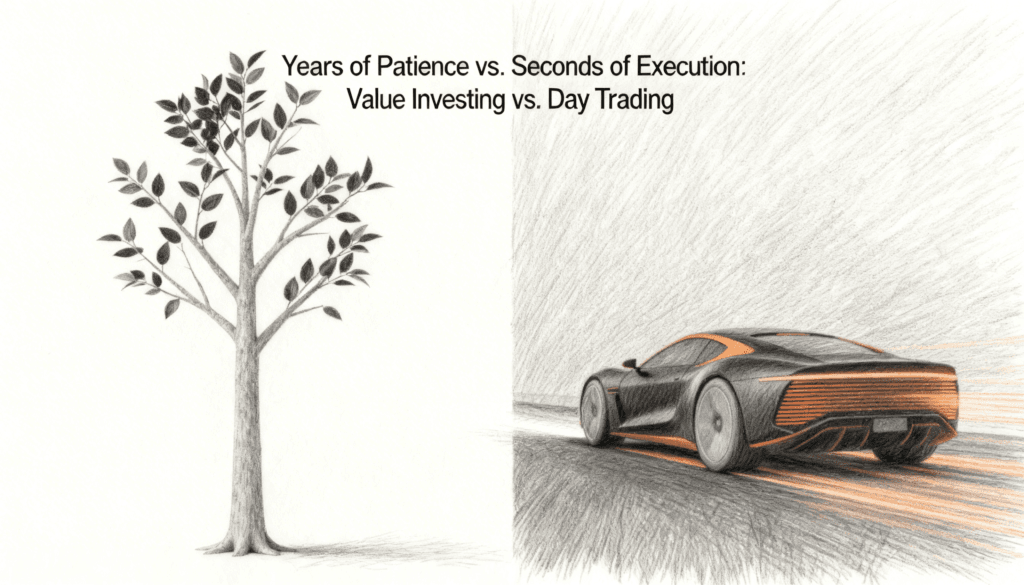
Value investing and day trading are often presented as two points on a spectrum. That is a polite way of describing them. A more honest description is that they are two different relationships with time itself.
The Philosopher and the Athlete
Value investing is a philosophy that wears a business suit. It asks questions that take months to answer. What is this company actually worth? Is the price lower than that worth? If yes, buy it and go do something else with your life until the market eventually notices. If no, keep waiting. The entire discipline is built around the assumption that patience is a competitive advantage, because most people do not have any.
Day trading is not a philosophy at all. It is a sport. It has more in common with professional poker or competitive video gaming than it does with owning a business. The day trader is not asking what a company is worth. That question is irrelevant on a five minute timeframe. The day trader is asking what other people are about to do in the next few minutes, and how to be standing in the right place when they do it.
This is a real and important distinction that often gets lost. The value investor is trying to be right about reality. The day trader is trying to be right about other people. These are not the same skill. One is closer to accounting. The other is closer to poker.
Time Is Not Neutral
Here is something that does not get said often enough. The choice between these two approaches is not really a choice about strategy. It is a choice about which part of your brain you are willing to trust.
Long time horizons favor the rational part of the mind. When you give yourself years to be right, you can afford to think calmly. You can read the annual report. You can sleep on it. You can be wrong for eighteen months and not panic, because eighteen months is a blink inside a decade. Value investing works partly because it gives your reasoning enough room to breathe.
Short time horizons do the opposite. They activate the part of the brain that evolved to respond to sudden movement in the grass. When the chart is moving and money is at stake and the decision has to be made in the next thirty seconds, you are not really reasoning. You are reacting. Some people get very good at this. But it is worth being clear eyed about what good means in that context. It means trained reflexes, not better thinking.
The day trader who succeeds is closer to a tennis player than to an analyst. And like a tennis player, most of their skill is invisible to outsiders and very hard to keep sharp. A value investor who takes a six month vacation comes back and picks up where they left off. A day trader who takes a six month vacation comes back to find that their edge has quietly eroded while they were not looking.
The Numbers Nobody Wants to Talk About
Most day traders lose money. This is not a controversial claim. It has been studied enough times in enough countries that the finding is boringly consistent. The percentage of people who actually make a living doing it, over long periods, is small enough to round down without offending anyone.
Value investors have a better track record on paper, but they have their own problem, which is that almost nobody can actually sit still long enough to be one. Owning a stock for seven years while it does nothing sounds easy in theory. In practice, most people last about seven months before they start fiddling. The strategy works. The humans trying to execute it often do not.
So we end up in a peculiar situation where one approach has great math and terrible adherence, and the other has terrible math and intense engagement. Both fail most people who try them, just for completely different reasons. This is worth sitting with for a moment, because it suggests the real question is not which strategy is better. It is which kind of failure you are better suited to avoid.
A Detour Through Chess
There is a useful parallel here from chess, of all places. Chess has two main formats that look similar but are wildly different experiences. There is classical chess, where games can last six hours and players think for twenty minutes before a single move. And there is blitz, where the entire game is over in five minutes and players are moving on instinct.
Great classical players are often only average at blitz. Great blitz players are often only average at classical. They are using different mental systems. The position on the board is the same. The clock changes everything.
Markets work the same way. Value investing is classical. Day trading is blitz. The pieces are in the same places. The companies are the same companies. But the mental machinery required to play well at each speed is almost entirely different. Expecting someone to be good at both is like expecting a marathon runner to also win sprinting medals. Possible in theory, extremely rare in practice, and usually a sign that the person is exceptional in ways that have nothing to do with the activity itself.
What Each Side Refuses to Admit
The value investing crowd likes to pretend that patience is a kind of moral achievement. It is not. Patience is a strategy that works because most people cannot do it, which makes it valuable, but it is not virtuous. A person who holds a stock for ten years because they forgot they owned it is getting the same returns as a person who holds it for ten years out of disciplined conviction. The market does not care about the intent. It only pays for the behavior.
The day trading crowd, for its part, likes to pretend that skill explains the winners. Sometimes it does. But survivorship bias is doing an enormous amount of quiet work in that community. The person who blew up their account last year is not posting on social media this year. The person who got lucky three times in a row is. If you only hear from the survivors, you start to think the game is winnable in a way that the actual distribution of outcomes does not support.
Both sides are, in their own ways, telling themselves slightly flattering stories. The value investor dresses up boredom as wisdom. The day trader dresses up gambling as expertise. The truth is messier and less useful for building a personal brand.
The Real Question
If you strip away the tribal loyalty and the identity performance, the honest question is something like this. Do you want to make decisions slowly and then do very little, or do you want to make decisions quickly and then do it again, and again, and again, for the rest of your working life?
That is not a strategy question. That is a temperament question, and possibly a lifestyle question. Some people find the first option unbearably dull. Some people find the second option unbearably stressful. Neither group is wrong about themselves. They are just describing what kind of animal they are.
The mistake is thinking you get to pick based on which returns look better in a backtest. You do not. You pick based on which mistakes you can live with, which losses you can stomach, and which version of your own mind you can actually operate for thirty years without breaking down. The best strategy in the world is useless if the person running it keeps quitting at the worst possible moment.
The Quiet Thing Nobody Says
Here is the contrarian note I promised to keep small. Value investing and day trading are more similar than either side admits, in one specific way. They are both attempts to beat something that is extremely hard to beat. One tries to outthink the market over years. The other tries to outreact it over minutes. Most people fail at both, and the people who succeed at either are usually doing something the average participant cannot copy.
If you step back far enough, the boring middle option, which is owning the whole market through an index and going to bed, quietly outperforms the majority of people in either camp. This is not what either tribe wants to hear. But it is true often enough that it should at least be acknowledged in the room before we start cheering for our favorite side.
That said, people do not choose these paths because they are optimal. They choose them because they fit something about who they are. The value investor enjoys the feeling of being slowly, quietly correct. The day trader enjoys the feeling of being fast and alive. These are real human needs, and no spreadsheet is going to argue them away.
So What
The years of patience and the seconds of execution are not really competing with each other. They are competing for different kinds of people, and the interesting question is not which one wins. It is which one suits the specific human being holding the mouse.
If you need to feel engaged every day, long term investing will feel like slow suffocation, and you will abandon it at exactly the wrong moment. If you need peace of mind, day trading will feel like being strapped to a machine that periodically electrocutes you, and you will quit after it takes your rent money.
Knowing which of those descriptions makes you wince is probably more useful than any chart, any backtest, or any confident opinion from someone on the internet.
Including, it should be said, this one.