Table of Contents
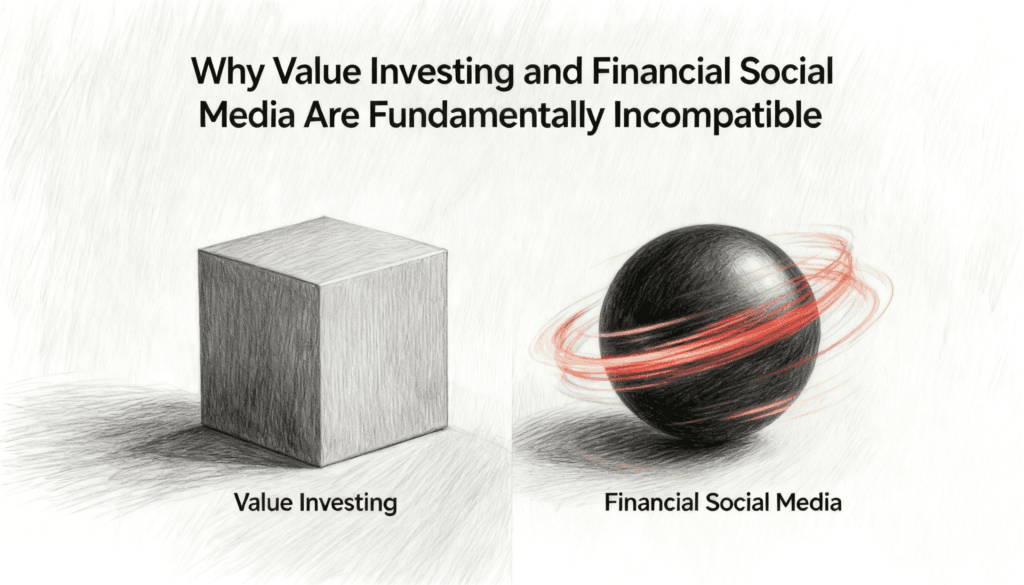
Imagine trying to meditate inside a nightclub. That is roughly what it feels like to practice value investing while scrolling through financial social media. The two activities are not just different. They are actively working against each other, like trying to read poetry during a fire drill.
This is not a small complaint about distraction. It is something deeper. Value investing and financial social media are built on opposite theories of how the mind should work, what information is worth, and what time is for. You cannot really do both. You can pretend to, but one of them will quietly eat the other.
And usually, it is not the boring one that wins.
The Problem With Thinking in Public
Value investing, at its core, is a strange and slightly antisocial activity. You are supposed to read annual reports nobody else reads. You are supposed to form opinions that the market has not yet agreed with. You are supposed to hold those opinions for years while the world laughs, shrugs, or forgets you exist. The entire point is to see something others do not see, and then to wait.
Now picture the exact opposite of that. Picture a place where thousands of people post their opinions every minute, where the loudest voices win, where being early is rewarded only if you also tell everyone you were early, and where silence is basically invisibility. That is financial social media. It is not designed for people who want to think slowly. It is designed for people who want to be noticed quickly.
These two things do not just differ in pace. They differ in what counts as success. A value investor succeeds by being right eventually. A financial influencer succeeds by being engaging immediately. Those are not the same job. They are barely even the same species of work.
Conviction Is Not a Content Format
One of the quietest tragedies of finance social media is what it does to conviction. Real investing conviction is a private thing. It grows slowly, out of reading, rereading, sitting with doubt, changing your mind, and eventually landing somewhere you trust. It is almost boring to describe because the process has no visual hook. There is no thumbnail for “I spent four months understanding a footnote.”
Social media cannot carry that kind of conviction. It can only carry the performance of conviction. And the performance is always louder, cleaner, and more certain than the real thing. A thoughtful investor who says “I think this business might be undervalued, but I could be wrong in several ways” gets scrolled past. An influencer who says “This stock is about to explode, trust me” gets the click. The algorithm is not evil. It is just indifferent to nuance, and nuance happens to be the thing value investing is made of.
There is a useful parallel here from an unexpected place. Chefs who become television personalities often stop cooking the food that made them interesting. The medium rewards speed, drama, and repeatable catchphrases, none of which help you slow braise anything. The craft and the camera pull in opposite directions. Finance has its own version of this. The investors who build audiences tend to drift, slowly and without meaning to, toward whatever performs. And whatever performs is rarely what works.
The Weight of Other People’s Opinions
Benjamin Graham, who more or less invented value investing, had a famous thought experiment about an imaginary business partner named Mr. Market. Mr. Market shows up every day and offers you wildly different prices for the same company, sometimes cheerful, sometimes panicked. The lesson was that you should ignore him most days and only take advantage of him when he was clearly out of his mind.
Graham wrote this before the internet. He could not have imagined what it would be like to have not one Mr. Market, but millions of them, all screaming different prices, all tagging you in their screenshots, all convinced you are the fool. The modern value investor is not just fighting the market. They are fighting a feed that refreshes every three seconds with someone else’s opinion about the exact stock they own.
Holding a position for years is hard under normal conditions. It becomes something close to impossible when a platform is engineered to make you feel, every few minutes, like you might be missing something. The discipline value investing requires is not intellectual. It is emotional. And financial social media is specifically designed to attack that exact emotion. It is not a coincidence. Engagement is just another word for reaction, and reactions are what ruin long term investors.
Information Has an Expiration Date, Except When It Does Not
Here is something that sounds obvious but is not. The information that matters to a value investor barely changes. A company’s competitive position, its management, its culture, the slow forces that decide whether it will still exist in ten years, these things do not move quickly. They are more like weather patterns than weather. You do not need hourly updates on them because hourly updates do not exist.
Financial social media, on the other hand, treats all information as if it expires in minutes. A tweet from this morning is already old. A chart from last week is ancient. Everything is urgent, everything is breaking, everything must be reacted to right now. This is not because the information is actually time sensitive. It is because the platform needs you to keep coming back, and nothing brings people back like the feeling that they might be late.
A value investor reading a quarterly report is engaging with information that will still be useful in five years. A trader reacting to a viral post is engaging with information that will be irrelevant in five hours. Both can call what they are doing “research.” Only one of them is doing the thing value investors mean when they say that word.
The Sarcastic Middle Ground Nobody Wants
You can, of course, try to have it both ways. Plenty of people do. They read their annual reports in the morning and post their hot takes in the afternoon. They tell themselves they are using social media for ideas, or for networking, or just to stay informed. And some of them really are doing that, for a while.
But here is the awkward truth. The medium shapes the message, and then the message shapes the messenger. You cannot spend hours a day inside a system that rewards certainty, speed, and performance, and come out the other end more patient and humble. Nobody is that strong. The water you swim in changes you. The value investors who spend serious time on financial social media tend, over months and years, to start thinking a little more like influencers. Their time horizons shrink. Their positions start reflecting what gets engagement. They begin caring, just a little, about how their portfolio looks to other people. And that is the exact moment value investing stops working, because value investing only works when you genuinely do not care what other people think for a while.
This is the counterintuitive part. The danger is not that social media gives value investors bad information. The danger is that it gives them an audience. And an audience changes everything. Once you have one, every decision becomes partly a performance, and investing is one of the few activities in the world where performing makes you worse at it.
What Warren Buffett Understood About Buildings
Warren Buffett famously works out of Omaha, not Wall Street, and has said more than once that the distance helps him think. This is usually told as a charming quirk, as if he just likes the pace of small city life. But there is something more serious happening. He built a physical wall between himself and the consensus. He decided, early on, that proximity to other opinions was a risk, not an asset.
Financial social media is the opposite of that wall. It is a wall removal service. It brings every opinion in the world directly into your head, at whatever pace you can tolerate, forever. For most activities this would be a gift. For value investing it is a slow poison, because the entire practice depends on your ability to sit alone with an idea long enough to find out if it is true.
You do not need to move to Omaha to practice value investing. But you probably do need to build some kind of wall. And the wall cannot be made of good intentions. It has to be made of actual absence. The feed has to be off, not muted. The app has to be deleted, not minimized. The information diet has to be boring, not curated.
This sounds extreme only because we have gotten used to a world in which constant input feels like the default state of being informed. It is not. It is the default state of being agitated. Those two things look similar from the outside and feel nothing alike from the inside.
The Part Where I Admit It Is Lonely
Value investing, practiced honestly, is a lonely activity. You read things nobody is talking about. You buy things nobody wants. You hold things nobody is excited about. And then you wait, often for years, while the people posting daily gains pass you over and over. It is not a glamorous life. It is not even a particularly interesting one to watch. This is probably why so few people actually do it, despite how many people claim to admire the ones who did.
Financial social media offers a way to feel less alone in that process. It offers community, conversation, the sense that someone out there is paying attention to what you are doing. These are real human needs and there is nothing shameful about wanting them. But the trade is steeper than it looks. What you gain in company, you lose in clarity. What you gain in validation, you lose in independence. And independence was the whole point.
The honest version of value investing might just be incompatible with the honest version of online life. Not because either is bad, but because they ask for opposite things from the same person at the same time. You can have one or the other. Choosing is not a failure of willpower. It is the first real decision.