Table of Contents
What Warren Buffett Actually Meant When He Called Diversification Protection Against Ignorance
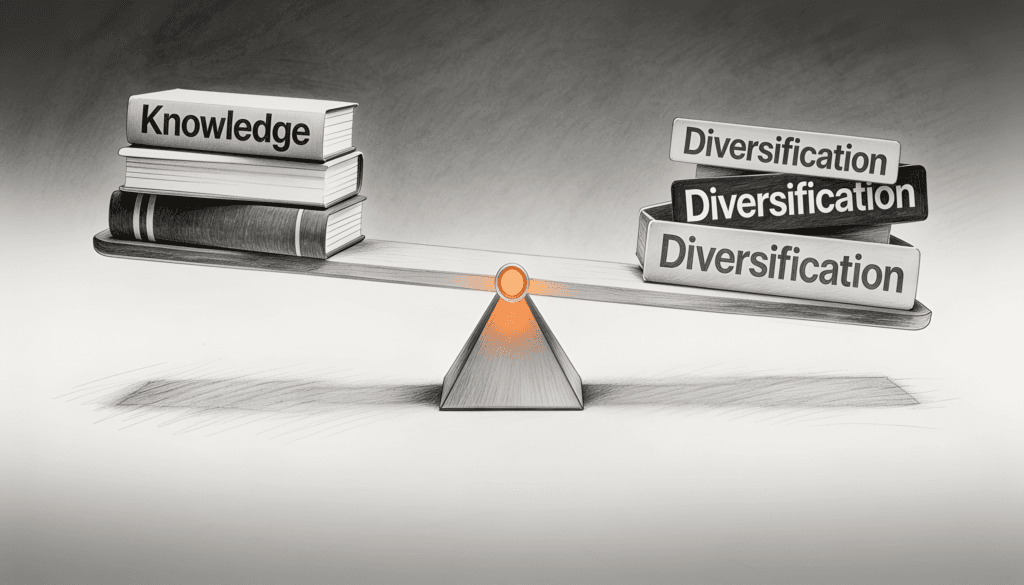
Warren Buffett once said that diversification is protection against ignorance, and that it makes little sense for those who know what they are doing. When most people hear that line for the first time, they laugh a little nervously and then quietly return to their index funds. Admitting that you do not know what you are doing feels like a confession, while spreading your money across forty different positions feels like a sign of maturity.
It feels responsible. It feels safe. It feels like the kind of move a financial advisor in a quiet office would nod approvingly at while sliding a brochure across the desk toward you. But there is something here worth sitting with, something a little uncomfortable that most discussions of Warren Buffett diversification conveniently skip over. Diversification, as it is sold to the average person, often functions less like a strategy and more like a coping mechanism.
This article is going to take that quote seriously. We will explore what Buffett genuinely meant, where he is right, where the picture gets more complicated, and what all of it means for how you actually manage your own money. By the end, you should understand the trade you are making every time you choose to own everything instead of choosing something.
The Comfort of Not Having to Think
Imagine walking into a restaurant and being completely unable to decide what to order. So instead of choosing, you ask the waiter to bring you a small portion of everything on the menu. You will not love the meal. You will not hate it either. You will leave full, mildly satisfied, and unable to remember a single dish you ate.
That is what diversification often looks like in practice. It is the buffet approach to investing, see the irony? You do not have to know what is good. You do not have to develop any taste of your own. You do not have to be wrong about anything in particular, because you have managed to be a little bit right and a little bit wrong about everything all at once.
There is a genuine psychological appeal to this. Human beings are not wired to tolerate being wrong. We are wired to avoid the sharp sting of a clear, identifiable mistake. Diversification lets you spread your wrongness so thin that it never quite tastes like failure.
The Emotional Logic Behind Spreading Bets
Your portfolio went down this quarter? Well, so did everyone else’s. You did the responsible thing. You followed the rules. The rules, of course, were written by people who assume you have absolutely no idea what you are doing. Which, statistically speaking, is a fair assumption to make about most investors.
Diversification lets you spread your wrongness so thin that it never quite tastes like failure. That comfort is real, but it is not the same thing as wisdom.
This is the part of the Buffett quote that gets lost. He was not saying diversification is stupid. He was pointing out that it exists to solve a specific problem, which is the problem of not knowing. For most people, that problem is real and permanent, which means the solution is genuinely appropriate. The trouble begins only when we confuse the solution with brilliance.
The Paradox of the Expert
Here is the strange thing about how investing advice gets distributed. The people who are most qualified to concentrate their bets are usually the ones who diversify the least. And the people who are least qualified are usually told to diversify the most. The system inverts itself in a way that almost feels poetic.
The plumber with a side interest in technology stocks is told to buy a broad index fund and forget about it. The hedge fund manager with twenty years of pattern recognition is encouraged to find his three best ideas and pour himself into them. The professor of biotechnology can take a meaningful position in a single drug company because she truly understands the molecule. The dentist down the street probably should not.
Diversification as Forced Humility to Treat Adults Like Children
What this reveals is that diversification, in the way it is most commonly prescribed, is about humility forced upon you by your own limitations. It is the financial equivalent of training wheels. Training wheels are wonderful for children. They become slightly embarrassing on adults who have had years to learn balance and never bothered.
But the real question is not whether you should ride without training wheels. The question is whether you have actually learned to ride. Most people have not. And most people never will, because learning to ride means putting in the time. It means reading the annual reports, sitting through the boring quarters, and watching your one big idea bleed for two years.
Diversification skips all of that. It lets you ride a bicycle that simply cannot fall over. The catch is that it also cannot really go anywhere particularly interesting. That is the bargain, and it is a fair one for someone who never intended to become a serious cyclist in the first place.
The Hidden Cost of Owning Everything
There is a quiet truth that does not get said often enough in conversations about index investing. When you own everything, you own the average. And the average, by its very definition, contains all the mediocrity, all the failing businesses, all the dying industries, and all the bloated giants that should have been broken up a decade ago.
You own them alongside the gems. You own the company about to cure a disease and the company about to file for bankruptcy. You own brilliance and rot, blended together into a single number that goes up roughly seven percent a year after inflation. That is not a bad outcome. It is a perfectly fine outcome. But it is not a great outcome, and the language we use around diversification frequently pretends that fine and great are the same thing.
Why Concentration Built Almost Every Fortune
Think about it this way. Almost every meaningful piece of wealth created in the last fifty years came from someone being concentrated. The founder who owned one company. The investor who bet early on the right trend and held on. The family that bought one piece of real estate in the right city and waited for decades.
You do not get rich by being everywhere. You get rich by being somewhere specific, being right about it, and staying there long after it stopped feeling exciting.
This is where Buffett himself becomes the clearest example. Berkshire Hathaway has long held enormous positions in a small handful of businesses. For years, a single holding in Apple represented an extraordinary share of the entire equity portfolio. Buffett did not get to where he is by owning a thousand tiny slices of everything. He got there by understanding a few things deeply and betting heavily on them.
Building Versus Preserving
So here is the distinction that the financial industry tends to blur constantly. Diversification preserves wealth. Concentration tends to build it. Those are two very different jobs, and they call for two very different tools.
The blurring is not accidental. There is no fee to be charged for telling someone to buy one excellent stock and hold it patiently for years. There is plenty of fee to be charged for managing a rotating portfolio of forty positions that need to be rebalanced every quarter, reviewed every month, and explained in a glossy report twice a year. Follow the incentives and the advice starts to make a different kind of sense.
The Charlie Munger Lens on Diworsification
Charlie Munger, Buffett’s late partner and intellectual sparring companion, used to say that you only need a few good ideas in your life to get genuinely rich, and that the entire trick is recognizing those ideas when they actually appear. He was famously dismissive of what he liked to call diworsification.
The idea was simple. Beyond a certain point, adding more positions to your portfolio does not meaningfully reduce your risk. It just reduces your edge. If you already hold three businesses you understand deeply and believe in, adding a fourth business you understand only slightly does not make you safer. It dilutes your conviction. It introduces noise. It quietly rewards you for being broad rather than for being right.
The Brutal Mathematics of Compounding
The mathematics of compounding is harsh in a way that most people never fully internalize. The difference between an investment that returns ten percent a year and one that returns fifteen percent is not simply five percent. Stretched across thirty years, it is the difference between modest comfort and serious, life altering wealth.
A single dollar growing at ten percent for thirty years becomes about seventeen dollars. That same dollar growing at fifteen percent becomes about sixty six dollars. The gap is enormous, and it grows wider with every passing year. Diversification, by its very nature, pulls you steadily toward the average. It smooths the curve, flattens the peaks, and softens the valleys. For someone who needs to sleep at night, that smoothing is a gift. For someone trying to build something extraordinary, it is a tax.
Beyond a certain point, more positions do not lower your risk. They lower your edge, and an edge is the only thing that ever made anyone exceptional money.
Knowing What You Do Not Know
So we arrive at the uncomfortable practical answer. Most people genuinely should diversify. Not because diversification is the height of wisdom, but because the alternative requires a level of honest self knowledge that most of us simply do not possess.
To concentrate intelligently, you have to know with real confidence where your edge actually lies. And the trouble with edges is that almost everyone believes they have one. The taxi driver who happened to pick one good stock in 1998 believes he has an edge. The person who got lucky on a crypto trade in 2021 believes he has an edge. The retiree who reads three financial articles a week believes he has one too.
Real Edges Are Rare and Expensive
Genuine edges are rare. They are built over years of obsession inside a narrow domain. They come from knowing something other people do not know, or from seeing something other people refuse to see, or from having the patience to wait for opportunities that other people are unwilling to wait for. Most people do not have this and never will, because most people are simply not willing to pay the price that it demands.
So the honest conclusion is awkward. Diversification is largely for people who do not know what they are doing. And most people, including most who feel quite confident, do not really know what they are doing. Therefore most people should diversify. There is no shame in this whatsoever.
Is Buffett Actually Right?
So is Warren Buffett correct when he says diversification is protection against ignorance? In the most precise reading, yes. He is describing the function of the tool accurately. Diversification protects you from the consequences of not knowing, and for the millions of people who do not know, that protection is exactly what they need.
Where the quote becomes misleading is in the implication that you could simply choose to be one of the people who knows. Most cannot, not because they lack intelligence, but because they lack the years of focused obsession that real knowledge requires. So Buffett is right about the principle and slightly unfair about the application. He built his fortune through concentration because he earned the right to concentrate. The average investor has not, and pretending otherwise is how people lose money.
A Practical Path Forward
Here is a reasonable way to hold both truths at once. Keep the core of your money diversified, because the core is what protects your future and your sleep. Then, if you are genuinely willing to do the work, carve out a smaller portion for concentrated bets in the narrow area where you actually understand something most people do not. Let that portion teach you whether your edge is real or imagined, and let the cost of that lesson stay small.
The people who built real fortunes were rarely peaceful about their investments. They were obsessed. They were focused. They were occasionally a little unhinged. They concentrated because they could not imagine doing anything else, because they had spent so long understanding their one thing that spreading themselves thinner would have felt like a betrayal of everything they knew.
You probably are not one of those people. Most of us are not. And that is completely fine. The only real mistake is pretending that diversification is the brilliant move rather than the safe one. It is a small lie we tell ourselves to feel sophisticated, and Buffett, in his blunt way, was simply refusing to tell it.