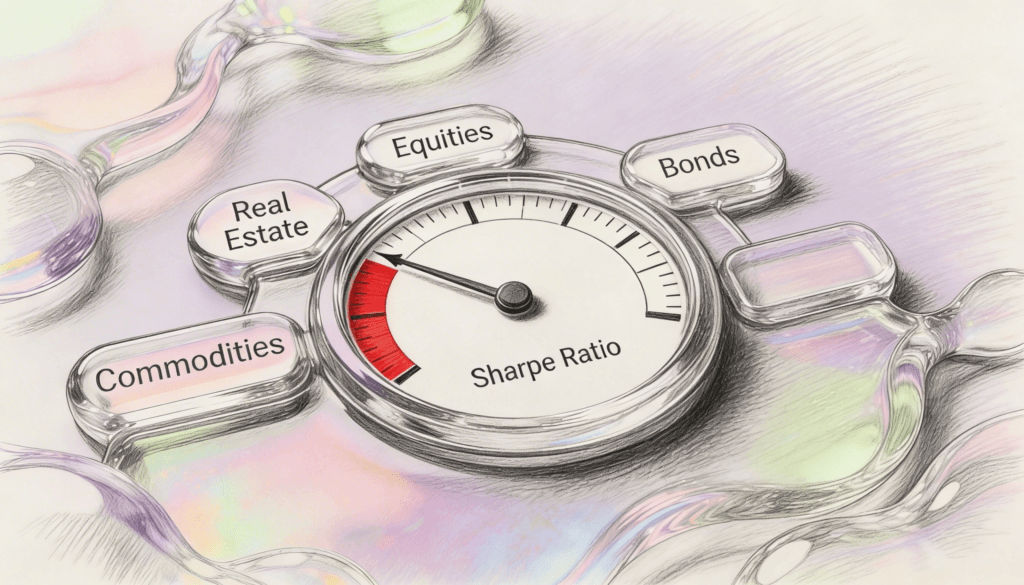
Why spreading your bets might be quietly destroying the metric it was meant to improve
Table of Contents
Somewhere along the way, diversification stopped being a strategy and became a religion. The faithful recite the creed without question. Spread your bets. Own a bit of everything. Sleep well at night. It sounds wise. It sounds responsible. And for decades, it mostly worked.
The logic is clean. Combine assets that do not move together and you can lower your portfolio’s volatility without dragging down returns. The Sharpe ratio, which measures return earned per unit of risk taken, should climb as a result. Less turbulence for the same destination. Who would argue with that?
Plenty of people should. Because in today’s markets, the standard approach to diversification is quietly undermining the very ratio it was meant to serve. Not because the math changed, but because the world did. What follows is not an argument against spreading risk. It is an argument against spreading it blindly, and a look at why doing so costs more than most investors realize.
The Sharpe Ratio Does Not Count Your Holdings
There is a common misunderstanding baked into how most people think about portfolio construction. They assume that more positions automatically means better risk adjustment. As if the Sharpe ratio were keeping score of how many tickers you own.
It is not. The Sharpe ratio cares about one thing: the character of your return stream. Specifically, how much excess return you squeeze out of every unit of volatility. Adding a new holding helps only when that holding brings something the portfolio did not already possess. A genuinely different pattern of returns. A response to economic forces that your other positions ignore. Without that, you are just adding furniture to a room that is already full.
Imagine a choir. Each new voice adds richness when it sings a different part. Soprano, alto, tenor, bass. The harmony deepens. But if every new member sings the same note, you do not get harmony. You get volume. The sound gets louder without getting more interesting.
Most portfolios today are choirs singing in unison. They hold positions across sectors and geographies and asset classes, and yet when markets move, they move together. The labels are different. The behavior is not.
Correlations Are Promises That Break Under Pressure
The entire architecture of diversification rests on one assumption: that correlations between assets are stable enough to plan around. History shows that stocks and bonds behave differently, that domestic and international equities do not always agree, that commodities march to their own drummer. So you build a portfolio that reflects those historical relationships and trust that they will hold.
But correlations are not laws of nature. They are symptoms of a particular market environment. Change the environment and the symptoms change too.
Three forces have reshaped that environment in ways that matter enormously. First, the rise of passive investing means that massive pools of capital now move in and out of markets without regard for individual company fundamentals. Index funds buy and sell baskets. When capital enters, everything rises. When it exits, everything falls. The differences between holdings get steamrolled by the sheer uniformity of the flow.
Second, central banks around the world spent years coordinating monetary policy in ways that compressed the natural variation between economies. When every major central bank is cutting rates or buying bonds simultaneously, the assets that are supposed to behave independently start dancing to the same music.
Third, and perhaps most importantly, correlations lie about their own stability. In calm periods, assets appear to move independently. Diversification looks like it is working. Then a crisis arrives and everything collapses together. Fear does not discriminate by sector or geography. It turns “risk on” and “risk off” into the only two categories that matter. The carefully measured low correlations from peaceful times evaporate exactly when you need them most.
It is a bit like testing a bridge only on sunny days and concluding it can handle any weather. The structural weakness does not show itself until the storm.
The Quiet Cost Nobody Talks About
Diversification has a price that does not appear on any fee schedule. It is the systematic dilution of your best thinking.
Suppose you have spent months researching a company. You understand its business, its management, its competitive position. You believe it will significantly outperform the market. So you buy it. But your allocation model says it can only be four percent of the portfolio. The remaining ninety six percent is split among dozens of other holdings you understand less well, chosen primarily because they check a box on a diversification checklist.
Now suppose you are right. The stock doubles. Your portfolio barely notices. That brilliant insight, the product of genuine effort and understanding, contributed almost nothing to your overall result because it was buried under the weight of everything else. Meanwhile, the mass of average positions pulled your total return toward the mean.
This is the trap. The more you diversify, the more your results converge toward the market itself. Your Sharpe ratio does not improve. It regresses to the market’s Sharpe ratio. You have not beaten the benchmark. You have become it.
A Lesson from Agriculture
Farmers learned something centuries ago that investors are still catching up to. Planting twenty different crops sounds like smart risk management. If one fails, the others survive. But if all twenty crops need the same soil conditions, the same rainfall, and the same growing season, then a single drought destroys everything at once. The variety was superficial. The vulnerability was shared.
This is exactly what happens in portfolios that diversify across names without diversifying across exposures. You might own a technology company, an industrial manufacturer, a consumer brand, and a bank. Four different sectors. Four different stories. But if all four depend on strong consumer spending, low borrowing costs, and stable global trade, they share a common root system. Pull out any one of those roots and the whole garden wilts together.
Genuine diversification requires something harder than buying different sectors. It requires owning assets that depend on genuinely different things. Assets where one thrives in conditions that challenge another. That kind of portfolio often looks odd on paper. It does not fit neatly into a pie chart. But it survives the droughts that wipe out the portfolios that only looked diverse.
Volatility Is the Wrong Enemy
The Sharpe ratio has a design flaw that rarely gets discussed. It uses standard deviation to measure risk. Standard deviation treats every surprise equally, whether it is a loss or a gain. A portfolio that occasionally surges upward is penalized just as much as one that occasionally crashes downward.
No investor has ever called their advisor in a panic because their portfolio went up too much. Yet the Sharpe ratio treats that scenario as problematic. This creates a strange incentive. When you diversify to reduce standard deviation, you are not just cushioning against losses. You are also clipping the upside. You are building a portfolio that avoids extreme outcomes in either direction.
For short term institutional money, that makes sense. A pension fund reporting to a board every quarter has legitimate reasons to smooth returns. But for an individual investor with a twenty or thirty year horizon, optimizing for smoothness is a peculiar choice. Over long stretches, the compounding of occasional large gains is one of the most powerful forces in wealth building. A portfolio that never drops much but also never surges will almost certainly finish behind one that endures some rough patches but captures the big moves.
The Sharpe ratio tells you how efficient the journey is. It says nothing about where you end up. Obsessing over it through aggressive diversification is like choosing your vacation based entirely on the comfort of the airplane seat rather than the quality of the destination.
The Paradox of Popular Strategies
There is a principle in game theory that applies here with uncomfortable precision. When a strategy is genuinely effective, it attracts followers. As followers multiply, the conditions that made the strategy effective begin to erode. The strategy becomes a victim of its own success.
International diversification is the textbook example. Decades ago, adding foreign stocks to a domestic portfolio produced real benefits because those markets operated somewhat independently. Different economic cycles, different policy environments, different investor bases. Then the textbooks told everyone to do it. Capital flowed across borders. Markets became interconnected. The correlations that were once low started climbing. The diversification benefit shrank precisely because everyone chased it.
The same story repeated with alternatives. Hedge funds, private equity, real estate, commodities. Each was sold as a way to add uncorrelated returns. Institutions poured money in. The crowding of capital into these spaces raised their correlation with traditional markets. Not because the assets changed their nature, but because the same hands now held everything.
Concentration Gets a Bad Reputation It Does Not Deserve
Our culture teaches us that concentration in investing is dangerous. It conjures images of someone putting their life savings into a single speculative bet and losing everything. Those stories are real. But they describe a failure of judgment, not a failure of concentration.
Concentration paired with ignorance is gambling. Concentration paired with deep understanding is something else entirely. It is the decision to let your strongest ideas carry real weight. To build a portfolio that actually expresses a view about the world rather than hedging that view into oblivion.
Think about how a film director works. A great director does not give every actor equal screen time. The leads carry the story. The supporting cast adds texture and depth. The extras fill out the world. A movie where every character appeared for exactly the same number of minutes would feel shapeless and forgettable.
Portfolio construction follows the same logic. Your highest conviction positions should drive outcomes. Supporting positions should complement them, not dilute them. And positions that do not serve a clear purpose should not be there at all. The question worth asking is not “how spread out am I?” but “does every piece of this portfolio justify its presence?” When the answer is honest, most portfolios turn out to have more extras than leads.
The Industry’s Convenient Truth
It is worth asking why the finance industry promotes broad diversification with such enthusiasm. The answer is not cynical exactly, but it is worth noticing. Diversification creates complexity. Complexity creates the need for products, advice, rebalancing services, and ongoing management. Every additional allocation is another decision point, another potential transaction, another reason to hire someone to oversee it all.
An investor who holds eight well chosen positions and understands each one deeply does not generate much business for the advisory ecosystem. An investor who holds forty positions across twelve asset classes, rebalances quarterly, and reviews allocations annually is a revenue stream.
None of this means advisors are acting in bad faith. Most genuinely believe in diversification because they were trained to believe in it. The problem is structural, not personal. The incentives of the industry align with more complexity, and more complexity gets dressed up as more diversification.
Where This Leaves You
The Sharpe ratio is a genuinely useful measure. It captures something important about how efficiently a portfolio converts risk into return. But it responds to the quality of diversification, not the quantity of it.
A portfolio that holds fewer positions but selects them for genuine independence will often produce a better Sharpe ratio than one that holds dozens of positions chosen mainly to fill allocation buckets. The first portfolio is built on understanding. The second is built on a checklist. Markets reward understanding.
The free lunch that diversification supposedly offers is real, but it is a much smaller portion than advertised. And it comes with a hidden side dish: the erasure of whatever makes your portfolio distinct.
The investors who sustain high Sharpe ratios over decades share something in common. They own what they understand. They size positions according to conviction. They tolerate discomfort in exchange for genuine differentiation. And they treat diversification as a tool to be used with precision rather than a blanket to be thrown over everything.
Diversification itself is not failing anyone. But the lazy version of it, the version that substitutes breadth for depth and volume for variety, is failing the Sharpe ratios of millions of portfolios. The fix is not to abandon diversification. It is to finally take it seriously.