Table of Contents
Humans have been arguing about what counts as real wealth for as long as humans have had wealth. The conversation usually sounds sophisticated. It is not. Strip away the jargon and the charts and the confident predictions, and you find the same instinct that made our ancestors carve their names into stones. People want to own something that will outlast them. They just cannot agree on what that something should be made of.
Today, that argument has two loudest voices. On one side stands the real estate investor, defender of the oldest asset class in human history. On the other stands the crypto holder, evangelist of the newest. They talk past each other constantly, and they usually think the other side is delusional. What makes this interesting is that they are both partly right, and the reasons they are right reveal something strange about how we decide what is valuable in the first place.
The Oldest Game in Town
Land is the asset class that predates everything. It predates currency. It predates writing. The first recorded laws, carved into stone thousands of years ago, were mostly about who owned which field and what happened if your neighbor’s goat wandered onto it. For most of human history, if you wanted to be rich, you owned land. If you wanted to be powerful, you owned more land. If you wanted to start a war, it was probably about land.
This is not a small detail. It means that when a modern real estate investor buys a rental property, they are participating in a ritual that goes back further than almost any other human activity except eating and sleeping. The rules have changed. The instinct has not. There is something in us that trusts dirt in a way we do not trust anything else, and that trust was installed long before any of us were born.
Real estate investors know this, even if they cannot articulate it. When they say land is “real” wealth, they are not making an economic argument. They are making an almost religious one. You can walk on it. You can fence it. You can hand it to your children and know that, barring a truly catastrophic event, it will still be there when they have children of their own. The asset class comes with a kind of ancestral permission slip.
The Newest Game in Town
Crypto, by contrast, is about sixteen years old. In human history terms, that is not even a rounding error. It is a blink. And yet in that blink, an entire parallel financial world has been built, complete with its own vocabulary, its own celebrities, its own spectacular frauds, and its own true believers who will explain to you at parties why everything you thought you knew about money is wrong.
The pitch is radical. Crypto holders argue that value does not need to be attached to anything physical at all. It does not need a government to stand behind it. It does not need a bank to keep track of it. It does not need a building to sit in. What it needs is a shared agreement, enforced by math, that a particular record in a particular ledger belongs to a particular person. That is it. That is the whole thing.
If this sounds absurd, it is worth remembering that every form of money has always been absurd in exactly the same way. Paper currency is just a promise. Gold is a soft yellow metal that we decided was special for reasons no economist can fully explain without eventually shrugging. Even land ownership is, in the end, a social agreement enforced by a government with the power to take the land away. The only difference with crypto is that the absurdity is newer and therefore more visible. We have not yet had time to forget that we made it up.
The Tangibility Illusion
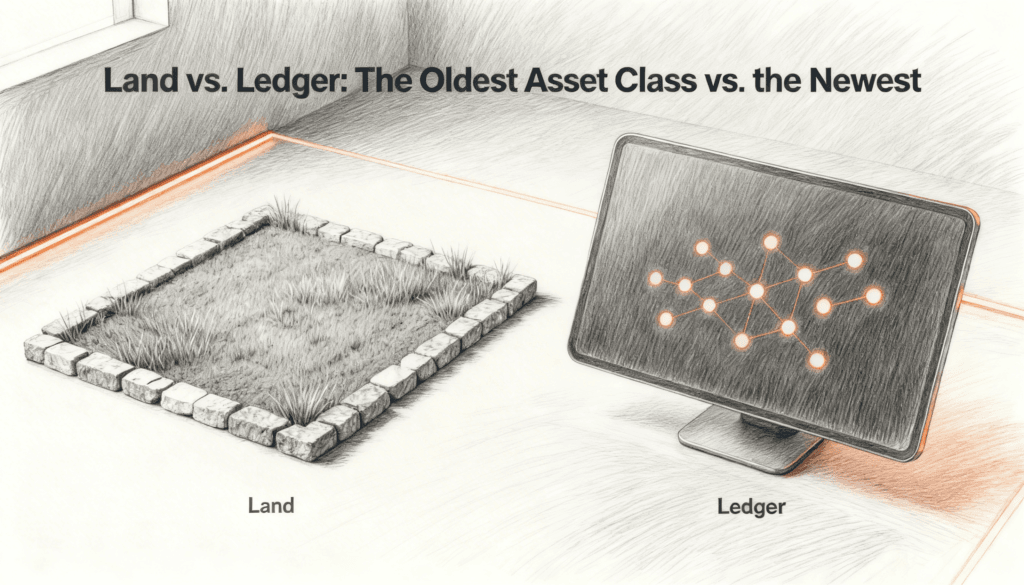
Here is where things get strange. The real estate investor will tell you that the problem with crypto is that it is not real. You cannot touch it. It exists only in a ledger. If the internet goes down, so does your net worth. These are fair points. They are also, ironically, the exact same points that could be made about land ownership if you squinted hard enough.
Your claim to a piece of land exists in a ledger too. It is just a ledger maintained by your local government, usually on paper, sometimes in a database, and it is only as reliable as the institution that maintains it. If that institution collapses, or decides it does not like you anymore, your deed becomes a piece of paper with no more power than a grocery receipt. History is full of people who thought they owned land right up until the moment someone with more guns informed them otherwise.
What makes land feel more real is not that it is actually more real. It is that the ledger backing it has been around for so long that we have stopped noticing it is a ledger at all. Crypto, by comparison, wears its ledger on the outside. It is honest about being a system of shared record keeping, which makes it feel flimsy. But the honesty is not the weakness people think it is. It might actually be the feature.
This is a strange thing to realize. The oldest asset class and the newest asset class are, underneath all the surface differences, doing the same job. They are both ways of keeping track of who owns what. One uses soil and fences and notaries. The other uses cryptography and distributed networks. The philosophical distance between them is much smaller than either side wants to admit.
What Each Side Gets Wrong
The real estate investor tends to underestimate how much of their confidence is borrowed from stability that they did not build and cannot guarantee. Land has been a safe bet for a long time, but “a long time” is not the same as “forever.” The institutional scaffolding that makes land ownership work can weaken. Zoning laws change. Tax policies shift. Climate patterns redraw maps. The deed in your drawer is only as strong as the civilization around it, and civilizations are not in the habit of lasting as long as they expect to.
The crypto holder tends to make the opposite mistake. They assume that because the old system has flaws, the new system must be the answer. But new does not mean better. It just means untested. A lot of the confidence in crypto comes from the fact that nothing truly catastrophic has happened to it yet at the civilizational level. It has not lived through a real war, a real depression, a real century. Until it does, calling it a store of value is a bit like calling a teenager wise because they have not yet made any of the mistakes that take decades to make.
Both sides would benefit from a little humility about time. Real estate is old enough to feel inevitable but is not. Crypto is new enough to feel revolutionary but might not be. The honest position is that we do not yet know which of these ledgers will be standing in two hundred years, and anyone who tells you otherwise is selling something.
The Quiet Agreement Underneath
What I find most interesting about this clash is that, at the deepest level, both camps agree on something important. They both believe that the standard financial system, the one built on banks and stocks and government managed currencies, is not quite enough. They are both looking for an exit. They just disagree about which door leads out.
That shared instinct is worth paying attention to. When two groups of people who cannot stand each other reach the same conclusion from opposite directions, it usually means they are both responding to something real. The thing they are responding to is a feeling, widespread and growing, that the old promises about money and ownership and security are no longer as solid as they used to be. Whether you bury your trust in soil or in math, you are still running from the same ghost.
Maybe that is the lesson worth taking away. The argument between land and ledger is not really about which asset is better. It is about what kind of uncertainty you are most willing to live with. The land buyer chooses the uncertainty of slow institutional decay. The crypto buyer chooses the uncertainty of fast technological chaos. Both are betting. Both are hoping. Neither has found the magic answer, because the magic answer does not exist.
The oldest asset class and the newest asset class have more in common than either would like to admit. They are both, in the end, just stories we tell each other about who owns what. The only question is which story you think will still be told when you are gone.