Table of Contents
Most investors treat a low Price to Free Cash Flow ratio the way a shopper treats a clearance rack. Something is cheap, so it must be a deal. The logic feels airtight. You are paying less for every dollar of cash the business generates. What could go wrong?
Quite a lot, actually.
The P/FCF ratio is one of the most popular valuation shortcuts in investing. You take the market price per share, divide it by the free cash flow per share, and you get a number that supposedly tells you whether a stock is cheap or expensive. A high number means the market is paying a premium. A low number means the market is offering you a bargain.
Or so the story goes.
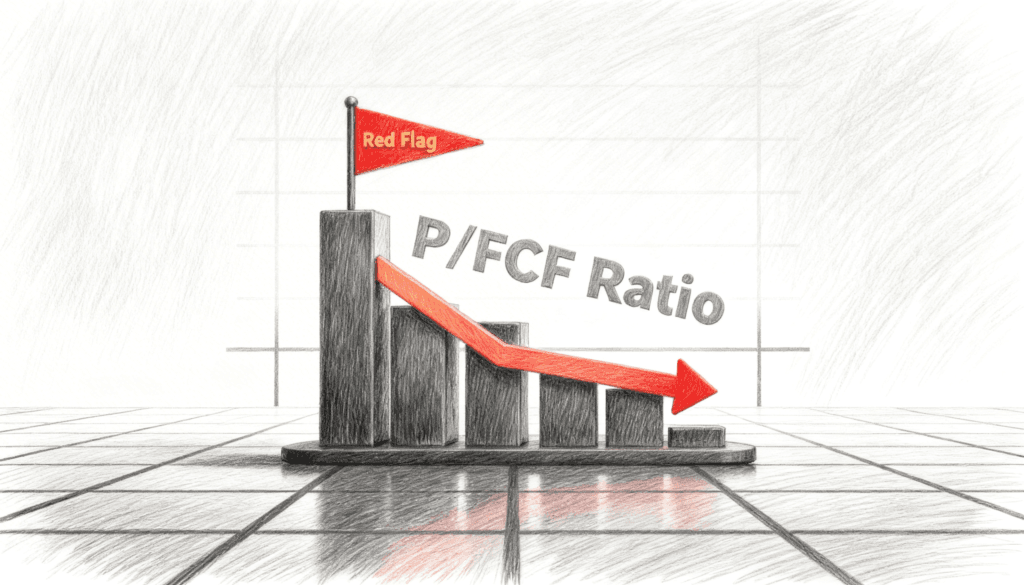
The problem is that free cash flow is not a fixed truth about a business. It is a snapshot. And snapshots, as anyone who has ever looked flattering in exactly one photo knows, can be deeply misleading. A low P/FCF ratio does not always mean you have found a hidden gem. Sometimes it means the market is telling you something you have not figured out yet.
Let us talk about why.
Free Cash Flow Is Not What You Think It Is
Before we get into the red flags, we need to understand what free cash flow actually measures and, more importantly, what it does not.
Free cash flow is typically calculated as operating cash flow minus capital expenditures. It represents the cash left over after a company has paid for its operations and maintained or expanded its asset base. In theory, this is the cash available to shareholders. It can be used for dividends, share buybacks, debt repayment, or reinvestment.
The appeal is obvious. Unlike earnings, which can be manipulated through accounting choices, free cash flow is supposed to be harder to fake. Cash is cash. Either it is there or it is not.
But this is where the intellectual comfort breaks down. Free cash flow is not immune to manipulation, and it is not immune to distortion. The number you see on a financial statement is the product of dozens of decisions, some of which are made specifically to make that number look better than it should.
Companies can boost free cash flow by delaying payments to suppliers, accelerating collections from customers, cutting maintenance spending, selling receivables, or restructuring the timing of capital expenditures. None of these tactics change the underlying economics of the business. They just move cash around on the calendar. And when you divide price by a temporarily inflated cash flow number, you get a ratio that looks attractively low but means almost nothing.
Think of it like a restaurant that stops buying fresh ingredients for a month. The cash flow statement looks fantastic. The kitchen, however, is a different story.
The Decline Discount
Here is the most common reason a stock trades at a low P/FCF ratio, and the one most investors refuse to accept: the business is in decline.
Markets are not stupid. They are not perfectly efficient either, but they are not stupid. When a company trades at five or six times free cash flow while its peers trade at fifteen or twenty, the market is usually pricing in a future that looks worse than the present. The cash flow you see today is not the cash flow the market expects to see in three years.
This is the fundamental trap of value investing done poorly. You look at the current numbers, decide the stock is cheap, and buy it. Then the numbers deteriorate. The P/FCF ratio was low not because the price was wrong, but because the cash flow was about to fall off a cliff.
Tobacco companies in the early 2000s are the textbook example people love to cite as proof that low P/FCF stocks can be winners. And some of them were. But for every tobacco company that rewarded patient investors, there are dozens of retail chains, media companies, and legacy technology firms that traded at low multiples right before their business models collapsed.
The market was not being irrational. It was being predictive.
The Capital Expenditure Illusion
This one is subtle, and it catches even experienced investors.
Free cash flow subtracts capital expenditures from operating cash flow. So if a company dramatically reduces its capital spending, free cash flow goes up mechanically. The P/FCF ratio drops. The stock looks cheap.
But what does reduced capital spending actually mean? In some cases, it means the company has become more efficient. It has found ways to do more with less. That is genuinely good.
In many other cases, it means the company is eating its own future. It is not investing in new equipment, new technology, new capacity, or new products. The cash flow looks great today because the company is borrowing from tomorrow.
This is especially common in industries with long asset lives. A pipeline company, a railroad, or a manufacturing firm can defer maintenance and replacement spending for years before the consequences show up. During that deferral period, free cash flow looks heroic. The P/FCF ratio looks like a screaming buy.
Then the pipes start leaking.
Working Capital Games
Working capital is the unglamorous plumbing of corporate finance. It includes things like inventory, accounts receivable, and accounts payable. Changes in working capital flow through the cash flow statement, and they can have an enormous impact on free cash flow.
Here is where it gets interesting. A company can generate a massive one time boost to free cash flow simply by running down its inventory, stretching its payables, or tightening its receivables. These are not necessarily signs of a healthy business. They can be signs of a desperate one.
When a retailer slashes inventory, free cash flow spikes. But if that inventory reduction means empty shelves and lost sales next quarter, the spike was not a sign of strength. It was a symptom of distress.
Similarly, when a company starts taking longer to pay its suppliers, cash flow improves temporarily. But suppliers notice. They start demanding less favorable terms, or they stop extending credit altogether. The short term cash flow gain creates a long term relationship problem that does not show up in any ratio.
The P/FCF ratio captures none of this nuance. It just sees the cash and calls it cheap.
Cyclicality Will Fool You Every Time
Some businesses are inherently cyclical. Their cash flows rise and fall with economic conditions, commodity prices, or industry cycles. At the peak of a cycle, these companies generate enormous free cash flow. Their P/FCF ratios look absurdly low.
This is the exact wrong time to buy.
When an oil company is trading at four times free cash flow, it probably means oil prices are at cyclical highs and the market expects them to come down. When a homebuilder looks cheap on a cash flow basis, it probably means housing activity is peaking. When a semiconductor company generates record free cash flow, it probably means the chip cycle is about to turn.
The low P/FCF ratio in these situations is not a signal to buy. It is a signal that the current level of cash generation is unsustainable. You are not getting a deal. You are getting the peak.
This is one of the great paradoxes of cyclical investing. These stocks look cheapest when they are most expensive and most expensive when they are cheapest. The P/FCF ratio, taken at face value, will lead you in the exact wrong direction at the exact wrong time.
One Time Events Dressed Up as Business Performance
Free cash flow can be inflated by events that have nothing to do with the core business. Asset sales, lawsuit settlements, insurance proceeds, tax refunds, and pension adjustments can all push cash flow higher in a given year.
These are not recurring. They will not happen again next year. But they show up in the free cash flow number, and they make the P/FCF ratio look lower than the business fundamentally deserves.
A company sells its headquarters building and leases it back. Free cash flow jumps. The P/FCF ratio drops. An investor who does not dig into the cash flow statement sees a bargain. An investor who does sees a company that just monetized its real estate and will now be paying rent forever.
The surface level number and the underlying reality are telling completely different stories.
The Debt Problem No One Talks About
The P/FCF ratio uses the equity price in the numerator but a cash flow figure in the denominator that exists before debt service. This creates a structural blind spot.
A company can have low P/FCF and still be in serious trouble because the free cash flow is entirely consumed by interest payments. The cash exists on paper, but none of it actually belongs to shareholders.
Imagine two companies with identical free cash flow. Company A has no debt. Company B has massive debt. They might trade at similar P/FCF ratios, but the actual value available to equity holders is radically different. Company A can distribute its cash flow, reinvest it, or save it. Company B has to hand most of it to bondholders.
This is why enterprise value to free cash flow is often a more honest metric. It accounts for debt. But most casual screeners use P/FCF, and most casual investors never look at the balance sheet.
When the Market Knows More Than You Do
There is a certain arrogance in looking at a low P/FCF ratio and concluding that the market has made a mistake. The market is the aggregate opinion of millions of participants, many of whom have access to better information, better models, and more experience than any individual investor.
This does not mean the market is always right. It means the market is usually right, and the burden of proof is on you when you disagree.
When a stock trades at a low P/FCF ratio, the first question should not be “why is this so cheap?” The first question should be “what does the market know that I do not?”
Maybe the answer is nothing. Maybe you have genuinely found a mispriced asset. It happens. But far more often, the market has identified a problem that is not yet visible in the trailing financial statements. Customer churn is accelerating. A key patent is expiring. A competitor is launching a superior product. Regulation is tightening.
The low ratio is not a gift. It is a warning label.
So When Is a Low P/FCF Actually Good?
After all this doom and gloom, it is worth noting that low P/FCF ratios can absolutely indicate genuine value. The trick is distinguishing between stocks that are cheap for good reasons and stocks that are cheap for bad ones.
A low P/FCF ratio is genuinely attractive when the free cash flow is sustainable and recurring, when capital expenditures reflect honest maintenance and growth spending rather than deferred costs, when working capital is stable, when the business is not at a cyclical peak, when there are no significant one time items inflating cash flow, and when the balance sheet is clean enough that the cash actually belongs to shareholders.
That is a lot of conditions. And checking all of them requires more than a screening tool and five minutes of research.
The Bigger Lesson
The real issue with the P/FCF ratio is not the ratio itself. It is the way investors use it. They treat it as a conclusion when it should be treated as a starting point.
A low P/FCF ratio is a question, not an answer. It says something interesting is happening with this stock. Your job is to figure out what that something is.
In behavioral psychology, there is a concept called the anchoring effect. Once people see a number, they anchor to it and adjust insufficiently from that starting point. A low P/FCF ratio is a powerful anchor. It makes you want to believe the stock is cheap. It makes you look for confirming evidence and ignore disconfirming evidence. It makes you feel like you have done the work when you have barely started.
The best investors treat low P/FCF ratios with suspicion first and enthusiasm second. They ask why before they ask how much. They look at the cash flow statement line by line instead of just glancing at the bottom number. They compare this year to last year and the year before that. They check whether the capital expenditure decisions make sense for the industry and the competitive environment. They read the footnotes.
Most people will not do any of this. Most people will see a low number on a screener, read a few confirming opinions online, and convince themselves they have found the next great value play. Some of them will be right. Enough of them will be wrong that the exercise is worth questioning.
A low P/FCF ratio can be a treasure map. But it can also be a trap door. The only way to tell the difference is to stop trusting the number and start interrogating it.
The ratio does not owe you a bargain. You owe yourself the diligence to find out whether it actually is one.