Table of Contents
How Banks Actually Create Money
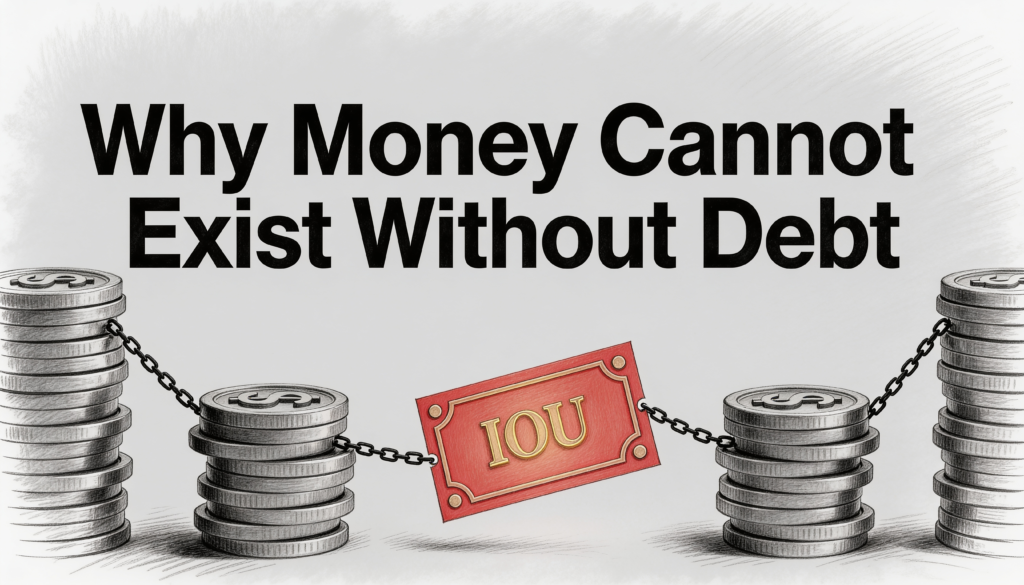
Money cannot exist without debt because nearly every unit of currency in circulation was created the moment someone borrowed it. When a bank issues a loan, it does not lend out existing savings. It creates brand new money by typing numbers into an account, and that money exists only as long as the debt behind it exists. Repay all the debt, and you erase the money.
If that sounds like a fringe theory, it is not. The Bank of England, one of the most established central banks on the planet, stated it plainly in a 2014 quarterly bulletin titled Money Creation in the Modern Economy. The authors wrote that the common understanding most people carry around is simply wrong.
Whenever a bank makes a loan, it simultaneously creates a matching deposit in the borrower’s bank account, thereby creating new money. The reality of how money is created today differs from the description found in some economics textbooks.
Read that again, because it overturns almost everything you were taught. The deposit does not fund the loan. The loan creates the deposit. Money does not arrive in the world as a neutral object. It arrives owing something to someone. It arrives in the red.
This article walks through the mechanism step by step, shows you the accounting that makes it unavoidable, and then answers the specific questions people ask once they grasp it. The goal here is not to argue that this system is good or bad. The goal is to show you, mechanically, why money and debt are two sides of the same coin.
A Worked Example: The $10,000 Loan
Abstract claims are easy to dismiss, so let us follow a single loan from start to finish. Imagine you walk into a bank and ask to borrow $10,000 to buy a used car.
Before you sign anything, that $10,000 does not exist. It is not sitting in a vault. It is not somebody else’s savings waiting to be lent. It is nothing.
When the loan is approved, the bank does two things at the exact same instant. On its balance sheet, it records a new asset of $10,000, which is your promise to repay. And it records a new liability of $10,000, which is the deposit it just placed in your checking account. Both entries appear together, created with a few keystrokes.
- Before the loan: the money supply does not include your $10,000.
- After the loan: the money supply has grown by exactly $10,000. You can spend it, transfer it, or withdraw it as cash.
You hand the $10,000 to the car seller. That money is real. It buys groceries, pays wages, and circulates through the economy. Yet every dollar of it began as your debt. This is how the bulk of the money supply comes into being: as private bank lending, not as government printing.
Now watch the reverse. As you repay the loan over the next 3 years, each payment shrinks the deposit the bank created. When the final installment clears, the original $10,000 of money vanishes from existence. It is not transferred to anyone. It is extinguished. The asset and the liability cancel out, and the money supply returns to where it started, minus the interest the bank keeps as income.
Money is created when debt is taken on and destroyed when debt is repaid. If you want the money to stay in the economy, someone, somewhere, must keep the debt alive.
Fractional Reserve Banking and the Multiplier
You may have learned a related model called fractional reserve banking, which says a bank keeps a fraction of deposits in reserve and lends out the rest, with the money multiplying as it passes from bank to bank. That model captures part of the picture, but it gets the direction backward. In modern practice, banks do not wait for deposits to lend. They lend first and find reserves afterward, because central banks supply reserves on demand to keep the payment system functioning.
Commercial banks are the primary creators of money in a modern economy. The amount of money in circulation expands and contracts with the willingness of households and businesses to borrow, and the willingness of banks to lend. Money supply and debt move together because they are, at bottom, the same thing measured from opposite sides.
What This Means for Savings, Government Debt, and Recessions
Once you accept that money is created as debt, several familiar ideas need rethinking. The accounting that governs banking also governs the entire financial system, and it leads to conclusions that feel uncomfortable until you sit with them.
The Accounting Identity Behind Everything
There is a rule in accounting so basic it sounds almost too simple to matter: every financial asset is somebody else’s financial liability. Your savings account is your asset and the bank’s liability. The cash in your wallet is your asset and the central bank’s liability. A government bond in a pension fund is the fund’s asset and the government’s liability.
Here is what that identity looks like laid out side by side.
| The asset (someone holds this) | The matching liability (someone owes this) |
| Cash in your wallet | Liability of the central bank |
| Your checking and savings balances | Liability of your commercial bank |
| Government bonds held by investors | Liability of the government (the national debt) |
| Corporate bonds in a fund | Liability of the issuing company |
| Money lent through a mortgage | Liability of the homeowner |
Zoom out far enough and a striking picture emerges. If you summed every financial asset and every financial liability on Earth, the total would be zero. The entire financial system is a perfectly balanced ledger of who owes what to whom. This is not poetry. It is mathematics.
And it leads to a conclusion that catches people off guard. For one person to be a net saver, another person must be a net borrower. The money resting peacefully in your savings account is someone else’s obligation. Your wealth does not sit in isolation like a pile of stones. It exists as a claim against someone else’s future output. Every plus has a minus somewhere on the other side of the ledger.
Why Fiat Money Is Debt by Design
Some people assume this only applies to bank deposits and that physical cash is different, a pure store of value with no strings attached. It is not. Look at the dollar bill itself. In the United States it is issued by the Federal Reserve, and it appears on the Fed’s balance sheet as a liability. Fiat money is, by its very construction, a liability of the institution that issues it. A banknote is an IOU that everyone has agreed to accept.
This is why the phrase “fiat money is debt” is not a slogan. It is a description of the accounting. The dollar has value because it is universally accepted as a claim, and because the government accepts it back in payment of taxes. There is no hidden vault of gold underneath standing in for the obligation. The obligation is the money.
Government Debt Is the Private Sector’s Savings
This is where the mechanics collide with politics. We hear constantly that the national debt is a crisis mortgaging our children’s future. But apply the accounting identity to the government and a different story appears.
If the government runs a surplus, taking in more in taxes than it spends, that money has to come from somewhere, and that somewhere is the private sector. By mathematical necessity, a government surplus is a private sector deficit. When the government saves, households and businesses must collectively go deeper into debt or run down their savings.
The opposite is also true. When the government spends more than it collects, the excess flows into private hands. It becomes household income. It becomes corporate revenue. It becomes savings. The national debt, viewed from the other side of the ledger, is simply the accumulated savings of everyone who holds government bonds and dollars.
This does not mean a government can spend without limit. Inflation is real. Resource constraints are real. A sovereign government that issues its own currency is in a fundamentally different position from a household, which cannot print money to pay its bills, but that does not give it unlimited power. The point is narrower and more useful: government debt is not a credit card bill waiting to bankrupt the nation. It is closer to the total amount of money the government has spent into the economy and not yet taxed back out.
What Happens When Everyone Repays at Once
Now apply the mechanism to a real event. In a healthy economy, new loans are constantly being created while old ones are being repaid, and the money supply stays roughly stable or grows. But what happens when everyone tries to pay down debt simultaneously and nobody wants to borrow?
This is not a thought experiment. It happened in 2008. Households panicked and rushed to save. Banks panicked and stopped lending. Across the economy, people tried to climb out of the red at the same moment.
The result was not a healthier system. It was a collapse. Because money is created by debt, a rush to repay debt destroys money faster than new lending can replace it. The money supply shrinks. Less money means less spending. Less spending means less income. And less income makes the remaining debt harder to pay, which pushes people to cut back even further. Economists call this a debt deflation spiral, and it is the direct consequence of the very mechanism we walked through earlier.
When money is created as debt, an economy where everyone tries to be debt-free at the same time is an economy where the money itself gets destroyed.
This also exposes the flaw in austerity during downturns. Cutting government spending in a recession does not make total debt vanish. It shifts the debt from the public balance sheet, held by an entity that can create currency, onto private households that cannot. The debt does not disappear. It moves to where it hurts more.
Common Questions About Money and Debt
Once the mechanism clicks, a predictable set of questions follows. Here are direct answers to the ones people ask most.
Does all money come from debt?
Almost all of it does. In a modern economy, the vast majority of the money supply is created by commercial banks when they issue loans, as the Bank of England confirmed. A small portion exists as physical cash and central bank reserves, but even those are recorded as liabilities of the central bank. So in accounting terms, essentially every form of money in circulation is matched by a corresponding debt somewhere in the system. There is no meaningful pool of debt-free money sitting in the economy.
What would happen if all debt were repaid?
If every loan in the economy were repaid at once, the money used to create those loans would be extinguished along with them, because repayment destroys the deposits that lending created. The money supply would collapse toward zero. Far from producing a prosperous, debt-free utopia, the simultaneous repayment of all debt would erase the medium of exchange itself, freezing transactions and grinding the economy to a halt. This is why eliminating all debt and eliminating all money describe the same outcome.
Is fiat money the same as debt?
In a structural sense, yes. Fiat money is issued by central banks and recorded as a liability on their balance sheets, and bank deposits are liabilities of commercial banks. A banknote functions as a universally accepted IOU. Its value comes from collective trust and from the fact that the government accepts it back in payment of taxes, not from any physical commodity backing it. So fiat money is best understood as a debt instrument that the entire society has agreed to treat as final settlement.
If money is debt, is all debt bad?
No, and this is the most important practical insight. Because money cannot exist without debt, the real question is never how to abolish debt but how to structure it wisely. Some debt creates productive capacity: a loan that builds a factory, funds an education, or develops new technology can generate far more value than it costs. Other debt extracts value, such as payday loans at triple-digit interest rates or speculative borrowing that inflates asset prices without producing anything real. The distinction that matters is between debt that builds and debt that bleeds, not between debt and no debt.
Why do we feel so much guilt about debt if it is necessary?
The moral weight comes from personal experience, where debt genuinely can crush an individual household. That intuition is valid at the personal level. The error is scaling it up to the entire system. Telling a whole economy to become debt-free is like telling everyone in a room to stand above the average height. It is not a matter of willpower. It is a matter of logic. The same obligation that feels like a burden to one person is, on the other side of the ledger, somebody else’s secure retirement. Both things are true at once.
The Bottom Line on Money and Debt
Walk back through what the mechanics showed us. A bank loan creates new money out of nothing by recording an asset and a matching liability at the same instant. That money lives in the economy as long as the debt survives, and it disappears when the debt is repaid. The accounting identity guarantees that every financial asset is somebody else’s liability, which means total net financial wealth across the world sums to zero. Government debt is the mirror image of private savings, and a stampede to repay debt all at once destroys the money supply itself.
Put together, these facts explain the title of this article. Money cannot exist without debt because money is debt, recorded from the creditor’s point of view. Every dollar is a promise. Every transaction is a transfer of obligation. The financial system is a vast web of promises, and if everyone kept their promises at the same instant, the web would vanish and take the economy with it.
This is not a reason for alarm. It is a reason for clarity. Understanding that money is fundamentally relational rather than physical changes how you think about saving, investing, and policy. Your wealth is not a heap of objects you accumulated in a vacuum. It is a claim on the future output of other people, and it exists only because someone sits on the other side of that claim.
So the next time someone insists that all debt is dangerous, you will know they are unintentionally describing a world with no money in it. And the next time someone shrugs that debt does not matter, you will know they are ignoring that every obligation has a human being underneath it. The useful question is never whether debt should exist. The useful question is whether the debt we create builds something real, and whether its weight falls on those who can carry it.