Table of Contents
There is a moment in every market cycle when a trade looks so clean, so perfectly set up, that it feels almost rude not to take it. The chart is screaming. The news confirms it. Social media is unanimous. Your gut says yes. Your neighbor says yes. The cab driver says yes.
And that, historically speaking, is exactly when you should start asking who arranged for all of this to look so inviting.
The Confidence Problem
Markets have a peculiar relationship with certainty. The more obvious a trade appears, the more participants pile into the same side. And the more participants pile into the same side, the more fragile the entire structure becomes. This is not a bug in the system. For certain players, it is the system.
Think of it like a stadium where everyone rushes to one side of the bleachers. The view might be better for a moment, but the structural risk just increased dramatically. In markets, that structural risk has a name. It is called a crowded trade. And crowded trades do not unwind gently. They collapse.
But here is the part that rarely gets discussed. That crowd did not always gather on its own. Sometimes it was guided there.
Market manipulation is not always the cartoonish villain in a dark room pressing buttons. More often, it is the careful construction of a narrative so compelling that rational people voluntarily walk into a trap. The bait does not need to be hidden. It needs to be attractive. And the most attractive bait of all is the feeling of certainty.
How Traps Get Built
The anatomy of a market trap is surprisingly elegant. It begins with a kernel of truth. There is always something real underneath. A stock is genuinely growing. A sector is genuinely hot. A commodity is genuinely in demand. The manipulation does not invent the story from nothing. It amplifies it beyond reason.
This amplification follows a pattern that has repeated for centuries. First, large players accumulate a position quietly, over weeks or months, without moving the price enough to attract attention. Then the narrative begins. Research reports emerge. Media coverage increases. Influencers start talking. The price begins to move, which creates its own momentum because nothing attracts money like a rising price.
At this stage, the trade looks obvious. And it is obvious. That is the point. The transparency is the trap.
By the time everyday investors see the opportunity, the large players who created the setup are no longer buying. They are waiting. They are waiting for enough volume, enough enthusiasm, enough conviction on the other side of their trade to allow them to exit. Your entry is their exit. Your confidence is their liquidity.
This is not conspiracy theory. This is market structure. Every trade requires a buyer and a seller. The question is simply which side has more information about why the trade is happening in the first place.
The Psychology of the Perfect Setup
There is a concept in behavioral science called the availability cascade. It describes how a belief becomes more credible simply because it is repeated more often. The more you hear something, the more true it feels. Not because the evidence has changed, but because your brain uses frequency as a shortcut for validity.
Markets exploit this relentlessly. When a trade idea appears simultaneously on financial news, social media, trading forums, and your colleague’s lunch conversation, it does not feel like coordination. It feels like consensus. And consensus feels safe.
But consensus in markets is a paradox. If everyone already agrees on the direction, then the move has largely already happened. The profit was made by those who arrived before the consensus formed. What remains is the illusion of profit and the reality of risk.
Consider the psychological sequence. You see a stock rising. You read positive coverage. You notice others profiting. You feel the fear of missing out. You enter the trade. At this exact moment, you are the most emotionally committed and the least analytically rigorous. You have been led down a corridor of confirmation, and every door behind you has closed.
This is not accidental. In the language of game theory, you have been playing a game where the rules were set before you sat down at the table.
The Invisible Hand That Is Not So Invisible
Adam Smith wrote about the invisible hand as a metaphor for self regulating markets. What he did not anticipate was that some hands would learn to be invisible on purpose.
Modern market manipulation operates in the gap between what is legal and what is ethical. Spoofing, layering, wash trading, and coordinated pump and dump schemes are illegal. But there is a vast gray area of behavior that achieves similar outcomes without technically breaking rules.
A hedge fund can legally build a large position, then go on television to discuss why they love the stock. They can publish research that supports their thesis. They can time their media appearances to coincide with options expiration dates when the impact on price is magnified. None of this is illegal. All of it is strategic. And the strategy depends entirely on other people finding the trade obvious enough to follow.
The financial industry has a term for this. They call it “talking your book.” It sounds almost charming, like a storyteller at a campfire. But the campfire is your money, and the storyteller is the one who brought the matches.
What makes this particularly effective is that the information being shared is often accurate. The stock might genuinely have good fundamentals. The sector might genuinely be growing. The manipulation is not in the facts. It is in the timing and the framing. Accurate information delivered at a strategic moment to serve someone else’s position is not education. It is advertising.
Lessons From the Casino Floor
There is a useful parallel in casino design. Casinos do not hide the slot machines. They put them right at the entrance, lights flashing, sounds chiming. They want you to see other people winning. They want the opportunity to feel obvious and accessible. The entire environment is engineered to make the next pull of the lever feel like the rational thing to do.
Markets, when manipulated, operate on the same principle. The winners are visible. The losers are silent. The opportunity is loud. The risk is whispered.
Professional poker players understand something that most market participants do not. If you sit down at a table and you cannot identify who the sucker is, you are the sucker. In manipulated markets, the trade that looks obvious to everyone is the equivalent of a poker hand that looks unbeatable. It probably is not. And the person who dealt it to you knows that already.
Why Smart People Fall for It
One of the most counterintuitive aspects of market traps is that they catch sophisticated investors more reliably than novices. This sounds backwards, but the logic is sound.
Experienced investors have frameworks. They have technical analysis, fundamental models, pattern recognition. When a trade fits their framework perfectly, they trust it. They trust it because their framework has worked before. And it has worked before because, most of the time, markets do follow patterns.
But the best traps are designed to match those frameworks exactly. A manipulated chart does not look random. It looks textbook. It looks like the setup you have been trained to recognize. The head and shoulders pattern, the breakout above resistance, the golden cross of moving averages. These are real patterns that work in normal conditions. In manipulated conditions, they are the bait on the hook.
Novices, ironically, sometimes avoid these traps because they do not recognize the patterns in the first place. They hesitate out of ignorance, which occasionally produces the same result as wisdom. The market does not care about your reasons for being right. It only cares that you are right.
The Information Asymmetry Nobody Talks About
Every financial market operates on information asymmetry. Someone always knows more. This is not cynicism. It is arithmetic. The question is not whether asymmetry exists, but how large it is and who benefits from it.
In a well functioning market, regulations exist to keep this asymmetry within tolerable limits. Insider trading laws, disclosure requirements, and market surveillance systems all serve to level the playing field. But the playing field has never been truly level. It has only been level enough to maintain participation.
This is the crucial insight. Markets need retail participation to function. They need volume, liquidity, and price discovery that comes from a broad base of participants. So the system cannot be so rigged that nobody plays. But it can be, and often is, tilted just enough that the house retains an edge.
The “obvious” trade is the mechanism through which this edge is exercised. It is the carrot that keeps participants engaged. Sometimes the carrot is real. Sometimes it is painted on the wall. And telling the difference requires a kind of skepticism that the market actively discourages, because skepticism reduces volume, and reduced volume is bad for everyone who profits from activity.
What Protection Actually Looks Like
So what does a thoughtful investor do with this information? The answer is not to become paranoid. Paranoia is just as expensive as naivety, because it keeps you out of trades that would have worked. The market is not always a trap. It is sometimes a trap. And the skill is in distinguishing the two.
The first defense is time. Manipulated moves tend to be urgent. They create a feeling that you must act now or miss the opportunity forever. Real opportunities rarely expire in an afternoon. If a trade demands immediate action, that urgency is worth questioning. The best investors in history have been characterized not by speed but by patience. Warren Buffett did not build his fortune by chasing momentum. He built it by waiting until the price came to him.
The second defense is asking who is on the other side. Every trade has a counterparty. If you are buying, someone is selling. If the trade is so obviously good, why is someone willing to take the other side? This question alone eliminates a surprising number of bad decisions.
The third defense is watching for unanimity. When every source of information agrees, that agreement itself is information. Not about the trade, but about the environment. Genuine opportunities tend to be debated. They tend to have credible voices on both sides. When the debate disappears and only cheerleaders remain, the trade has likely moved past opportunity and into something else.
The fourth, and perhaps most important defense, is understanding your own role in the ecosystem. Retail investors are not the apex predators of financial markets. They are participants in a system designed and operated by institutions with more capital, more information, more technology, and more influence. This does not mean retail investors cannot profit. They absolutely can. But they profit by being selective, patient, and deeply skeptical of anything that feels too easy.
The Uncomfortable Truth
There is a discomfort in accepting that markets are not purely meritocratic arenas where the best analysis wins. They are competitive environments where information, access, and capital create structural advantages. The “obvious” trade is often obvious because someone made it obvious. And they made it obvious because they need you on the other side.
This does not mean you should never trade. It means you should trade with the understanding that the map you have been given might not match the territory. It means treating certainty as a warning signal rather than a green light. It means recognizing that in a game where the smartest players spend billions on technology, research, and market infrastructure, the idea that you found a great trade by scrolling through social media for ten minutes should inspire suspicion, not confidence.
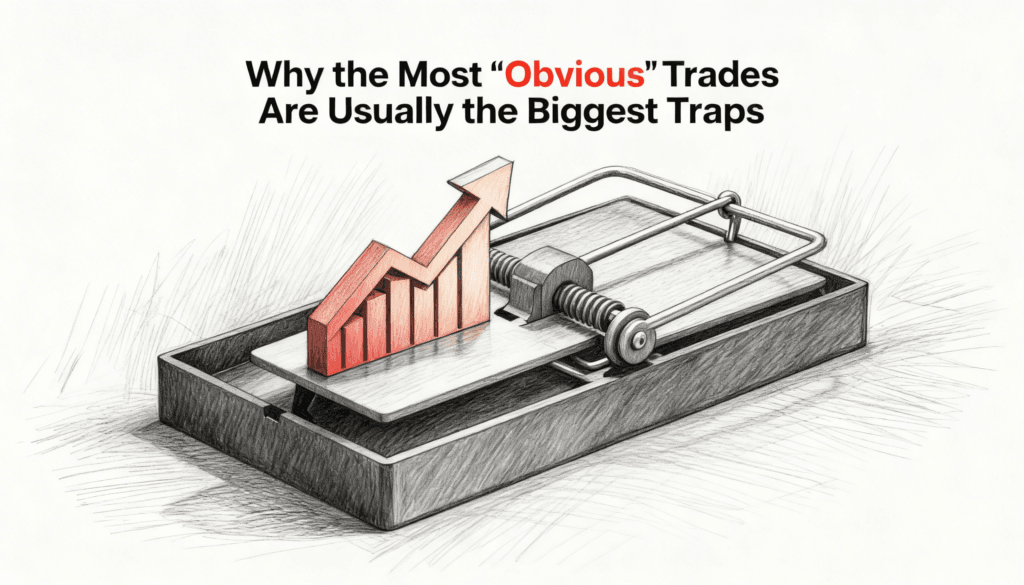
The baited hook works because the fish does not know it is a hook. It only sees the worm. And the worm looks perfect. It looks, in fact, obvious.
The most valuable skill in any market is not finding the best trade. It is recognizing when you are being invited to find it.