Table of Contents
There is a peculiar kind of blindness that only affects people who can see perfectly well. It does not strike in the dark or in moments of confusion. It strikes in broad daylight, when everything looks clear, profitable, and obvious. It strikes hardest when your portfolio is green and the charts keep climbing like they have somewhere important to be.
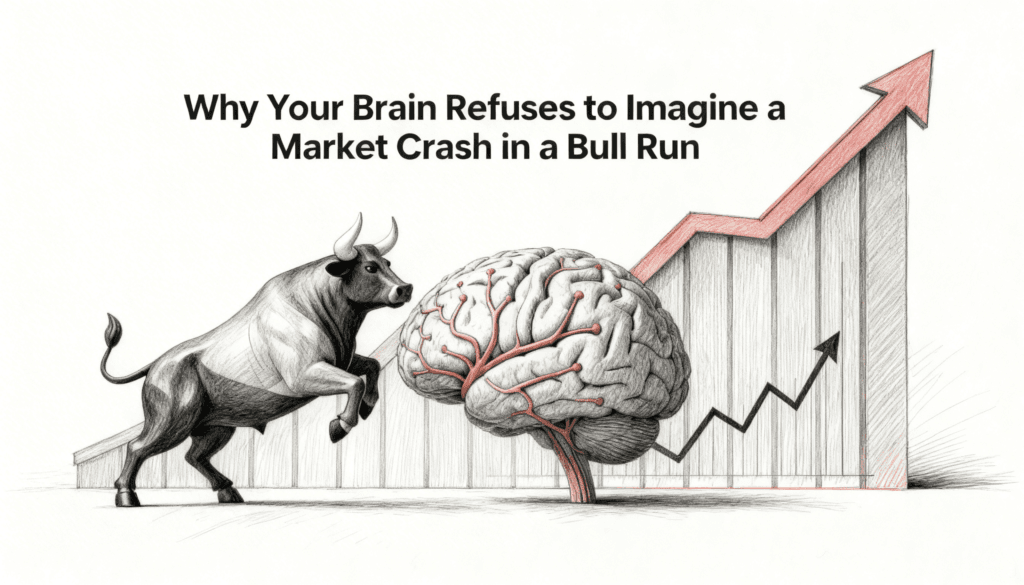
This blindness has a name. Psychologists call it recency bias. But that clinical label does not capture what it actually does to you. What it actually does is something closer to hypnosis. Your brain, fed a steady diet of rising prices and optimistic headlines, quietly deletes the possibility that things could go the other way. Not tomorrow. Not next month. Not ever. The crash becomes theoretically possible in the way that asteroid impacts are theoretically possible. You know it can happen. You just cannot feel it.
And that gap between knowing and feeling is where fortunes go to die.
The mind is a lazy historian
Your brain does not process the world by carefully weighing all available evidence. That would take too long and burn too many calories. Instead, it takes a shortcut. It asks a simpler question: what happened recently? Whatever the answer is, your brain assumes that is what will keep happening.
This is not a flaw in some abstract sense. For most of human history, this shortcut worked beautifully. If the river flooded last week, it was reasonable to stay on higher ground this week. If the berries from a certain bush made you sick yesterday, avoiding them today was smart. The recent past was a reliable trailer for the near future.
But financial markets are not rivers or berry bushes. They are systems driven by collective human psychology, leverage, policy, and the occasional geopolitical earthquake. They do not care about your brain’s preference for continuity. A market that went up for three years can collapse in three weeks. Your brain, trained on the savannah and not on Wall Street, simply does not accept this.
So during a bull run, something quietly shifts in your mental architecture. Each green day is not just a data point. It is a brick in a wall that eventually blocks your view of anything else. After enough bricks, you cannot see the other side at all. You do not even remember there is another side.
The emotional math that does not add up
Here is where it gets interesting, and slightly uncomfortable. Recency bias is not just a thinking error. It is an emotional one. During a sustained rally, your brain is not only updating its model of the market. It is updating its model of you.
You start to feel competent. You start to feel like someone who understands how this works. Every correct call, even the ones that were pure luck, gets filed under skill. Every gain reinforces the narrative that you are doing something right. And once that identity takes hold, imagining a crash is not just an intellectual exercise. It is a threat to your self concept.
This is why experienced investors sometimes lose more money in crashes than beginners do. Beginners are still nervous. They have not yet built an identity around being right. But the person who has been riding a bull market for years? They have fused their ego with their portfolio. Suggesting the market might crash is like suggesting their judgment is flawed. And the brain protects the ego the way a mother bear protects her cubs. Aggressively and without much rational deliberation.
There is an irony here worth sitting with. The more successful you have been, the more dangerous recency bias becomes. Success does not inoculate you against the bias. It deepens it. The best track record in a bull market can become the worst preparation for a bear one.
The world conspires to keep you comfortable
Your brain does not operate in a vacuum. It operates inside a media ecosystem that is spectacularly good at reinforcing whatever you already believe. During a bull run, financial news becomes a kind of cheerleading squad with better vocabulary. Analysts raise their price targets. Magazines put smiling CEOs on their covers. Social media fills with screenshots of gains and rocket emojis.
This is not conspiracy. It is economics. Optimism sells. Bullish headlines get more clicks than cautious ones. Fund managers who say the rally will continue get more airtime than those who warn about valuations. The entire information environment tilts toward confirmation of what is already happening.
And your brain, already predisposed by recency bias to believe the trend will continue, receives this wall of confirmation like a warm bath. Every optimistic article, every bullish forecast, every friend who just made a killing on some stock you have never heard of, all of it strengthens the invisible prison of the present moment.
The philosopher Aldous Huxley once worried that we would be destroyed not by what we fear, but by what we enjoy. He was talking about society, but he might as well have been describing the experience of an investor in a bull market. The pleasure is real. The danger is that the pleasure itself becomes the anesthetic.
Pattern recognition gone rogue
Your brain is, at its core, a pattern recognition machine. This is one of its greatest strengths. It is also, in certain contexts, one of its most expensive liabilities.
In a bull market, the dominant pattern is simple: things go up. Your brain detects this pattern quickly, usually within a few months of consistent gains. Once detected, the pattern gets promoted from observation to expectation. And once it becomes expectation, contradictory evidence gets filtered out with ruthless efficiency.
This is the same mechanism that makes you flinch when someone pretends to throw something at your face. Your brain detected a pattern and reacted before your conscious mind could intervene. In that context, the speed is helpful. In the context of investing, it is the reason people hold positions far too long, add money at the top, and mistake a mature rally for a young one.
Why imagining the crash is almost physically difficult
Try this thought experiment. If the market is up thirty percent this year, sit down and genuinely try to imagine it dropping forty percent over the next six months. Not as an abstract possibility. Try to feel it. Try to imagine logging into your brokerage account and seeing your net worth cut nearly in half. Try to imagine the headlines, the panic, the friends who suddenly stop talking about their portfolios.
If you are being honest, you will notice something strange. The scenario feels fake. It feels like fiction. Your brain resists it the way your body resists holding your hand over a flame. There is an almost physical recoil from the image.
This is recency bias at its most visceral. It has moved beyond cognition into something that feels more like instinct. Your brain has been marinating in a particular reality for so long that alternative realities feel not just unlikely but somehow illegitimate. They do not compute.
Neuroscience offers a partial explanation. The brain regions involved in imagining the future overlap significantly with those involved in processing memory. When you try to envision the future, your brain essentially remixes elements from your past. If your recent past contains nothing but rising markets, your brain literally lacks the raw material to construct a vivid image of a crash. It is like asking someone to paint a sunset when they have only ever seen the color blue.
The paradox of preparation
Here is the most counterintuitive part. The best time to prepare for a crash is exactly when preparing feels the most absurd. When the market is soaring and your returns are spectacular and everything in your environment is screaming that the good times will continue, that is precisely the moment when risk management matters most.
But recency bias makes this preparation feel like paranoia. Rebalancing your portfolio during a bull run feels like leaving a party at ten o clock. Hedging your positions feels like buying an umbrella on a cloudless day. Raising cash feels like surrendering. Every rational precaution is emotionally coded as cowardice or stupidity.
This is why so few investors actually do it. The bias is not just in your head. It is in the social pressure, the media, the performance comparisons, the fear of missing out. The entire system is designed to keep you fully invested at exactly the moment when a little caution would serve you best.
Warren Buffett’s famous line about being fearful when others are greedy is probably the most quoted and least followed piece of investment advice in history. Everyone agrees with it in theory. Almost no one can execute it in practice. And recency bias is the primary reason why.
What you can actually do about it
Knowing about recency bias does not make you immune to it. This is important to accept. You cannot think your way out of a bias that operates below the level of conscious thought. But you can build systems that compensate for it.
The most effective approach is precommitment. You make decisions about what you will do in various scenarios before those scenarios arrive. You write down your plan when the market is calm, and you commit to following it when the market is not. This works because it removes the decision from the emotional moment when recency bias is strongest.
Another approach is deliberate exposure to contradictory narratives. During a bull run, actively seek out bearish analysis. Not because the bears are right and the bulls are wrong. But because your brain is already doing the bulls’ work for free. It needs help hearing the other side.
Historical study also helps, though less than you might think. Reading about past crashes is useful, but recency bias has a frustrating ability to make historical crashes feel like ancient history. The 2008 financial crisis is less than two decades old, but to someone who started investing in 2020, it might as well be the fall of Rome. Still, the exercise of studying what markets can do to the unprepared has some protective value. It keeps the possibility alive in your mind, even if it cannot make it feel real.
Perhaps the most honest strategy is simply to build humility into your process. Assume that you are being fooled. Assume that the current trend has hypnotized you, at least a little. Assume that your confidence is partly a product of circumstances rather than insight. This does not mean you should panic or sell everything. It means you should hold your convictions with slightly open hands.
The final word
Recency bias will not be cured. Not by this article, not by experience, not by sophistication. It is part of the operating system. The traders who survived the dot com crash still got caught in 2008. The ones who survived 2008 still made mistakes in the years that followed. Each time, the bias reasserted itself, wearing a slightly different costume but playing the same old trick.
The goal is not to eliminate the bias. The goal is to respect it. To acknowledge that your brain is running software designed for a world without stock markets, and that this software has predictable failure modes when applied to investing. You would not fly a plane using maps from the sixteenth century. You should not navigate markets using instincts from the Pleistocene.
The bull market whispers that it will last forever. Your brain, desperate for continuity, believes it. And somewhere in the future, a correction waits patiently, not angry, not vengeful, just inevitable. The question is not whether it will arrive. The question is whether you will have made room for the possibility before it does.
Because the crash never asks for permission. And the brain never sends a warning. That is the arrangement. The sooner you accept it, the better your chances of surviving it.