Table of Contents
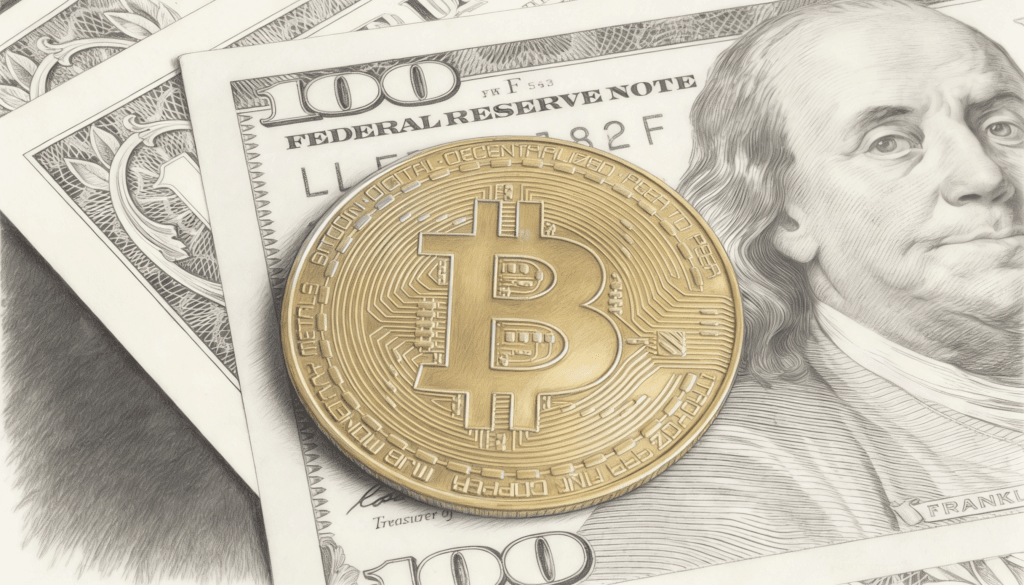
Your brain is a liar. Not in the malicious sense, but in the way it processes value. Hand someone a crisp hundred dollar bill and watch their eyes light up. Show them $100 worth of Bitcoin on a screen and you’ll get a very different reaction. Same value, wildly different emotional response.
This isn’t about intelligence or financial literacy. It’s about how millions of years of evolution wired our brains to understand the world through physical objects we can touch, see, and stash under our mattresses. Bitcoin arrived about 14 years ago. Evolution takes a bit longer to catch up.
The Tangible Delusion
Physical money carries what psychologists call tangibility bias. When you hold cash, your brain activates the same circuits it uses for any physical possession. The weight, the texture, even the smell of fresh bills all send signals to your brain that scream “this is real, this is mine, this has value.”
Bitcoin has no weight. It has no texture. You cannot smell it unless your overheating mining rig is on fire, and at that point you have bigger problems.
This creates a fascinating split in perception. The hundred dollar bill feels like wealth because it engages multiple senses. Bitcoin feels like a number in a database because, well, it is a number in a database. Your rational mind knows they’re both just abstractions of value. Your emotional brain doesn’t care what your rational mind thinks.
The irony runs deeper. That dollar bill is arguably more abstract than Bitcoin. It’s a piece of paper whose value depends entirely on collective agreement and government backing. Bitcoin, for all its digital etherealness, at least has a hard supply cap and cryptographic proof of ownership. Yet the paper feels more real.
The Pain of Paying Problem
Here’s where things get interesting. Studies on payment methods show that paying with cash hurts more than paying with a credit card. The physical act of handing over bills creates what researchers call the “pain of paying.” You see your wallet getting thinner. You feel the loss.
Bitcoin inverts this completely. Spending Bitcoin often feels less real than even credit cards. You’re moving numbers from one address to another. There’s no wallet getting lighter, no physical exchange, no immediate feedback that you just lost something.
This should make Bitcoin the ultimate spending tool. The less pain you feel, the more freely you spend. But it doesn’t work that way in practice. Instead, many Bitcoin holders become digital dragons, hoarding their coins and refusing to spend them. Why?
Because absence of payment pain doesn’t automatically create spending desire. It creates a different kind of psychological relationship with money. When spending doesn’t hurt, but the money itself doesn’t feel quite real, you enter a strange limbo where neither saving nor spending feels particularly compelling.
The Storage Location Paradox
Ask someone where their money is and they’ll point to their wallet, their bank, their pocket. These are physical locations or institutions with buildings you can visit. Ask a Bitcoin holder where their coins are and watch them struggle.
They might say “on the blockchain” or “in my wallet,” but these are metaphors awkwardly grafted onto digital concepts. The blockchain isn’t a place. Your wallet is software. The private key that controls your Bitcoin could be in your head, written on paper, stored on a hardware device, or scattered across multiple locations using advanced cryptography.
This spatial ambiguity matters more than you might think. Our brains evolved to track resources in physical space. Where is the food stored? Where did I hide the valuable shells? Location and value became deeply intertwined in our psychology.
Bitcoin has no location in the traditional sense. This creates cognitive dissonance. Your brain keeps trying to put it somewhere, to give it a place in the physical world. When it can’t, the value feels slippery, less concrete, easier to dismiss as “not real money.”
The counterintuitive twist is that this apparent weakness is actually Bitcoin’s superpower. Money that exists nowhere can be accessed from anywhere. But try explaining that to the part of your brain that still thinks in terms of mammoth hunting territories.
Mental Accounting Theater
Behavioral economists discovered that people treat money differently depending on where it comes from and where it goes. This is called mental accounting. We create mental buckets for different types of money and treat each bucket according to different rules.
Tax refund money feels like “free money” even though it’s your own money that the government borrowed interest free. Gambling winnings get spent more freely than salary. Birthday cash goes into a different mental account than the paycheck you worked for.
Bitcoin creates an entirely new category of mental account, one without precedent in most people’s experience. Is it savings? Is it an investment? Is it spending money? Is it more like gold or more like dollars?
Most Bitcoin holders put it in the “investment” bucket, which is why they rarely spend it. But this creates a strange situation. If Bitcoin is supposed to be the future of money, treating it purely as an investment defeats the purpose. It’s like buying a car and never driving it because you’re hoping it becomes a collector’s item.
The hundred dollar bill doesn’t have this problem. Everyone agrees on what bucket it belongs in. It’s spending money. Sure, you can save it, but nobody thinks of cash in their wallet as an investment vehicle.
The Visibility Trap
Money in your bank account is invisible, but at least it’s invisible in a familiar way. You check an app, you see a number, you understand it represents dollars in a vault somewhere, even though you know the bank doesn’t actually have all that cash sitting around.
Bitcoin is invisible in a more profound way. The number you see doesn’t represent coins in a vault. It represents cryptographic proof that you control certain entries on a distributed ledger that exists simultaneously everywhere and nowhere.
This deeper level of abstraction creates what we might call the visibility trap. The more visible something is, the more real it feels. The less visible, the less real. Bitcoin is maximally invisible. Not only can you not see it, but understanding what “it” even is requires grappling with concepts most people find bewildering.
Physical cash wins the visibility contest by default. It’s right there. You can literally count it. Your brain doesn’t need to understand monetary theory or cryptography. It just needs to recognize that the green paper is valuable because everyone else recognizes it too.
Time Horizon Distortion
Hand someone a hundred dollar bill and ask them how long they’ll hold onto it. Most people will spend it within days or weeks. It’s cash. Cash is for spending.
Give someone $100 worth of Bitcoin and ask the same question. Suddenly you’re getting answers like “I’m holding for at least five years” or “I’ll sell when it hits $100,000.” Same value, completely different time horizon.
This happens because the medium changes the message. Physical cash feels ephemeral. It wears out, it can be stolen easily, it doesn’t earn interest sitting in your wallet. The natural thing to do with cash is spend it before it loses value or goes missing.
Bitcoin feels permanent in a way cash never could. It’s secured by cryptography. It can’t wear out. It might appreciate. The rational move, your brain tells you, is to hold it. Never mind that this makes it useless as currency.
The really fascinating part is that both instincts are wrong. Cash loses value to inflation, so hoarding it is foolish. But Bitcoin’s volatility means holding it indefinitely is gambling, not saving. Yet our brains push us toward spending cash and hoarding Bitcoin, regardless of what financial logic might suggest.
The Conversion Tax
Every time you think about spending Bitcoin, your brain performs an automatic calculation. It converts the Bitcoin price into dollars, then evaluates whether the purchase is worth it in dollar terms. This conversion creates psychological friction.
With cash, there’s no conversion. A hundred dollar bill is worth a hundred dollars. Simple. Clean. No mental math required.
But with Bitcoin, you’re always doing math. If Bitcoin is worth $40,000 and you’re spending 0.0025 Bitcoin on something, you need to calculate that this equals $100. Then you need to decide if the purchase is worth it. Then, if you’re like most Bitcoin holders, you need to consider what that Bitcoin might be worth in the future.
This is what economists call a “cognitive tax.” Every transaction requires extra mental effort. Given that humans are fundamentally lazy creatures who avoid unnecessary cognitive work, this tax alone is enough to make Bitcoin feel like “different” money.
The irony is that we perform similar conversions all the time when traveling abroad. Yet foreign currency still feels like spending real money because you’re exchanging it for physical bills and coins. The physical transformation makes the conversion feel legitimate. Bitcoin conversions happen purely in the abstract, which makes them feel more like accounting than spending.
Trust Architecture
When you accept a hundred dollar bill, you’re trusting the United States government, the Federal Reserve, the banking system, and the complex web of institutions that give the dollar value. But here’s the thing: you don’t think about any of that. The trust is invisible, baked into the cultural background.
When you hold Bitcoin, the trust architecture is completely different and much more visible. You’re trusting mathematics, cryptography, the Bitcoin protocol, the developers who maintain it, the miners who secure it, and your own ability to secure your private keys. Unlike with dollars, you’re forced to think about this trust structure constantly.
This creates a peculiar psychological burden. The dollar’s trust system is so normalized that it’s invisible. Bitcoin’s trust system is so new and technical that it demands constant attention and evaluation. Even if Bitcoin’s trust model is theoretically superior, the mere fact that you have to think about it makes it feel less trustworthy.
Your brain interprets invisible trust as reliable trust. It’s been working in the background your whole life without problems, so why worry? Visible trust, trust that requires active maintenance and understanding, feels fragile even when it isn’t.
The Identity Component
Money is never just money. It’s a statement about who you are and what you value. The way you handle money communicates things to yourself and others.
Carrying cash suggests you’re practical, grounded, maybe a bit old school. It’s neutral, expected, unremarkable. Nobody builds their identity around using dollars.
Holding Bitcoin is different. It says you’re tech savvy, future oriented, willing to take risks. It aligns you with a particular worldview about money, government, and the future of finance. For better or worse, Bitcoin has become identity in a way that regular currency never was.
This identity component changes the psychological equation. You might spend a hundred dollar bill without thinking twice. But spending Bitcoin feels like a statement. Are you losing faith? Are you a true believer or just a speculator?
The paradox is that money works best when it’s boring. The most effective currency is the one you never think about. Bitcoin demands that you think about it constantly, which makes it psychologically exhausting to use as actual money. Dollars feel abundant. There are trillions of them. The government can print more whenever it wants. This abundance makes them feel less precious, more disposable. Spending a hundred dollar bill doesn’t feel like depleting a finite resource.
Bitcoin is capped at 21 million coins. Everyone who holds it knows this. Spending any amount of Bitcoin feels like giving away a piece of something finite and irreplaceable.
This is scarcity theater at its finest. Yes, Bitcoin is scarce. But so is your personal supply of dollars. You have a finite amount of money regardless of the form it takes. Yet scarce money feels more valuable to hold and harder to spend than abundant money.
The Divisibility Puzzle
A hundred dollar bill is already divided. It’s one hundred units of one dollar. Simple. If you need to split it, you get change. The mental model is clean.
Bitcoin is divisible down to one hundred millionth of a coin. These tiny units are called satoshis. Technically, this makes Bitcoin more divisible than dollars. But our brains weren’t built to think in hundred millionths of anything.
This extreme divisibility creates confusion rather than clarity. When prices are listed in fractions of fractions of Bitcoin, your brain has to work harder to evaluate whether something is expensive or cheap. Is 0.0015 Bitcoin a lot or a little? You need to do math to figure it out.
Compare this to looking at a price tag that says $100. Instant comprehension. No calculation required. Your brain has been trained since childhood to evaluate dollar amounts. It has no such training for Bitcoin denominations.
The cruel joke is that divisibility should make money more useful, not less. But when divisibility outpaces human cognitive comfort, it becomes a feature that makes the money feel alien rather than accessible.
Why This Matters
Understanding why your brain treats these two forms of value differently isn’t just an academic exercise. It explains why Bitcoin hasn’t achieved widespread use as currency despite being technically superior in many ways. It illuminates why financial innovation doesn’t automatically translate to adoption. And it reveals deep truths about how our psychology shapes our economic behavior.
The hundred dollar bill isn’t better money in any objective sense. It’s just better adapted to the hardware running in your skull. That hardware evolved to deal with physical objects, face to face exchanges, and resources you can guard with your body. Bitcoin asks your brain to operate in ways it never evolved to handle.
This doesn’t mean Bitcoin will fail or that digital currency is doomed. It means that changing how billions of brains think about money takes time. New generations growing up with digital everything might find Bitcoin as natural as millennials found email. But for now, we’re stuck with brains that treat identical values as completely different currencies based entirely on their form.
Every financial innovation faces this same challenge. How do you get brains built for bartering shells and livestock to embrace abstract digital representations of value? The answer isn’t better technology. It’s patience, time, and the slow rewiring that comes from repeated exposure.
Your brain treats a hundred dollar bill and $100 of Bitcoin differently because it’s doing exactly what evolution designed it to do: prioritize the tangible over the abstract, the familiar over the novel, the visible over the invisible. That’s not a bug. That’s a feature. The question is whether we can update the software while the hardware stays the same.
For now, those two identical values will continue living in different psychological universes. Same money, different reality. Welcome to the weird world where your brain makes the rules and value is whatever your neurons say it is.