Why the Simplest Line on a Chart Might Be the Most Truthful Thing in Finance
Table of Contents
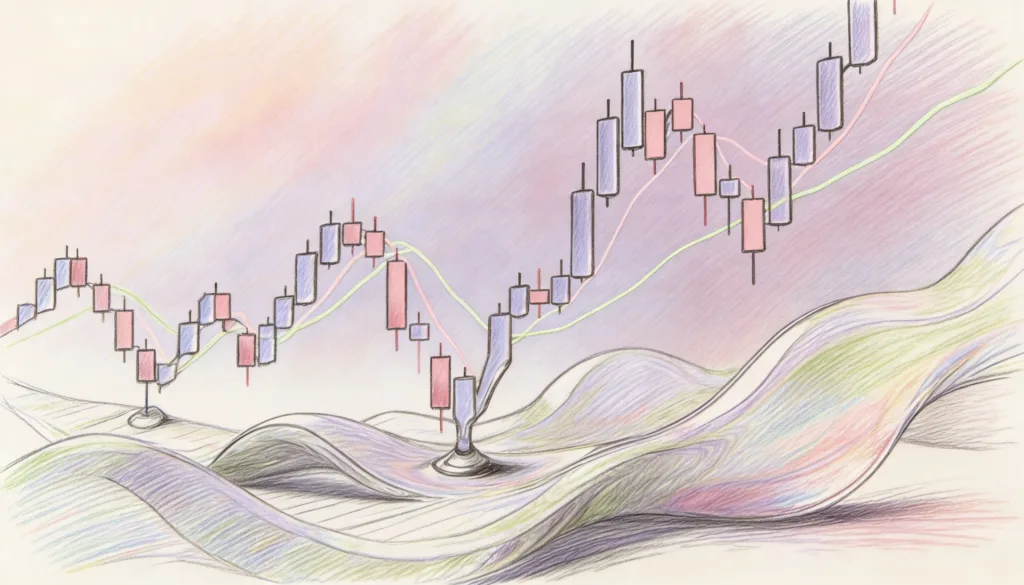
There is a line on almost every stock chart that nobody wants to talk about when things are going well. It sits there quietly, moving with the patience of geological time while prices dart around it like nervous birds. It does not care about your thesis. It does not care about your conviction. It is the 200 day moving average, and it has a habit of telling the truth at the exact moment you least want to hear it.
The concept is almost embarrassingly simple. You take the closing price of an asset for the last 200 trading days, add them up, and divide by 200. That is it. No proprietary algorithm. No machine learning. No PhD required. And yet this single line, born from elementary school arithmetic, has an uncanny ability to separate what is actually happening from what people wish were happening.
In a world that rewards complexity and charges premium fees for it, the 200 day moving average is almost offensive in its simplicity. It is the financial equivalent of your grandmother telling you to eat your vegetables. You already know. You just do not want to listen.
The Gravity Nobody Escapes
Mean reversion is one of those ideas that sounds obvious until you try to act on it. The basic premise is that prices, like most things in nature, tend to return to some average over time. They overshoot. They undershoot. But eventually, the rubber band snaps back. The 200 day moving average serves as a reasonable proxy for this gravitational center.
Think of it like body temperature. Your temperature fluctuates throughout the day. After exercise, it spikes. In deep sleep, it drops. But it always gravitates back toward roughly the same number. If it stays elevated for too long, something is wrong. If it stays depressed, something is also wrong. The deviation itself is information.
Markets work the same way, though the analogy breaks down in one important respect. A human body has built in mechanisms that force temperature back to normal. Markets have no such mechanism. What they have instead is something more interesting and more dangerous. They have human psychology. And human psychology, as it turns out, is the most reliable mean reverting force in the known universe.
When a stock sits far above its 200 day moving average, it means that the recent price action has dramatically outpaced the longer term trend. People are excited. They are extrapolating. They are telling stories about paradigm shifts and new eras. The further the price stretches from that average, the more energy it has borrowed from the future. And borrowed energy, like borrowed money, eventually comes due.
The Emotional Thermometer
Here is where things get interesting from a psychological standpoint. The 200 day moving average does not actually predict anything. It is a lagging indicator by definition. It tells you where the average has been, not where it is going. And yet it works. The reason it works has less to do with math and more to do with the human condition.
The distance between price and the 200 day average is, in a very real sense, a measure of collective emotion. When the gap widens to the upside, you are looking at a market that is running on enthusiasm. When it widens to the downside, you are looking at a market running on fear. Neither state is sustainable, not because of any mathematical law, but because humans cannot maintain extreme emotional states indefinitely. We get tired. We get bored. We start second guessing ourselves.
This is the counterintuitive part. The indicator works not because of what it measures about the market, but because of what it reveals about the people in the market. It is a mirror dressed up as a chart tool. The line itself is meaningless. What matters is how far away from it people have collectively wandered, and what that distance tells you about their state of mind.
There is a well documented phenomenon in behavioral psychology called the hedonic treadmill. It describes how humans quickly adapt to both positive and negative changes in circumstances, always returning to a baseline level of satisfaction. Lottery winners are not permanently happier. Accident victims are not permanently miserable. The system recalibrates. Markets, being nothing more than large groups of humans making decisions under uncertainty, follow the same pattern. The 200 day moving average is simply the hedonic treadmill made visible.
Why Smart People Ignore It
One of the more fascinating dynamics around the 200 day moving average is how consistently sophisticated investors dismiss it. Fundamental analysts view it with suspicion because it says nothing about earnings, cash flows, or competitive advantages. Quantitative traders consider it too crude for their models. Value investors see it as technical analysis, which in their circles is roughly equivalent to astrology.
And they all have a point. The 200 day moving average tells you nothing about whether a company is well run. It tells you nothing about interest rates, trade policy, or sector rotation. It is agnostic about every single thing that professional analysts spend their careers studying.
But this is precisely what makes it useful. Because it ignores all of those things, it captures something those things cannot. It captures the net effect of every opinion, every model, every thesis, every fear, and every hope, distilled into a single number that moves with the deliberation of a glacier. It is the scoreboard, not the play by play. And sometimes, when you are drowning in analysis, looking at the scoreboard is exactly what you need.
There is an old saying that when you hear hoofbeats, think horses, not zebras. The 200 day moving average is the horse. It is the boring, obvious, unsexy answer that happens to be right more often than anyone would like to admit. The zebra hunters, armed with their sophisticated models and proprietary data, often end up circling back to the same conclusion the moving average suggested weeks earlier.
The Cruelty of Simplicity
There is something almost cruel about the 200 day moving average. It does not negotiate. A stock price that has fallen below it and stayed there is not in a dip. It is not consolidating. It is not building a base. It is in a downtrend. The moving average does not care that you bought at a higher price, that you have a stop loss you do not want to trigger, or that the company just posted record revenue. It only knows the average, and the average says the trend has changed.
This is where the concept of mean reversion acquires a certain philosophical weight. There is a long tradition in human thought, from Stoic philosophy to Buddhist teaching to modern cognitive behavioral therapy, that revolves around the same essential insight. Your perception of reality and reality itself are two different things. The gap between them is where suffering lives.
In investing, the 200 day moving average is one of the few tools that relentlessly closes that gap. It will not let you pretend things are better than they are. It will not let you pretend things are worse than they are. It just sits there, averaging, indifferent to narrative, impervious to spin.
Viktor Frankl, the psychiatrist who survived the Holocaust, wrote about the human tendency to create meaning even in meaningless situations. Investors do this constantly. They construct elaborate stories to explain why a stock trading thirty percent below its moving average is actually a buying opportunity, or why a stock trading forty percent above it still has room to run. The stories are sometimes right. But the moving average, that stubborn line, is a constant reminder that stories are not data.
The Problem with Being Right
If mean reversion is so reliable, and the 200 day moving average is so informative, then why does anyone ever lose money? The answer is elegantly simple. Knowing a principle and acting on it are not the same thing.
Consider a parallel from fitness. Everyone knows that consistent exercise and reasonable eating habits will, over time, produce a healthy body. The information is free. It is not complicated. It requires no special equipment. And yet the global fitness industry generates hundreds of billions of dollars annually selling the same basic truth in increasingly elaborate packaging. The problem was never information. The problem is execution. The problem is that doing the simple thing consistently is one of the hardest challenges a human being can face.
In investing, the 200 day moving average presents the same challenge. It might tell you clearly that a stock is overextended, that mean reversion is coming, that the rubber band is about to snap. And you will sit there, watching it stretch further, watching other people make money on the extension, and you will start to doubt the line. You will start to doubt the math. You will start constructing reasons why this time is different.
Every market cycle produces a chorus of voices explaining why the old rules no longer apply. The 200 day moving average has heard every version of this argument. It heard it during the dot com bubble. It heard it during the housing mania. It heard it during the crypto boom. And every time, with the patience of a parent waiting out a toddler’s tantrum, it proved its point again.
Lessons From Other Disciplines
What makes mean reversion particularly compelling as a concept is that it is not unique to finance. It is a universal pattern that shows up wherever complex systems interact with time.
In baseball, a player who hits far above his career average early in the season will, more often than not, regress toward that average as the sample size grows. Scouts call this regression to the mean. It does not mean the player is getting worse. It means the early data was not representative of the underlying ability. The 200 day moving average operates on the same principle, smoothing out the noise to reveal the signal underneath.
In medicine, the phenomenon known as regression to the mean explains why so many quack treatments appear to work. If you take an herbal supplement when you are feeling your worst, you will probably feel better the next day. Not because of the supplement, but because you were already at an extreme and the natural trajectory was back toward normal. The supplement just happened to be there when the inevitable correction occurred.
This is an underappreciated lesson for investors. Much of what passes for financial genius is simply being positioned correctly when mean reversion does its thing. The hedge fund manager who bought at the bottom was not necessarily smarter than everyone else. He may have just been in the right place when the rubber band snapped back. The 200 day moving average, in its brutal honesty, makes no distinction between skill and luck. It only tracks the outcome.
The Line That Teaches Patience
Perhaps the greatest gift of the 200 day moving average is not what it reveals about markets but what it demands of you. It moves slowly. It will not give you quick answers. It requires you to zoom out, to resist the pull of daily volatility, to accept that the most meaningful trends are visible only from a distance.
In an age of instant information, real time data, and algorithmic trading measured in microseconds, there is something almost rebellious about watching a line that takes 200 days to update itself. It is a protest against the cult of speed. It insists that some truths take time to become apparent and that rushing to conclusions is more dangerous than waiting for clarity.
The philosopher Blaise Pascal once observed that all of humanity’s problems stem from our inability to sit quietly in a room. The 200 day moving average is the financial version of this insight. It asks you to sit quietly. To watch. To wait. To let the average do its work, knowing that the truth it reveals is worth the patience it requires.
The markets will always generate noise. There will always be a crisis, a breakthrough, a paradigm shift, a reason to panic or to celebrate. The 200 day moving average will acknowledge none of it until the signal is strong enough to matter. And by the time the average turns, you will know it is real. Not because someone on television told you so. Not because a model predicted it. But because 200 days of accumulated evidence have bent the line in a direction that cannot be argued with.
The Uncomfortable Truth
The lesson of the 200 day moving average is one that most investors would rather not hear. You are not special. Your stock is not special. Your thesis is not special. Everything, given enough time, reverts to the mean. The brilliant trade reverts. The catastrophic loss reverts. The market that seems invincible reverts. The market that seems doomed reverts.
This is not nihilism. It is actually the opposite. It is a kind of mathematical humility. If you accept that extremes are temporary, that the average always reasserts itself, then you are free from the two most destructive forces in investing. You are free from the greed that says this will go up forever and from the fear that says it will go to zero. Both are stories. The average is just the average.
There is a reason the 200 day moving average has survived decades of financial innovation, through the rise of computers, algorithms, derivatives, and artificial intelligence. It endures because it is true in the way that gravity is true. You do not have to believe in it. You do not have to understand why it works. But if you ignore it, you will eventually feel its pull. And by then, the correction will already be underway.
The most honest thing in finance has no opinion. It has no agenda. It just averages the last 200 days and draws a line. What you do with that line is up to you. But whatever you do, do not pretend it is not there.