Table of Contents
Every generation of investors falls in love with a new metric. In the 1990s it was earnings per share. In the 2000s it was EBITDA. In the 2010s it was revenue growth. Each one had its moment in the spotlight, and each one eventually revealed itself to be an unreliable narrator. Not because the numbers were wrong, but because they were incomplete. They told you what a company earned or grew, but they never told you the thing that actually matters: whether the business is any good at turning money into more money.
That is where return on invested capital enters the picture. ROIC is not glamorous. It does not trend on social media. Nobody at a dinner party has ever leaned in and whispered, “You have to look at the return on invested capital for this stock.” But ROIC has a quality that most financial metrics lack entirely. It is very difficult to fake.
The Metric That Cannot Hold a Poker Face
Most financial metrics are, at their core, performances. Earnings per share can be inflated through buybacks. Revenue can be juiced through aggressive accounting or channel stuffing. EBITDA strips out so many real costs that Charlie Munger once called it “bullshit earnings.” These metrics are not useless, but they are easy to dress up. They are the financial equivalent of a first date where everyone is on their best behavior.
ROIC is the second date. It is the one where the mask slips.
Here is why. Return on invested capital measures how much profit a company generates for every dollar of capital it has put to work. That is it. The formula itself is straightforward: you take a company’s net operating profit after taxes and divide it by the total capital invested in the business. What makes ROIC powerful is not the math. It is what the math reveals.
When you look at ROIC, you are essentially asking one question. Did this company take the resources it was given and create something more valuable than what existed before? This is not a question about size. It is not a question about momentum. It is a question about quality. And quality, unlike growth, is almost impossible to manufacture out of thin air.
A company can grow revenue by 30% and still be destroying value if the capital required to produce that growth exceeds the returns it generates. This is one of the great counterintuitive truths of investing that most people never absorb: growth can be the enemy of value. A business that grows rapidly while earning returns below its cost of capital is essentially a machine that converts investor money into economic waste. It just does it with impressive looking top line numbers, which is why so many people miss it.
The Difference Between Motion and Progress
There is a concept in physics called displacement. It is different from distance. With distance, you can walk ten miles in a circle and your displacement is zero. You moved a lot, but you went nowhere. Many companies operate exactly this way. They are in constant motion. They acquire. They expand. They launch new products. They hold investor days with ambitious slide decks. And at the end of a decade, the value per share has gone nowhere because the capital deployed into all that activity never earned a return worth the effort.
ROIC is displacement, not distance. It tells you whether all that motion actually took the business somewhere meaningful. A company with a high and stable ROIC is one that has found something genuinely scarce in capitalism: an activity where it can deploy money and get back considerably more than it put in, over and over again.
This is rarer than most people think. Competition in free markets is relentless. If a business earns outsized returns, competitors notice. They copy. They undercut. They innovate around the advantage. The natural state of returns in a competitive economy is mediocrity. Earning a high ROIC is hard. Sustaining one is borderline remarkable. And that is precisely why it matters so much as a signal.
What ROIC Tells You About Moats
Warren Buffett popularized the idea of economic moats, but he rarely talks about how to measure them. ROIC is one of the best tools for the job. A durable competitive advantage should, by definition, allow a business to earn returns on capital that exceed the cost of that capital for extended periods. If the moat is real, it shows up in the numbers. If the moat is imaginary, ROIC will expose that too.
Consider two companies in the same industry. Both are growing at similar rates. Both have similar margins. But one has an ROIC of 25% and the other sits at 8%. The difference is not cosmetic. It is structural. The first company has pricing power, or scale advantages, or switching costs, or some combination of forces that allow it to extract more value from each dollar it invests. The second company is running on a treadmill. It is working just as hard but getting far less for the effort.
This distinction matters enormously over time. A business that compounds capital at 25% and reinvests a significant portion of its earnings will create staggering amounts of wealth over a decade. A business that compounds at 8% while needing to reinvest just as aggressively will create far less. The gap between these two outcomes is not linear. It is exponential. And the only way to see it coming is to look at where the capital goes and what it produces when it gets there.
The Reinvestment Equation Nobody Talks About
Here is where ROIC becomes truly interesting, and where most analysis stops too early. A high ROIC by itself is useful information, but it is only half the story. The other half is reinvestment rate: how much capital can the company deploy at those attractive returns?
Think of it this way. A lemonade stand might have an incredible ROIC. The ingredients are cheap, the margins are high, and the invested capital is minimal. But you cannot reinvest millions of dollars into a lemonade stand. The opportunity is real but small. Now contrast that with a company that earns a 20% ROIC and can reinvest billions of dollars at that rate because the addressable market is enormous. The compounding potential of the second business is in a completely different universe.
The true gems of investing sit at the intersection of high ROIC and large reinvestment runways. These are the businesses that can take their superior economics and scale them. They can grow without diluting the quality of their returns. This combination is so powerful that it essentially automates wealth creation. The company earns great returns, reinvests the proceeds, earns great returns on those proceeds, and the cycle continues.
This is also why some beloved companies with high returns on capital turn out to be mediocre investments. If a business earns a 30% ROIC but has nowhere to reinvest at those rates, the excess cash flows back to shareholders as dividends or buybacks. That is fine, not terrible, but the compounding engine stalls. The stock might perform reasonably well, but it will not deliver the kind of returns that make careers.
Why the Market Misprices This Repeatedly
You would think that a metric this fundamental would be priced into every stock at all times. It is not. And the reason comes down to human psychology more than financial ignorance.
Investors are drawn to narratives. A company with a thrilling story about disrupting an industry will attract capital even if its ROIC is atrocious. A boring company in an unglamorous sector with a 30% ROIC will be overlooked because nobody wants to talk about it at a cocktail party. The market is, in the short term, a popularity contest. And ROIC is not popular. It is just correct.
There is a parallel here with how people choose restaurants. The place with the long line and the Instagram presence is not necessarily the one with the best food. Sometimes the best meal in the city is at a quiet spot with no wait, run by someone who has been perfecting the same dishes for twenty years. ROIC investing is a lot like finding those restaurants. You are ignoring the hype and paying attention to what actually ends up on the plate.
The market also has a persistent habit of overpaying for growth and underpaying for quality. A company growing revenue at 40% with a low ROIC will often trade at a higher multiple than a company growing at 15% with a spectacular ROIC. This makes no mathematical sense if you extend the analysis beyond a year or two, but markets are not always interested in what makes mathematical sense. They are interested in what makes a good story right now.
This creates opportunity for anyone willing to do the work.
The Dark Side: When ROIC Misleads
No metric is perfect, and ROIC has its blind spots. It is important to understand them because blind faith in any single number is the fastest way to lose money in finance.
First, ROIC is backward looking. It tells you what returns the business earned on capital that was already deployed. It says nothing definitive about what future returns will look like. A company with a declining competitive position can have a beautiful trailing ROIC that is about to collapse. Blockbuster had great returns on invested capital right up until it did not.
Second, ROIC can be artificially inflated by underinvestment. If a company stops spending on maintenance, research, or growth, the denominator shrinks and the ratio improves. This is the financial equivalent of making your car more fuel efficient by never changing the oil. The numbers look good for a while, and then the engine seizes.
Third, accounting conventions can distort the calculation. Companies that grow through acquisitions carry goodwill on their balance sheets, which inflates invested capital and depresses ROIC. Companies that grow organically do not face this issue. Comparing the two without adjusting for this difference is comparing apples to something that is not quite an apple.
The point is not that ROIC is flawed beyond usefulness. The point is that it requires context and judgment, like every tool worth using.
ROIC as a Worldview
There is something deeper going on with ROIC that goes beyond stock picking. It represents a way of thinking about resource allocation that applies far beyond finance.
Every decision in business, and arguably in life, is a capital allocation decision. You have limited resources. Time, money, energy, attention. The question is always the same. Where do you deploy them to get the best return? Organizations that think this way tend to make better decisions over time. They do not chase activity for its own sake. They do not confuse motion with progress. They ask, relentlessly, whether the resources being committed are generating results that justify the commitment.
The companies that consistently earn high returns on invested capital tend to share certain cultural traits. They are disciplined about which projects get funded. They are willing to say no to growth that does not meet a return threshold. They think in terms of decades, not quarters. This is not a coincidence. High ROIC is not just a financial outcome. It is a reflection of organizational intelligence.
Jeff Bezos understood this intuitively. For years, Amazon was criticized for not generating profits, but Bezos was playing a different game. He was reinvesting every available dollar into initiatives with enormous long term ROIC potential. The profits were not absent. They were deferred. And when the returns on those investments materialized, the compounding effect was extraordinary. He was thinking about ROIC before the business generated much of one, which is either visionary or lucky. Probably both.
The Bottom Line
ROIC will never be the most exciting thing in finance. It will never be the subject of a viral tweet or a breathless CNBC segment. It does not lend itself to dramatic predictions or bold calls. It is quiet. It is patient. It is annoyingly rational.
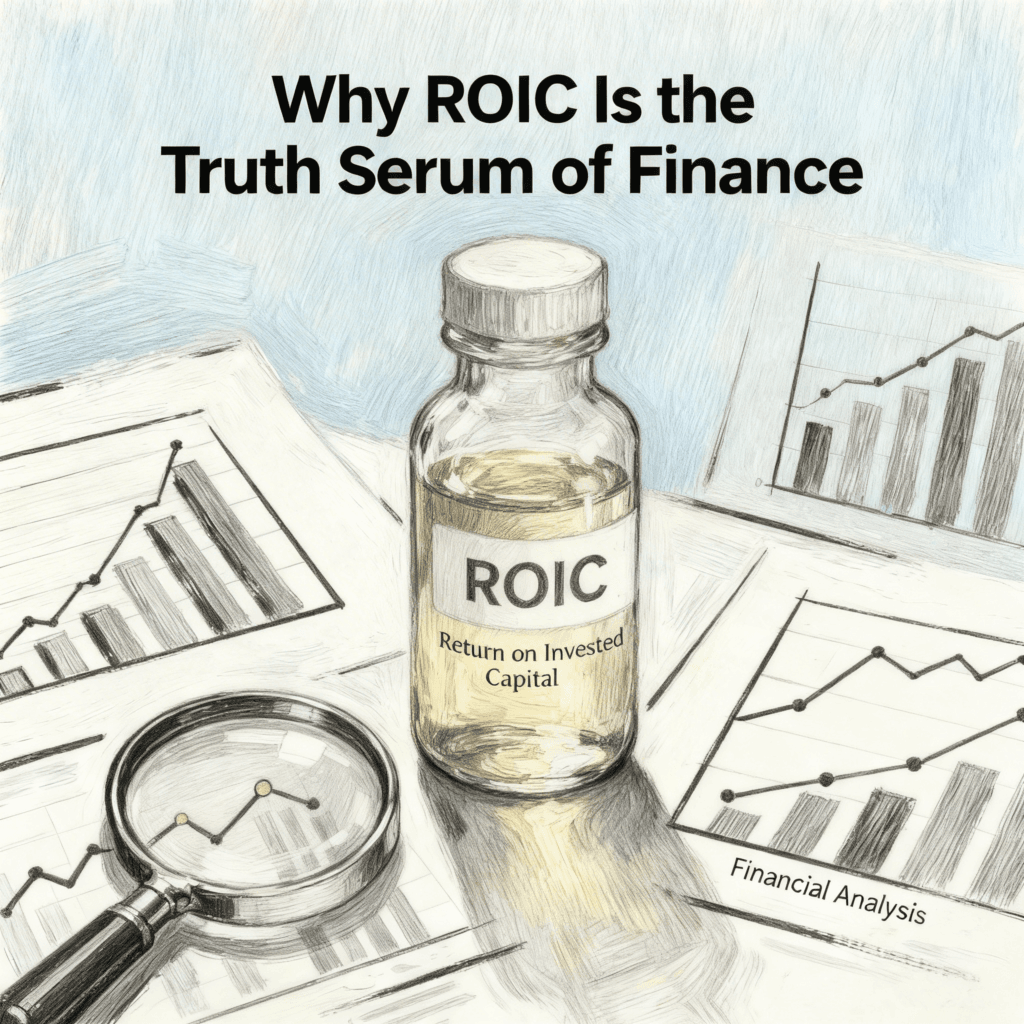
But it is the closest thing investing has to a truth serum. It cuts through the noise of earnings manipulation, revenue growth theater, and narrative driven valuations. It asks a simple, almost rude question: is this business actually good at what it does with the money it has been given?
The answer to that question, tracked over time, will tell you more about a company’s future than almost any other piece of information you can find. Not because ROIC is magic. But because capital efficiency is the foundation on which everything else in business is built. Growth without it is a mirage. Margins without it are fragile. Size without it is just expensive mediocrity at scale.
In a financial world addicted to complexity, ROIC is refreshingly simple. And in a world full of metrics that can be gamed, it is refreshingly honest. That combination, simplicity and honesty, might explain why so few people talk about it. In finance, as in life, the truth is rarely the most popular thing in the room. But it is usually the most valuable.