Table of Contents
There is a strange ritual that plays out every time a stock collapses after a short seller publishes a report. The company screams manipulation. Retail investors cry foul. Politicians call for investigations. Cable news anchors furrow their brows and ask whether short selling should be banned altogether.
And then, quietly, months later, the SEC opens a fraud case against the very company that was screaming the loudest.
Nobody apologizes to the short seller. Nobody ever does.
Short selling might be the most misunderstood activity in all of finance. It is also, arguably, one of the most socially valuable. That is not a popular opinion. It is not supposed to be. But the unpopularity is itself part of the story, because it reveals something uncomfortable about how markets actually work and who we prefer to listen to.
The Mechanic Nobody Wants to Thank
To understand why short sellers matter, you first have to understand what a market is supposed to do. In theory, a stock price is a collective guess about the future value of a company. Buyers push the price up when they think the company is worth more. Sellers push it down when they think it is worth less. The price, at any given moment, is supposed to reflect something close to the truth.
But here is the problem. The system is structurally biased toward optimism.
Think about who participates in the conversation around any given stock. The company itself has every incentive to paint a rosy picture. Its executives are compensated in stock options. Its investor relations team exists to make the story sound good. Wall Street analysts, despite their reputation for independence, overwhelmingly issue “buy” ratings because their banks want to win underwriting business from those same companies. Fund managers who own the stock talk it up on television. Even financial media tends to frame rising prices as good news and falling prices as bad news, regardless of whether either move is justified.
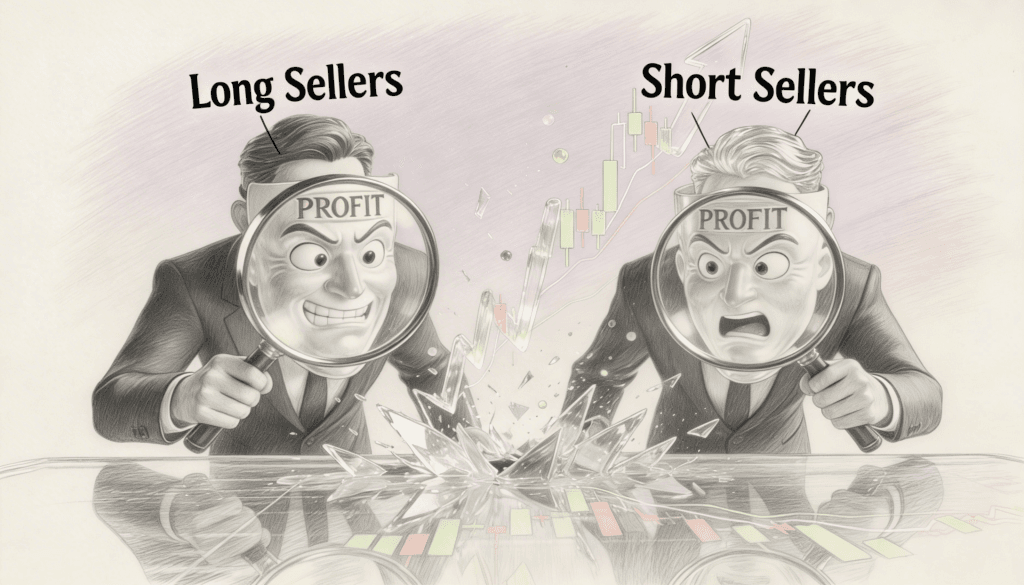
Into this ecosystem of cheerfulness walks the short seller, the only market participant with a direct financial incentive to ask: “Is any of this actually true?”
That is not villainy. That is an auditor who pays for the privilege of doing the audit.
The Asymmetry Nobody Talks About
There is a deep asymmetry in how we treat optimists and pessimists in financial markets, and it has nothing to do with evidence.
When a hedge fund manager goes on television and says a stock is going to triple, nobody asks whether he already owns shares. Nobody calls it manipulation. Nobody demands that regulators investigate whether his bullish thesis is distorting the market. He is simply “sharing his conviction.” Audiences nod along. The stock ticks up. Everyone feels good.
When a short seller publishes a detailed report alleging that a company is fabricating its revenue, the response is immediate hostility. The company issues a press release calling the report an “attack.” Message boards fill with accusations of conspiracy. Sometimes the short seller receives death threats.
The asymmetry is remarkable when you step back and look at it. A person who says “this stock is great, buy it” is treated as a friend. A person who says “this stock is a fraud, here is my evidence” is treated as an enemy. And the treatment has almost nothing to do with who is right.
This is not a quirk of Wall Street culture. It is a feature of human psychology. Daniel Kahneman and Amos Tversky demonstrated decades ago that people experience losses roughly twice as intensely as equivalent gains. When a short seller’s report causes a stock to drop, every shareholder feels that pain immediately. The short seller becomes the face of the loss, even if the real cause was the company lying about its numbers. Killing the messenger is not just a metaphor in financial markets. It is standard operating procedure.
A Brief History of Being Right and Getting Punished
The track record of prominent short sellers reads like a list of people who were correct about important things and suffered for it.
Jim Chanos identified Enron’s accounting fraud well before the company collapsed. Enron was a Wall Street darling, beloved by analysts, celebrated in business magazines, and praised by politicians. Chanos was mocked, dismissed, and accused of running a smear campaign. He was right. Enron was a house of cards. Thousands of employees lost their retirement savings. But the narrative at the time was clear: Chanos was the villain, Enron was the victim.
Carson Block and Muddy Waters Research built a practice around exposing fraud in Chinese companies listed on American exchanges. The pattern repeated each time. Block would publish a report. The company would deny everything. Investors would rage. And then the evidence would prove Block right, sometimes spectacularly so.
More recently, Hindenburg Research published a report on the Adani Group that wiped billions of dollars in market value. The response from Adani’s supporters was fierce. Hindenburg was accused of being a tool of foreign interests, of destabilizing markets, of acting in bad faith. But the questions Hindenburg raised about corporate governance and related party transactions were detailed, specific, and documented.
In each case, the pattern is identical. The short seller speaks. The crowd attacks the short seller. Time vindicates the short seller. The crowd forgets and moves on to attacking the next one.
The Immune System Metaphor
If you want to understand the role of short sellers in financial markets, think about the immune system.
Your body is full of cells doing their work, growing, dividing, performing their functions. Most of the time, everything runs smoothly. But occasionally, something goes wrong. A cell begins to grow uncontrollably. It ignores the signals that are supposed to keep it in check. Left alone, it becomes a tumor.
The immune system exists to identify these rogue cells and eliminate them before they cause damage. It is not a popular system within the body. The rogue cells, if they could talk, would probably accuse the immune system of being overly aggressive, of attacking innovation, of stifling growth. But without it, the entire organism is at risk.
Short sellers function as the immune system of financial markets. They identify the rogue cells, the companies that are growing in ways that do not make sense, that are telling stories that do not add up, that are rewarding insiders while misleading everyone else. When short sellers do their job well, the damage is contained. When they are prevented from doing their job, the damage metastasizes.
This is not theoretical. Every major financial scandal in recent memory involved a period where short sellers were raising alarms and being ignored. Enron. Lehman Brothers. Wirecard. The pattern is so consistent it should be its own case study in business schools.
Why Banning Short Selling Always Backfires
Whenever markets tumble, politicians and regulators instinctively reach for the same solution: restrict or ban short selling. It happened during the 2008 financial crisis. It happened during the European debt crisis. It happens every time the public needs someone to blame and the short sellers are the most convenient target.
The evidence on what happens when you ban short selling is remarkably clear, and it is the opposite of what you would expect.
Removing the skeptics from the market did not make the market healthier. It made it sicker. Prices lost one of their few natural correction mechanisms and became less reliable as signals of actual value.
This makes intuitive sense if you think about it for more than a moment. If you silence every person in a room who disagrees, you do not create consensus. You create an echo chamber. And echo chambers in financial markets have a specific name: bubbles.
A market without short sellers is a market where overvaluation can grow unchecked until it becomes catastrophic. The correction, when it finally comes, is far more violent than it would have been if dissenting voices had been allowed to operate all along.
The Uncomfortable Truth About Who Gets Hurt
The strongest emotional argument against short selling is that it hurts ordinary investors. When a short report drives a stock down, real people lose real money. That pain is genuine and should not be dismissed.
But this argument contains a hidden assumption that falls apart on inspection. It assumes the stock price before the report was the “real” price and the price after the report is somehow artificial. In reality, if the short seller’s allegations are true, the pre-report price was the artificial one. It was inflated by misinformation, by hype, by the very fraud the short seller exposed.
The short seller did not destroy value. The company destroyed value by lying. The short seller simply forced the market to acknowledge what had already happened.
Consider who actually benefits when fraud goes unexposed. The insiders, the executives selling their inflated shares, the promoters collecting fees, the early investors cashing out before the truth emerges. These are the people who profit from silence. The ordinary investors who buy in late, trusting the inflated price, are the ones who eventually pay when the whole thing unravels.
Short sellers, paradoxically, protect ordinary investors by accelerating the moment of truth. A fraud that collapses after six months causes less damage than one that collapses after six years. Every day a fraudulent company continues to operate, more people buy in at artificial prices. The short seller, by forcing the reckoning sooner, limits the total number of victims.
The Journalism Parallel
There is a useful comparison to be made with investigative journalism. Journalists who expose corporate wrongdoing are generally celebrated. They win Pulitzer Prizes. Movies get made about them. We understand, at least in principle, that holding powerful institutions accountable is a public good even when the revelations are uncomfortable.
Short sellers do functionally the same thing. They investigate. They document. They publish. The only difference is that they put their own money behind their conclusions. A journalist who writes a negative story about a company risks a lawsuit. A short seller risks that, plus financial ruin if they are wrong. The skin in the game is not smaller. It is larger.
Yet we celebrate one and demonize the other. The distinction seems to come down to the fact that short sellers make money when they are right. Somehow, the profit motive taints the entire enterprise, even though every other participant in the market is also motivated by profit. The analyst who issues a buy rating is motivated by profit. The CEO who hypes the stock is motivated by profit. Only when profit aligns with skepticism does it suddenly become suspicious.
What Markets Look Like Without Skeptics
If you want to see what a market looks like when short selling is effectively impossible, look at the early stage cryptocurrency market of 2021. With no practical mechanism for betting against tokens, prices were determined almost entirely by enthusiasm. Projects with no revenue, no product, and sometimes no coherent business plan reached valuations in the billions. The correction, when it came, was devastating and indiscriminate. Legitimate projects and outright scams fell together because the market had no way to distinguish between them in real time.
Short sellers provide that distinction. They are the market’s fact checkers, operating in real time, with real consequences for being wrong. Remove them and you do not get a kinder, gentler market. You get a market that is better at lying to itself.
The Verdict Nobody Wants to Hear
Short sellers are not heroes. Many of them are aggressive, abrasive, and motivated primarily by profit. Some have undoubtedly crossed ethical lines. The profession, like any other, has its bad actors.
But the function they serve is irreplaceable. In a financial system structurally biased toward optimism, where companies, analysts, bankers, and media all have incentives to tell you things are going well, short sellers are the only participants with a structural incentive to tell you when things are going badly. They are the only ones who make money by being right about problems rather than by ignoring them.
A market that punishes its skeptics is a market that is asking to be lied to. And a market that is asking to be lied to will eventually get exactly what it deserves.
The short sellers tried to warn us. They always do. Maybe next time, instead of reaching for the pitchforks, we could try listening.