Table of Contents
There is a strange magic trick hiding in the tax code. It is not illegal. It is not even obscure. But most people walk right past it because it is dressed in the most boring costume imaginable: depreciation.
The word itself is enough to make your eyes glaze over. It sounds like something an accountant mumbles while adjusting their glasses. But behind that dull exterior is one of the most powerful wealth building mechanisms available to ordinary investors. It is the reason a landlord earning $150,000 a year can legally owe nothing in federal income tax while their neighbor, a salaried employee earning the same amount, hands over tens of thousands to the IRS every April.
This is not a glitch. It is a feature. And understanding it changes how you see money, taxes, and the entire game of building wealth.
The Basic Idea, Without the Boring Parts
Let’s start with what depreciation actually is, because most explanations make it harder than it needs to be.
The government recognizes that things wear out. Buildings age. Roofs leak. Appliances break down. So the tax code lets you deduct the cost of that wear and tear from your income, even if the property is actually going up in value. Read that again. You get to claim your building is losing value on paper while it appreciates in reality.
This is like telling your boss you are getting weaker every year while quietly bench pressing more and more weight in the gym.
For residential rental property, the IRS lets you spread the cost of the building (not the land, just the structure) over 27.5 years. So if you buy a rental property and the building portion is worth $275,000, you get to deduct $10,000 every single year from your rental income. That is $10,000 in income that simply vanishes from your tax return. No cash left your pocket. No check was written. The money is still yours. But the IRS pretends it does not exist.
Now multiply that across a few properties and something remarkable starts to happen.
Where the Math Gets Interesting
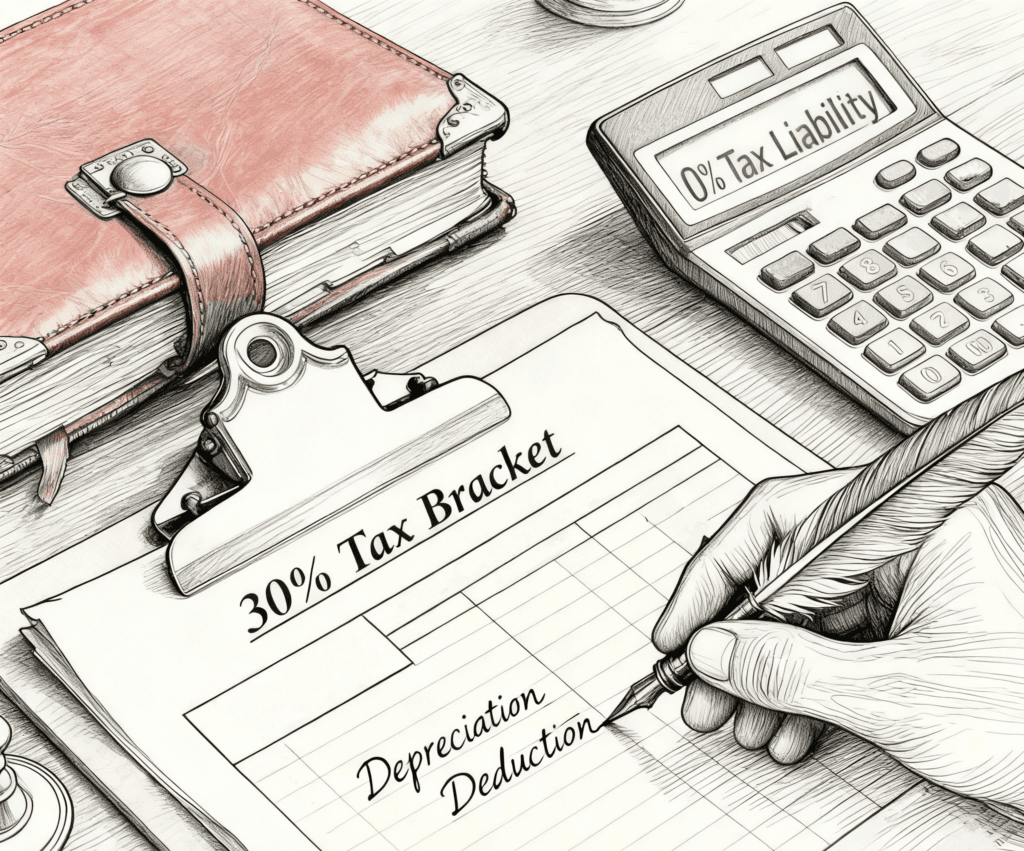
Say you are in the 30% tax bracket, earning a healthy income from your day job or your business. You buy a rental property that generates $20,000 a year in net rental income after expenses. Normally, that $20,000 would be taxed. You would owe roughly $6,000 on it.
But depreciation hands you a $10,000 deduction. Suddenly your taxable rental income is $10,000, not $20,000. Your tax bill on that rental income just got cut in half.
Now here is where it gets truly interesting. What if you own multiple properties? What if the combined depreciation deductions across your portfolio exceed your total rental income? Then your rental income is not just reduced. It is eliminated. On paper, you are breaking even or even showing a loss, while in reality cash is flowing into your bank account every month.
And for certain investors who qualify as real estate professionals under the tax code, those paper losses can spill over and offset other income too. Your W2 wages, your business income, all of it. This is how a person firmly planted in the 30% bracket can engineer their way down to an effective rate of zero.
It is not evasion. It is not even avoidance in the shady sense. It is using the rules as they were written, for the purposes they were intended.
Why the Government Wants You to Do This
Here is the part that surprises people. The government is not being tricked here. Depreciation exists as a deliberate incentive. Politicians and policymakers understood something important: the country needs housing. It needs people willing to buy, maintain, and manage rental properties. It needs capital flowing into real estate.
So they created a carrot. A very large, very orange, very tax deductible carrot.
Think of it this way. The government could build and manage all the housing itself. But that would be enormously expensive and, based on historical evidence, not particularly well done. Instead, it says to private investors: you take on the risk, you deal with the tenants, you fix the toilets at 11 PM, and in exchange, we will let you shelter a significant chunk of your income from taxes.
It is a deal. And like most deals, it favors the party that actually understands the terms.
The Phantom Expense
The most counterintuitive thing about depreciation is that it is an expense you never actually pay. Every other deduction on your tax return represents real money that left your hands. You paid mortgage interest. You paid for repairs. You paid property taxes. Real dollars, gone.
Depreciation is different. It is a phantom. The IRS treats it as an expense, but your bank account does not shrink by a single cent when you claim it. You are deducting the theoretical decline in value of a physical structure. Meanwhile, that structure might be worth more than when you bought it.
This is the financial equivalent of getting a receipt for a meal you never ate and still being allowed to expense it.
Now, the IRS is not entirely naive about this. There is a mechanism called depreciation recapture, which we will get to shortly. But the key insight is this: depreciation lets you defer taxes into the future. And in finance, deferral is almost as good as elimination. A dollar saved today and invested is worth far more than a dollar paid today and gone forever.
Time is the silent partner in this arrangement. Every year you defer taxes through depreciation, that money is working for you instead of sitting in a government account. It is compounding. It is generating returns. It is building the next down payment. The government will eventually want some of it back, but by then, you have had years of productive use from capital that would have otherwise disappeared.
The Recapture Problem (And Why It Is Not Really a Problem)
Let’s address the elephant. When you sell a property, the IRS comes knocking for depreciation recapture. All those years of phantom deductions? The government wants to tax you on them when you sell, typically at a rate of 25%.
This sounds like the whole strategy falls apart. You defer, defer, defer, and then get hit with a big bill at the end. Game over, right?
Not quite.
First, 25% recapture on the depreciation portion is still often lower than what you would have paid at your ordinary income tax rate during the years you were claiming it. If you were in the 30% bracket or higher, you saved 30 cents on the dollar each year and only owe 25 cents when you sell. That is a net win before you even consider the time value of money.
Second, and this is the real move, you do not have to sell. At least not in the traditional sense.
The 1031 Exchange: The Escape Hatch
Section 1031 of the tax code allows you to sell a property and roll the proceeds into a new investment property without triggering any tax at all. No capital gains tax. No depreciation recapture. Nothing. The tax bill does not disappear. It gets deferred again, pushed further into the future, potentially indefinitely.
And here is the kicker. When you acquire the new property, you start depreciating that one too. So the cycle begins again. Fresh depreciation deductions. More phantom expenses. More taxable income vanishing from your return.
Some investors ride this cycle for decades. They move from property to property, 1031 exchanging each time, collecting depreciation along the way, never triggering a taxable event. The tax bill keeps getting pushed down the road like a can that never stops rolling.
And what happens if you never sell? What if you hold until you die? Under current law, your heirs receive a stepped up basis. The property’s cost basis resets to its fair market value at the time of your death. All that accumulated depreciation recapture? All those deferred gains? They vanish. Gone. Your heirs inherit the property at its current value and can start depreciating it all over again.
The government essentially forgives the entire tab. This is not a loophole. It is written plainly into the law. But it is one of the most astonishing features of the tax code, and most people have never heard of it.
Cost Segregation: Depreciation on Steroids
If standard depreciation is a solid tool, cost segregation is the power version. This is a strategy where you hire an engineer to break down your property into its component parts. Instead of depreciating the entire building over 27.5 years, you identify elements that can be depreciated over 5, 7, or 15 years. Things like carpeting, appliances, landscaping, parking lots, and certain fixtures.
By accelerating the depreciation on these shorter lived components, you front load enormous deductions into the early years of ownership. A property that might give you $10,000 a year in standard depreciation could generate $20,000 or more in year one through cost segregation.
This is particularly powerful when combined with bonus depreciation rules that have allowed investors to take 100% of certain short lived asset depreciation in the first year.
The result is that in the early years of owning a property, your paper losses can be massive. Massive enough to wipe out not just your rental income, but potentially your other income as well, depending on your tax situation and real estate professional status.
The Real Estate Professional Status
This is the lock that opens the final door. Normally, rental losses are considered passive. They can only offset other passive income. You cannot use them against your salary or business income. There is a wall between the two.
But the IRS makes an exception for people who qualify as real estate professionals. If you spend 750 hours or more per year in real estate activities, and more time in real estate than in any other occupation, those passive losses become non passive. They can offset anything.
This is why you see so many high earning households where one spouse works a lucrative job and the other manages the rental portfolio. It is not a coincidence. It is strategy. The managing spouse qualifies as the real estate professional, unlocking the ability to use all that beautiful depreciation against the household’s total income.
A household earning $300,000 with enough depreciation deductions flowing through could reduce their taxable income dramatically. In some cases, to zero. Legally. Cleanly. While their actual cash flow remains robust.
What Most People Get Wrong
The biggest misconception about this strategy is that it requires being wealthy to start. It does not. It requires being educated about how the system works. The first rental property, even a modest one, begins generating depreciation deductions immediately. You do not need a portfolio of fifty units to benefit.
The second misconception is that this is risky or aggressive. It is neither. Depreciation is one of the most standard, well established provisions in the tax code. Every commercial real estate investor in the country uses it. Every REIT uses it. Every corporation that owns property uses it. The only people who do not use it are the people who do not know about it.
And that might be the most important point of all. The gap between those who pay maximum taxes and those who minimize them legally is not a gap of income. It is a gap of knowledge. The tax code is not a flat road where everyone walks the same path. It is a landscape full of doors, and depreciation is one of the biggest ones standing wide open.
The Philosophical Angle
There is something deeply strange about a system where the more you own, the less you owe. Salaried employees have almost no tools to reduce their tax burden. Their income is reported, withheld, and taxed before they ever see it. But investors, particularly real estate investors, operate in a different universe where income is flexible, deductions are abundant, and the rules reward ownership over labor.
You can view this as unfair. Many people do. But you can also view it as information. The system exists. It is not changing anytime soon. The question is not whether it is just. The question is whether you are going to understand it or ignore it.
Depreciation is not glamorous. It will never trend on social media. Nobody posts about their Schedule E deductions. But behind the scenes, it is quietly building wealth for the people who took the time to learn what it actually does.
A 30% tax bracket turning into 0% is not magic. It is not fraud. It is not reserved for the ultra rich. It is math, patience, and a willingness to read the rules of a game that everyone is playing but very few bother to understand.
The information is free. The properties cost money. But the tax savings, compounded over decades, can be worth more than the properties themselves. That is the real trick. And now you know how it works.
Comments are closed.