Table of Contents
There is a particular cruelty in how markets destroy wealth. Not because the destruction itself is unusual. Things lose value all the time. The cruelty is in the packaging. Some losses arrive like a meteor. Others arrive like rust. And the human mind, for all its pattern recognition, is almost comically bad at treating both with the same respect.
This is a piece about tail risk. But more specifically, it is about the two faces of tail risk that rarely get discussed in the same room. One is dramatic. The other is mundane. One makes the news. The other makes the news irrelevant, because by the time anyone notices, the damage is already structural.
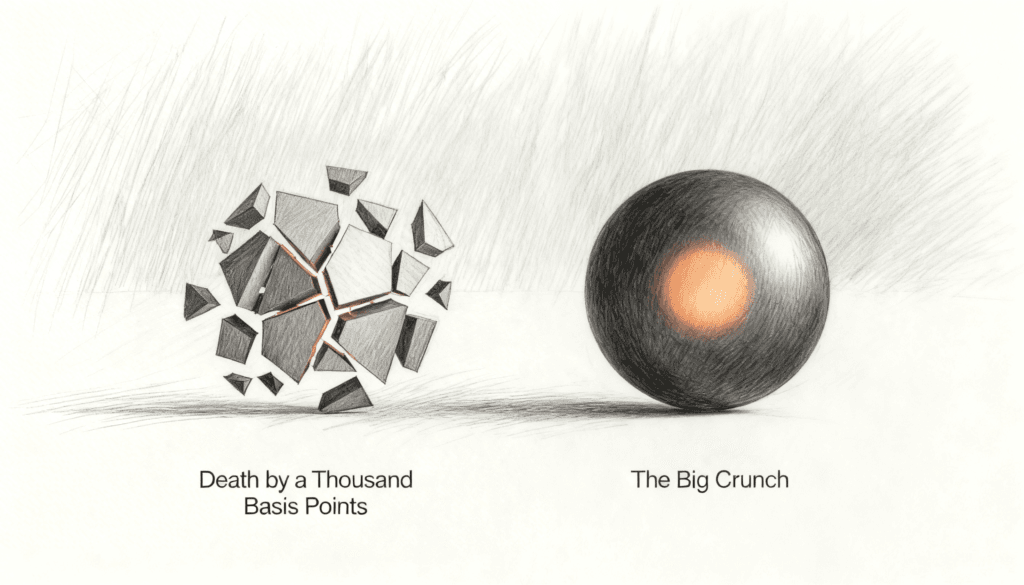
Let us call them what they are. The Big Crunch is the catastrophic event. The flash crash, the sovereign default, the moment a bank that was fine on Friday is not fine on Monday. It is the kind of risk people build bunkers for, literally and financially. The other, Death by a Thousand Basis Points, is the slow erosion. The fees that compound against you. The inflation that outruns your yield. The portfolio that looks stable on paper while quietly bleeding purchasing power over decades. One kills you in a day. The other kills you so slowly you might write a retirement plan around it.
The Spectacle Problem
Humans are narrative creatures. We understand stories with beginnings, middles, and catastrophic ends. This is why The Big Crunch gets all the attention. It has characters. It has drama. A hedge fund blows up. A currency collapses. Someone on television says the word “contagion” and suddenly everyone is an epidemiologist of finance.
The 2008 financial crisis is the textbook example. Lehman Brothers did not gradually become insolvent over forty years while people politely ignored it. It happened in a way that felt sudden, even though the underlying rot had been building for the better part of a decade. But the narrative that survived is the spectacular one. The weekend meetings. The emergency phone calls. The ticker symbols falling off cliffs.
This is not accidental. The human brain is wired to prioritize acute threats over chronic ones. A lion in the tall grass gets your full attention. A slight nutritional deficiency that will weaken your bones over twenty years does not. Markets exploit this wiring with ruthless efficiency.
The result is a peculiar asymmetry in how people manage risk. Enormous intellectual and financial resources go into hedging against crashes. Tail risk funds exist specifically to profit from catastrophic events. Options strategies are built to protect against the sudden downward move. Portfolio insurance, stop losses, circuit breakers. The entire architecture of modern risk management is oriented toward The Big Crunch.
Meanwhile, the slow bleed goes largely unhedged. Not because people do not know about it, but because it does not feel like an emergency. And things that do not feel like emergencies do not get budgets.
The Algebra of Slow Decay
Here is where it gets uncomfortable. Death by a Thousand Basis Points is, for the vast majority of investors, the more likely way to underperform. Not the more dramatic way. The more likely way.
Consider what actually erodes returns over a lifetime of investing. Management fees. Transaction costs. Tax drag. The bid ask spread. The behavioral penalty of buying high and selling low. The gap between the return a fund generates and the return its investors actually capture. Each of these is small in isolation. Each is enormous in accumulation.
This is the tyranny of compounding in reverse. Everyone loves compounding when it works in their favor. Einstein supposedly called it the eighth wonder of the world, though he almost certainly did not. But compounding is agnostic. It works just as faithfully against you. A one percent annual drag on returns does not cost you one percent over thirty years. It costs you roughly twenty six percent of your terminal wealth. That is not a rounding error. That is a house.
The insidious part is that this drag is largely invisible in real time. Your portfolio goes up in most years. Your statements look fine. You are making money in nominal terms. The loss is not a loss in the traditional sense. It is the absence of money you never knew you were supposed to have. Try getting angry about something you cannot see. Try building a protest movement around an opportunity cost.
Why The Big Crunch Is Easier to Sell
There is a reason financial media and fund managers prefer to talk about crash risk. It is marketable. Fear is the oldest sales tool in existence, and catastrophic scenarios are fear in its purest, most concentrated form.
A fund manager who says “I will protect you when the market drops fifty percent” is telling a compelling story. A fund manager who says “I will save you forty basis points a year through operational efficiency” is telling a story that puts people to sleep at dinner parties. Both statements, if true, could produce similar outcomes over a long enough horizon. But only one of them gets assets under management.
This creates a strange incentive structure. The financial industry is, in many ways, better compensated for addressing the risk that is less likely to matter than the one that is almost certain to matter. The elaborate tail risk hedge that costs you premium every quarter might protect you in the once a decade crash. But the cost of that protection is itself a form of Death by a Thousand Basis Points. You have traded one type of tail risk for the everyday version of the other.
There is an irony here that deserves more attention than it gets. Some of the most sophisticated risk management strategies in existence are themselves sources of the slow erosion they were never designed to address. The insurance has a cost. The cost compounds. And the event you are insuring against may never arrive, or may arrive in a form your hedge was not built to capture.
The Survivorship Illusion
One reason The Big Crunch feels more dangerous than it often is comes down to survivorship bias running in an unusual direction. We remember the people and institutions that were destroyed by catastrophic events. We do not hold conferences about the millions of retirement accounts that quietly underperformed their benchmarks by a percent and a half per year for three decades.
The retiree who lost everything in a single crash is a cautionary tale. The retiree who ended up with thirty percent less than they could have had because of fee drag and poor timing is just a retiree. There is no documentary about that person. There is no congressional hearing. There is no memorable date attached to their outcome. They just have a smaller number than they might have, and they probably do not even know it.
This is where the comparison starts to feel less like finance and more like medicine. In public health, chronic diseases kill far more people than acute emergencies. Heart disease is not dramatic. It does not make for good television. But it is the leading cause of death in most developed nations. Meanwhile, shark attacks get the documentary treatment despite being statistically irrelevant.
The financial parallel is almost perfect. The slow killers, fees, inflation, behavioral mistakes, tax inefficiency, are the heart disease of portfolios. The crashes are the shark attacks. Both can end you. But only one of them is working on you right now, today, while you read this.
The Contrarian Position
Here is where it is worth being slightly contrarian. The current fashion in certain financial circles is to dismiss tail risk hedging entirely. The argument goes something like this: crashes are unpredictable, hedges are expensive, just hold a diversified portfolio and ride it out. This is reasonable advice for many people. It is also incomplete.
The Big Crunch is rare, but it is not fictional. And its rarity is part of what makes it dangerous. People who have never lived through a genuine crash have a theoretical relationship with the concept. They know it can happen the way someone in a landlocked city knows tsunamis can happen. The knowledge is real. The preparation is not.
There are certain catastrophic scenarios, sovereign debt crises, currency collapses, systemic banking failures, that do not care about your time horizon or your diversification. They restructure the rules of the game itself. When the game changes, strategies designed for the old game do not just underperform. They become meaningless.
So the honest answer is not that one risk matters more than the other. It is that most people are poorly calibrated on both. They over allocate attention to crashes and under allocate attention to erosion. Or they dismiss crash risk entirely because it feels like fearmongering. The correct posture, uncomfortable as it may be, is to take both seriously without letting either one dominate your decision making.
What This Actually Means
If you have read this far, you might be wondering what the practical takeaway is. It is simpler than the problem might suggest.
First, audit the slow bleed. Know what you are paying in fees, in all their forms. Not just the expense ratio on a fund, but the transaction costs, the tax consequences of turnover, the advisory fees, the platform fees. Add them up. Then compound them forward over your actual time horizon. The number will be larger than you expect. It is almost always larger than people expect.
Second, do not dismiss crash risk just because it is fashionable to be stoic about it. Having some portion of a portfolio that genuinely protects against catastrophic scenarios is not paranoia. It is acknowledgment that the future contains events you cannot model. The key is to make sure the cost of that protection is not itself a form of the slow bleed you are trying to avoid. This is the tightrope. It is not easy to walk.
Nobody wants to hear that the biggest threat to their financial future is probably boring. Not a crash. Not a black swan. Not some geopolitical catastrophe that makes for gripping television. Just the quiet, persistent math of small costs compounding over long periods, occasionally punctuated by a crisis that reveals how much damage the quiet math has already done.
But that is the shape of the thing. Two tails, one loud and one silent, and a world that only watches for the loud one.
The thousand basis points do not announce themselves. They do not ring a bell. They just show up, year after year, patient as gravity, and take what compounding allows them to take. The Big Crunch, if it comes, takes the rest.
The investors who survive both are not the ones who saw the future. They are the ones who respected the arithmetic of the present.