Table of Contents
There is a strange ritual that happens at every dinner party where someone has made a little money in the market. It starts with a casual mention. Maybe between the salad and the main course. Someone says they got into a stock early. Or a fund. Or crypto. The table gets quiet for half a second. Then everyone leans in.
Nobody asks about the fundamentals. Nobody asks about the balance sheet or the competitive moat or the debt ratio. They ask one question: how much are you up?
And just like that, a portfolio is born. Not from research. Not from conviction. From proximity.
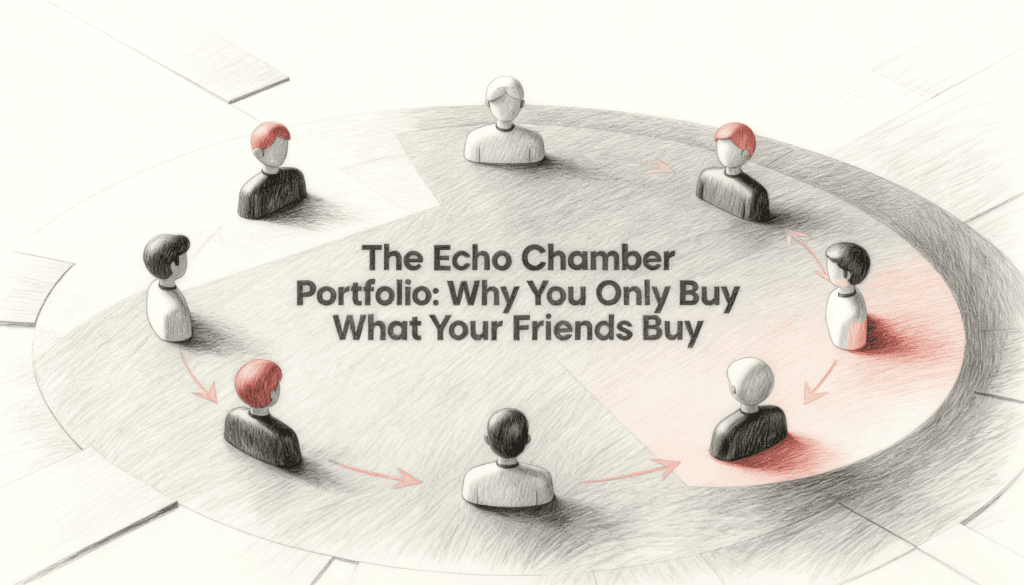
Welcome to the echo chamber portfolio. It is the most common investment strategy in the world, and almost nobody admits to using it.
The Dinner Table as Trading Desk
Humans are not built to make financial decisions in isolation. We are social creatures who survived for thousands of years by copying what worked for the tribe. If your neighbor found a berry bush that did not kill him, you ate from that bush too. This was brilliant logic in the savanna. It is terrible logic on the stock market.
But the instinct remains. When your college roommate tells you about a stock that doubled, your brain does not process that as a data point. It processes it as a survival signal. Someone in your group found food. You should follow.
Behavioral finance calls this herding. But that word makes it sound like a passive, mindless drift. It is not. It is active. It is enthusiastic. You go home from that dinner, open your brokerage app, and buy the thing your friend mentioned before you have even Googled what the company does. You might read about it afterward, but let us be honest about the sequence. The decision came first. The research, if it happens at all, is just a permission slip you write yourself after the fact.
This is not stupidity. It is biology running software that was never designed for capital markets.
The Information Cascade That Feels Like Wisdom
Here is where it gets interesting. The echo chamber portfolio does not feel like a mistake while you are building it. It feels like being well informed.
Think about how information actually travels through your social circle. One person buys a stock. They mention it. Two more people buy it. Now three people at your gym or your office or your group chat are all in the same position. When you hear about it, you are not hearing one opinion. You are hearing what sounds like a consensus.
But it is not a consensus. It is an echo. The original signal bounced around a closed room and came back amplified. In information theory, this is called a cascade. Each person in the chain assumes the people before them did their homework. Almost none of them did. They each assumed the person before them did.
So you end up with a group of otherwise intelligent people, all holding the same stock, all pointing at each other as the source of their conviction. It is a circle of confidence with no center.
The financial historian Charles Kindleberger documented this pattern across centuries of market bubbles. The South Sea Bubble, the Dutch tulip mania, the dot com boom. In every case, the mechanism was the same. Not mass delusion, but serial imitation dressed up as independent analysis.
Why Your Portfolio Looks Like Your Friend Group
If you mapped the holdings of any tight social circle, you would find an uncomfortable amount of overlap. Not because these people have similar risk profiles or financial goals. But because they talk to each other.
This reveals something counterintuitive about diversification. We all know we should diversify our assets. Fewer people realize they should diversify their information sources. If every investing idea you act on comes from the same five people, you do not have a portfolio. You have a group project.
And group projects, as anyone who survived school knows, tend to produce mediocre results with an uneven distribution of effort.
The problem deepens on social media. Your feed is already curated to show you what you engage with. If you click on one post about a particular sector or asset class, the algorithm starts serving you more. Within a week, it looks like the entire world is bullish on the same thing. But you are not seeing the world. You are seeing a mirror.
This is the same mechanism that creates political echo chambers. And it works the same way in finance. You start thinking your view is the consensus because everyone you see holds it. But everyone you see holds it because an algorithm decided to show you those people. The circle tightens until it feels like certainty.
Certainty, in investing, is almost always a warning sign.
The Social Cost of Independent Thinking
Here is the part that does not get discussed enough. Even if you recognize the echo chamber, leaving it is socially expensive.
Imagine your entire friend group is excited about a particular investment. They are sharing screenshots of their gains. They are making plans about what they will do when it hits some target price. Now imagine you do your own research and decide it is overvalued. What do you do?
If you say nothing and do not buy, you are the person who missed out. If you voice your concern, you are the pessimist. The buzzkill. The one who does not get it. Social groups do not reward dissent, especially when the group is making money.
This creates a bizarre incentive structure where the socially rational move and the financially rational move are opposites. You can be right and lonely, or wrong and included. Most people choose included. It is not a character flaw. It is a deeply human response to a deeply human situation.
There is a famous study from the 1950s by Solomon Asch on conformity. He showed people a series of lines and asked which ones matched in length. The answer was obvious. But when actors in the room confidently gave the wrong answer, a significant number of real participants went along with the group. They chose wrong and together over right and alone.
Now replace lines with stock picks and the experiment runs itself every single day.
The Accountability Illusion
The echo chamber portfolio also creates a subtle psychological trap around accountability. When you make an investment based on your own research and it fails, the weight falls entirely on you. You made a bad call. It stings. But it also teaches.
When you buy something because everyone in your circle bought it and it fails, the blame diffuses. It was not your fault. Everyone got it wrong. The loss hurts the same financially, but it feels different emotionally. Shared failure is easier to metabolize than solo failure.
This seems like a benefit. It is actually a poison. Because if you never fully own your mistakes, you never fully learn from them. The echo chamber protects your ego at the expense of your education. You walk away from a bad investment not with a lesson, but with a story about how the whole group got unlucky.
Luck is the word people use when they do not want to examine the process.
Over time, this creates investors who have years of experience but very little actual skill development. They have been in the market for a decade, but they have never made a truly independent decision. They have followers with portfolios, not investors with conviction.
The Bizarre Comfort of Losing Together
There is a concept in psychology called shared reality. People feel more confident in their beliefs when others around them hold the same ones. This applies to everything from political opinions to restaurant choices to, yes, investment decisions.
But here is the dark side. Shared reality also applies to losses. Losing money alone feels like failure. Losing money as part of a group feels like an event. Something that happened to us. There is a strange comfort in collective losses that makes people less likely to sell, less likely to reevaluate, and more likely to double down.
This is why you see communities online hold onto failing investments far past the point of reason. The social bond around the position becomes more important than the position itself. Selling would mean leaving the group. And the group, at this point, is not really about the investment anymore. It is about identity.
When your portfolio becomes your personality, you have stopped investing and started performing.
Breaking Out Without Blowing Up
The point here is not that you should ignore everyone around you and become a lone wolf investor. Isolation is its own kind of bias. People who refuse all outside input tend to develop blind spots just as dangerous as those who accept input uncritically.
The goal is to change the sequence. Instead of hearing a tip, buying, and then rationalizing, you flip it. You hear a tip, research independently, form your own thesis, and then decide. The difference sounds small. In practice, it changes everything.
It also helps to deliberately seek out people who disagree with your current positions. Not to be contrarian for its own sake, but because dissent is the only reliable way to stress test an idea. If your investment thesis cannot survive a skeptical friend asking hard questions over coffee, it probably cannot survive a volatile market either.
Warren Buffett once said something that gets quoted so often it has almost lost its meaning, but it remains structurally true. Be fearful when others are greedy, and greedy when others are fearful. What people miss about this advice is that it is not really about timing the market. It is about recognizing when your emotional state is being set by the crowd rather than by the facts.
The echo chamber does not announce itself. It feels like information. It feels like community. It feels like being smart because smart people around you agree. The only reliable signal that you are in one is this: if every investment idea you have had in the past year came from someone you know personally, you are not investing. You are subscribing to someone else’s strategy without knowing their risk tolerance, time horizon, or whether they actually still hold the position they told you about.
The Portfolio That Is Actually Yours
The most valuable thing an investor can build is not a collection of winning stocks. It is a decision making process that belongs to them. One that can survive a dinner party where everyone is excited about something. One that can tolerate the social discomfort of saying, I will look into it, rather than, I am in.
Your friends are not your financial advisors. They are not trying to mislead you. They are doing exactly what you are doing: sharing what excites them, seeking validation, building a story around their choices. There is nothing wrong with that. It is human.
But your portfolio should not be a byproduct of your social life. It should be a reflection of your own analysis, your own goals, and your own tolerance for being wrong. Because when the market turns, and it always turns, the echo chamber goes quiet. The group chat that was full of rocket emojis three months ago is suddenly silent. And you are left holding positions that were never really yours to begin with, wondering why you felt so confident about something you never actually understood.
The best investment you will ever make is not a stock or a fund or an asset class. It is the habit of thinking for yourself in rooms full of people who are not.
That is harder than it sounds. It is also worth more than most portfolios will ever return.