Table of Contents
There is a word in finance that functions like a diplomatic passport. It gets you through any conversation without being questioned. Say it in a meeting, and heads nod. Print it in a prospectus, and money flows in. That word is diversification.
It sounds responsible. It sounds mature. It sounds like something your financial advisor would say right before charging you a fee for doing very little. And in the world of hedge funds, it has become the most celebrated excuse for delivering returns that would embarrass a savings account.
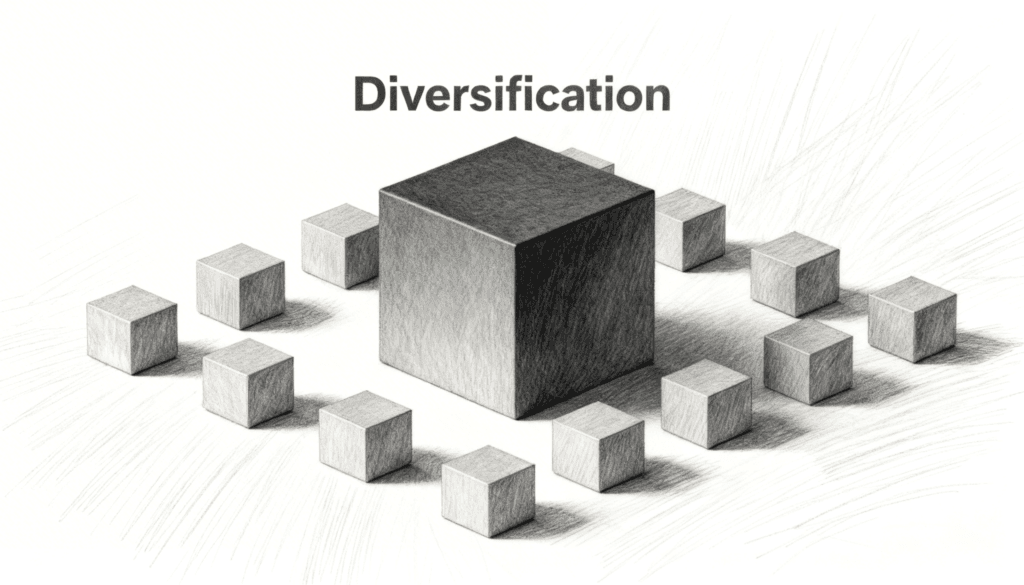
Let us be honest about what diversification actually means in practice. It means placing bets in enough directions that you are almost guaranteed to cancel out your own winners with your own losers. It is the financial equivalent of ordering every dish on the menu because you could not decide what you wanted for dinner. You will not go hungry. But you will not enjoy the meal either.
The Original Sin
The idea behind diversification is not stupid. In fact, it is mathematically elegant. Harry Markowitz published his portfolio theory in 1952, and it earned him a Nobel Prize. The core argument is simple: by combining assets that do not move together, you can reduce risk without proportionally reducing return. On paper, this is brilliant. In a textbook, it is undeniable.
But somewhere between the academic paper and the corner office of a hedge fund manager in Greenwich, Connecticut, something went very wrong. Diversification stopped being a tool and became a religion. And like most religions, it started attracting followers who did not fully understand what they were worshipping.
The original concept was about smart allocation. What it became was an excuse for intellectual laziness dressed up as prudence. Hedge fund managers discovered that if they spread capital across enough positions, enough asset classes, and enough geographies, they could survive almost any storm. They would not thrive in any season. But they would survive. And survival, combined with a two and twenty fee structure, is a very comfortable business model.
The Comfortable Lie
Here is something that does not get said enough: most hedge funds are not in the business of generating extraordinary returns. They are in the business of gathering assets. And diversification is the single best sales pitch ever invented for asset gathering.
Think about it from the manager’s perspective. If you concentrate your portfolio and you are wrong, you get fired. If you diversify your portfolio and deliver mediocre returns, you get to blame the market. One path carries career risk. The other carries a mild sense of disappointment at the annual investor meeting. It is not difficult to guess which path most managers choose.
This is not speculation. The data is painfully clear. Over the last two decades, the average hedge fund has underperformed a simple index fund. Not by a little. By a lot. And they have done so while charging fees that would make a luxury hotel blush. The diversified hedge fund portfolio has become a monument to the idea that looking busy is not the same as being productive.
Warren Buffett once made a famous bet that a simple S&P 500 index fund would outperform a collection of hedge funds over ten years. He won. Not because he is a genius, although he probably is. He won because the hedge funds were so diversified, so hedged, so carefully balanced across every conceivable risk factor that they had essentially engineered their own mediocrity. They had taken the most dynamic capital market in human history and turned it into a very expensive version of standing still.
Conviction Is the Real Currency
The hedge funds that have actually made legendary returns share one common trait. They were not diversified. They were concentrated. They had conviction.
George Soros did not break the Bank of England by spreading his capital across forty currency positions. He put a massive bet on one idea. He believed the British pound was overvalued within the European Exchange Rate Mechanism, and he committed to that belief with everything he had. That single trade made him over a billion dollars in a day.
John Paulson did not make his fortune in the 2008 financial crisis by hedging his bets across the housing market. He studied the subprime mortgage machine, concluded it was going to collapse, and built a concentrated position designed to profit from that collapse. His fund made fifteen billion dollars. Not from diversification. From the opposite of it.
These are not anomalies. They are the rule among the truly great. The pattern repeats itself throughout the history of investing. The biggest wins come from concentrated conviction. Diversification, by design, dilutes conviction. And diluted conviction produces diluted returns.
There is a parallel here worth exploring. In evolutionary biology, the species that thrive are not the ones that try to adapt to every environment simultaneously. They are the ones that specialize. The cheetah did not become the fastest land animal by also learning to swim, climb trees, and dig burrows. It committed to speed. That commitment meant vulnerability in other areas, yes. But it also meant dominance in one area that mattered enough to sustain the species for millions of years.
Hedge funds that diversify across everything are trying to be the animal that does everything adequately. They can survive. But they will never be the cheetah.
The Psychology of Spreading Thin
There is a deeper reason why diversification persists despite its track record of mediocrity. It feels good. It feels safe. And humans are wired to prioritize feeling safe over being right.
For a hedge fund manager, a concentrated bet that goes wrong is not just a financial loss. It is a narrative catastrophe. Investors will question your judgment. The financial press will write about you. Your competitors will quietly enjoy your suffering over drinks at a charity gala. But a diversified portfolio that underperforms? That is just the market being difficult. That is just a tough year. That is something everyone can relate to.
Diversification is, in many ways, an emotional insurance policy. It does not protect the portfolio as much as it protects the manager. It provides cover. And in an industry where career risk matters more than investment risk, cover is the most valuable commodity there is.
This is the uncomfortable truth that the hedge fund industry does not want to discuss. The diversification is not always for the client. It is for the manager. The client pays two and twenty for the privilege of funding someone else’s job security.
When Diversification Becomes Disguise
There is a version of diversification that is genuinely useful. Owning stocks and bonds that behave differently during market stress makes sense. Holding some international exposure alongside domestic investments makes sense. Having a portion of your wealth in assets that protect against inflation makes sense.
But that is not what many hedge funds do. What many hedge funds do is something far more elaborate and far less useful. They create portfolios with hundreds of positions across dozens of strategies, layered with derivatives and hedges and overlays, all designed to reduce volatility to the point where the portfolio barely moves in any direction.
The result is a product that looks sophisticated. It looks like the managers are doing something complex and valuable. The quarterly reports are filled with charts and risk metrics and attribution analysis. It looks like a lot of work. And it is a lot of work. But the work is not generating returns. The work is generating the appearance of generating returns.
This is where diversification crosses the line from strategy into theater. It becomes a performance. The fund is not trying to make money. It is trying to look like it is trying to make money. There is a meaningful difference between those two things, and that difference is where the fees disappear.
The Fee Paradox
Consider the economics for a moment. A typical hedge fund charges a management fee of two percent and a performance fee of twenty percent. The management fee is charged on total assets regardless of performance. The performance fee is charged on profits above a certain threshold.
Now think about what diversification does in this context. By reducing volatility and returns, the fund makes the management fee the reliable income stream. The performance fee becomes almost secondary. A fund managing ten billion dollars collects two hundred million in management fees annually whether it makes a single dollar of profit or not.
This creates a perverse incentive. The more you diversify, the more stable your assets become, because investors do not panic and withdraw when volatility is low. The more stable your assets, the more reliable your management fee income. You do not need to be great. You just need to not be terrible. And diversification is the most efficient path to not being terrible.
The investor, meanwhile, is paying luxury prices for economy class performance. They are paying for the promise of alpha, which is the industry term for returns above the market. But what they are receiving is very expensive beta, which is just market exposure you can get from an index fund for almost nothing.
The Case for Less
None of this means concentration is easy. It is not. Concentration requires something that diversification does not: the courage to be wrong in public. It requires deep research. It requires genuine understanding of an asset or a situation. It requires the willingness to sit with a position while the market disagrees with you, sometimes for years.
Most people, and most managers, are not built for that. It is psychologically grueling. The doubt is constant. The second guessing is relentless. Every drawdown feels like confirmation that you have made a terrible mistake.
But here is the counterintuitive part. The discomfort is the point. The difficulty is what creates the return. If concentration were easy, everyone would do it, and the excess returns would disappear. The fact that it is hard is precisely what makes it valuable. The premium exists because most people would rather be comfortably mediocre than uncomfortably excellent.
This is true beyond investing. In almost every field, the people who achieve remarkable things are the ones who concentrated their efforts. A novelist does not write a great book by simultaneously working on twelve manuscripts. A startup does not succeed by entering ten markets at once. A chess grandmaster does not win by playing safe, balanced openings in every game. Greatness requires focus. Focus requires sacrifice. And sacrifice is the one thing that diversification was specifically designed to avoid.
What This Means for the Industry
The hedge fund industry is slowly being forced to confront this reality. Institutional investors are getting smarter. Pension funds and endowments that once allocated billions to diversified hedge fund portfolios are pulling back. They are realizing that they do not need to pay two and twenty for something they can approximate with a blend of index funds and a modest allocation to truly concentrated, high conviction managers.
The funds that will survive and thrive are not the ones with the most diversified portfolios. They are the ones with the most distinctive ideas. They are the ones willing to look different from the market, not mirror it with a slight tilt.
The hedge fund industry was built on a promise: that brilliant minds, freed from the constraints of traditional asset management, could generate superior returns. Diversification betrayed that promise. It took the freedom and used it to build a more complicated version of average.
The Bottom Line
Diversification is not inherently wrong. As a concept, it is sound. As a tool, it has its place. But as the dominant philosophy of an industry that charges premium fees for supposedly premium thinking, it is a contradiction.
If you are going to charge investors for extraordinary, you need to deliver something that could not have been achieved by a robot following a simple set of rules. And the honest truth is that most diversified hedge funds cannot pass that test.
The next time someone tells you that diversification is the only free lunch in finance, ask them a simple question. If it is free, why does it cost two and twenty?
The answer, like most answers in finance, has less to do with mathematics and more to do with incentives. Diversification is not a strategy. It is a business model. And it is a very good one. Just not for the people paying the fees.