Table of Contents
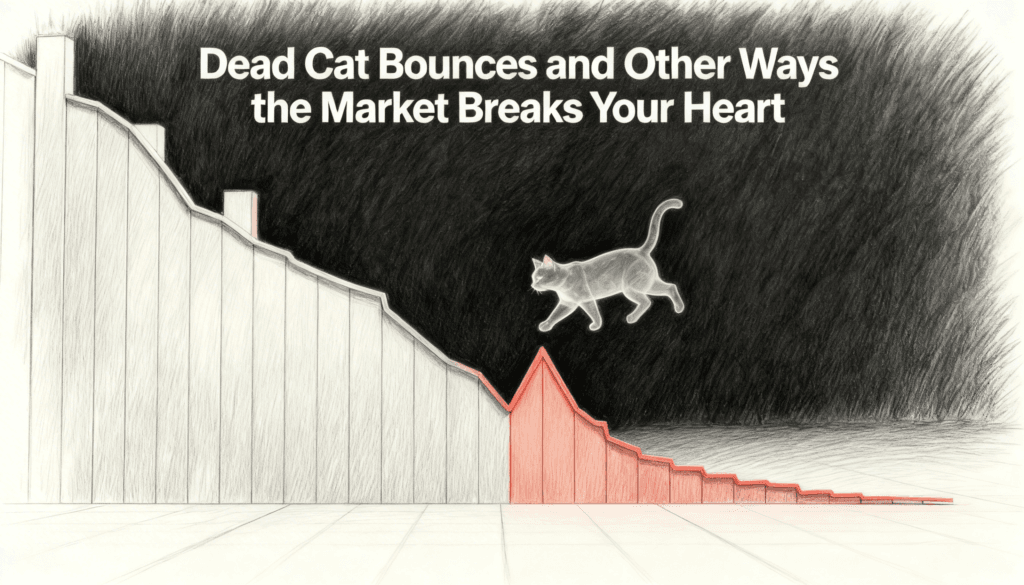
There is an old saying on Wall Street that even a dead cat will bounce if it falls from high enough. The image is grotesque on purpose. It is supposed to make you uncomfortable, because the thing it describes should make you uncomfortable too. A dead cat bounce is when a stock or an entire market drops hard, then briefly recovers, and then continues falling. The recovery is the trap. It looks like hope. It feels like the worst is over. It is not.
But this article is not really about dead cat bounces. Not entirely. It is about the deeper pattern they represent. Markets have a peculiar talent for exploiting the gap between what you feel and what is actually happening. They do not just take your money. They take your confidence, your patience, and sometimes your identity. And they do it using mechanisms that look, at first glance, like opportunities.
Let us start with the bounce itself.
The Anatomy of False Hope
A dead cat bounce works because human beings are pattern completion machines. We see a decline, then a rise, and our brains rush to finish the story. Decline, rise, continued rise. Recovery. Relief. This is the narrative arc we have been trained on since childhood. Things get bad, then they get better. The hero falls, then stands back up.
Markets know this about you. Not consciously, of course. Markets are not sentient. But they are made of people, and people are predictable in their irrationality. When a stock drops forty percent in two weeks and then gains eight percent in day, something happens in the collective nervous system. Short sellers take profits. Bargain hunters arrive. Financial television finds someone willing to say the word “bottom.” And for a brief, intoxicating moment, it feels like the story is completing itself the way stories are supposed to.
Then Wednesday comes.
The psychologist Daniel Kahneman spent decades studying how people miscalculate probability and risk. One of his most useful observations was that humans feel losses roughly twice as intensely as equivalent gains. This is loss aversion, and it is the emotional engine behind almost every heartbreak the market delivers. But here is the part that does not get discussed enough. Loss aversion does not just make you afraid of losing money. It makes you desperate to believe the loss is over. The dead cat bounce is not a market phenomenon. It is an emotional one. The price action is just the surface. Underneath, it is millions of people collectively deciding they cannot bear the story to continue in this direction.
The Sunk Cost Seduction
There is a close cousin to the dead cat bounce that operates on a longer timeline. It does not happen in days. It happens in years. It is what occurs when you hold a losing position not because you believe it will recover, but because selling would mean admitting you were wrong.
Economists call this the sunk cost fallacy. Psychologists call it escalation of commitment. Regular people call it stubbornness. Whatever the label, the mechanism is the same. You bought a stock at one price. It is now much lower. Selling crystallizes the loss into something real and permanent. Holding keeps it theoretical, a number on a screen, not a verdict on your judgment.
This is where investing intersects with something that looks surprisingly like grief. Elisabeth Kübler Ross did not write about stock portfolios, but her framework maps onto them with eerie precision. Denial is when you stop checking your account. Anger is when you blame the Fed, the algorithm traders, or that analyst on YouTube. Bargaining is when you set a mental target. “If it just gets back to what I paid, I will sell.” Depression is when it does not. And acceptance, the healthiest stage, is the one most investors never reach because the market keeps offering tiny bounces that restart the whole cycle.
The sunk cost seduction is particularly cruel because it disguises itself as discipline. Holding through volatility is supposed to be a virtue. Every investing book tells you not to panic sell. And that advice is often correct. But there is a meaningful difference between holding a fundamentally sound investment through a rough quarter and refusing to sell a broken thesis because your ego will not let you. The market does not care which one you think you are doing.
Anchoring, or Why the Price You Paid Is Irrelevant
Here is something that should be obvious but somehow is not. The price you paid for a stock has absolutely no bearing on its future. None. The stock does not know what you paid. The market does not care about your cost basis. Your purchase price is a fact about your past, not a fact about the company.
And yet.
Nearly every retail investor, and plenty of professionals, mentally anchors to their entry price. This is the reference point against which all future movement is judged. Up from where I bought is good. Down from where I bought is bad. This is not investing. This is scorekeeping. And the scorecard is rigged because you chose an arbitrary starting line.
Anchoring is one of the most well documented cognitive biases in behavioral economics. Kahneman and Tversky demonstrated it with spinning wheels and random numbers. Give someone an arbitrary figure before asking them to estimate something unrelated, and the arbitrary figure will pull their estimate toward it. In markets, your purchase price is that arbitrary figure. It warps your perception of value, risk, and timing. It makes you hold losers too long and sell winners too early. And it does this while feeling completely rational.
The counter intuitive truth is that the best investors evaluate positions as if they bought them today. Not yesterday, not last year, today. Would you buy this stock right now at this price with this information? If the answer is no, then holding it is just a slower version of buying it. You are choosing it again every day you do not sell. Most people do not want to confront this because it means admitting that inaction is also a decision.
The Narrative Trap
Markets do not move on numbers alone. They move on stories. And stories are where things get genuinely dangerous.
Consider the dot com bubble. It was not built on spreadsheets. It was built on a narrative so seductive that questioning it felt foolish. The internet was going to change everything. And it did change everything. That was the diabolical part. The story was true. It was just priced as if the future had already arrived, and every company with a domain name was going to survive to see it.
This is what makes narrative traps so effective. They contain a kernel of truth. Artificial intelligence really is transformative. Electric vehicles really are the future. Clean energy really does matter. The narrative is not wrong. But the market has a habit of taking a correct observation about the next twenty years and pricing it into the next twenty minutes. And when reality reasserts itself, as it always does, the correction feels like betrayal.
There is a concept in literary theory called the unreliable narrator. It is when the person telling you the story cannot be trusted to tell it accurately. Markets are the ultimate unreliable narrator. They tell you a story through price action, and that story feels authoritative because it is backed by real money. But the story is being told by a crowd, and crowds are magnificent at conviction and terrible at accuracy. The price of an asset at any given moment is not a truth. It is a consensus. And consensus has been wrong about nearly everything at some point.
The challenge is that you cannot simply dismiss narratives. You have to live inside them. Every investment thesis is a story about the future. The skill is not avoiding stories. It is maintaining the uncomfortable awareness that you are inside one, that it might be wrong, and that the moment it feels most obviously right might be precisely when it is most dangerous.
Mean Reversion and the Cruelty of Being Early
There is another way the market breaks your heart that does not involve being wrong. It involves being right too soon.
Mean reversion is one of the most reliable patterns in financial markets. Things that go up too far tend to come back down. Things that go down too far tend to come back up. Over long enough time horizons, extremes moderate. This is comforting in theory. In practice, it is a torture device.
Being early in a market is functionally identical to being wrong. If you short an overvalued stock in January and it doubles by June before collapsing in September, the fact that you were “right” provides very little comfort while you are facing a margin call in April. The market can stay irrational longer than you can stay solvent. John Maynard Keynes said this, and he was not speaking hypothetically. He nearly went broke trading currencies before eventually making a fortune. The lesson is not that he was smart. The lesson is that even being smart and correct was almost not enough.
This is the particular cruelty reserved for analytical investors. You can do the research. You can read the balance sheets. You can identify the mispricing. And the market can still spend two years making you look like a fool before it finally agrees with you. Patience is supposed to be a virtue in investing, but the market tests patience the way the ocean tests sandcastles. Relentlessly, and without any interest in whether you survive.
The Paradox of Information
We live in an age of infinite financial information. Earnings calls are transcribed in real time. Every economic data point is dissected within seconds. Retail investors have access to tools that would have been science fiction twenty years ago. And none of it has made investing emotionally easier.
If anything, more information has made things worse. This is because information creates the illusion of control. If I just read one more analyst report. If I just understand this one more indicator. If I just build a better spreadsheet. The implicit promise is that enough information will eliminate uncertainty. But uncertainty is not a bug in financial markets. It is the product. Risk is what you are being compensated for. If the outcome were knowable, there would be no return.
The Heart of It
So why does the market keep breaking hearts? Because it is designed to. Not by conspiracy. Not by malice. But by structure. Markets are mechanisms for transferring wealth from the impatient to the patient, from the emotional to the disciplined, from those who confuse activity with progress to those who understand that doing nothing is sometimes the most sophisticated strategy available.
The dead cat bounce is just the most vivid example. But the pattern repeats everywhere. In the sunk cost positions you cannot let go of. In the anchoring that distorts your judgment. In the narratives that feel like insight but function like traps. In the information that promises clarity and delivers noise.
The real heartbreak is not losing money. Money comes back. The real heartbreak is what losing money reveals about yourself. That you are not as rational as you thought. That you are not immune to fear or greed or the desperate need to be right. That you are, despite your spreadsheets and your research and your carefully constructed investment thesis, a human being operating in a system that treats human nature as raw material.
This is not a reason to stop investing. It is a reason to invest with humility. The best investors are not the ones who never get fooled. They are the ones who recover quickly when they do. They recognize the dead cat bounce for what it is. They sell the position that is never coming back. They update their thesis when the evidence changes. They understand that the market is not a puzzle to be solved but a relationship to be managed. And like all relationships, it will sometimes break your heart.
The question is not whether it will happen. The question is what you do after.