Table of Contents
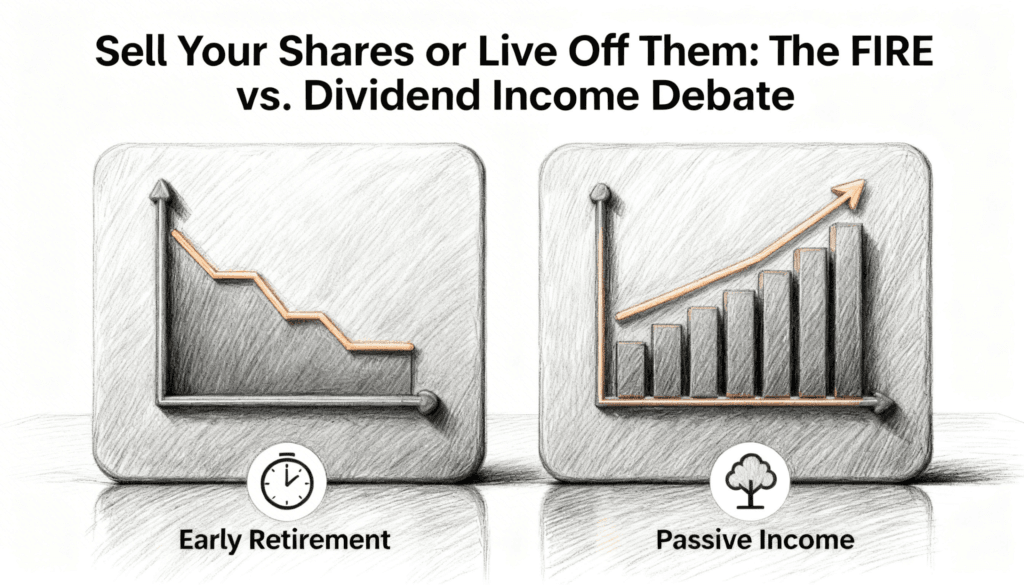
There is a war happening in personal finance, and most people do not even know they have picked a side. On one end, you have the FIRE movement telling you to build a pile of investments, then slowly sell pieces of it to fund your life. On the other, dividend income investors insist you should never touch the pile at all. Just live off what it produces.
Both groups want the same thing. Financial freedom. Both believe they have found the rational path to get there. And both think the other side is making a fundamental mistake.
What makes this debate fascinating is not the math. The math, depending on which assumptions you feed it, will happily validate either position. What makes it fascinating is that two groups of intelligent people, looking at the same financial instruments, have arrived at completely opposite philosophies about what money is for and how wealth should behave once you have it.
This is not really an argument about spreadsheets. It is an argument about identity.
The FIRE Doctrine: Your Portfolio Is a Block of Ice
The FIRE movement, short for Financial Independence Retire Early, treats your investment portfolio like a consumable resource. You spend your working years building it up, then you spend your post working years drawing it down. The most famous rule of thumb is the four percent rule: withdraw four percent of your portfolio in your first year of retirement, adjust for inflation each year after, and statistically your money should last about thirty years.
The beauty of this approach is its simplicity. You do not need to care what your portfolio is made of, as long as it is diversified and cheap to own. Index funds, total market funds, maybe some bonds for stability. You are not picking stocks. You are not chasing yield. You are buying the entire market, riding the long term upward trend of capitalism, and skimming off the top when you need to eat.
FIRE followers see this as rational and clean. And in many ways, it is. You are optimizing for total return, which means your money goes wherever the market rewards it most. If growth stocks are outperforming dividend payers, your portfolio captures that growth. You are not limiting yourself to companies that happen to write checks to shareholders.
But there is a psychological cost that FIRE literature tends to gloss over. Every time you sell shares to cover your expenses, your portfolio gets smaller. The math says this is fine. Your emotions may disagree.
Imagine watching your account balance drop from one million to nine hundred thousand during a bad year, knowing you still need to pull out forty thousand for living expenses. The math says you will probably be okay. Your nervous system says something quite different.
The Dividend Income Doctrine: Your Portfolio Is a Fruit Tree
Dividend investors see things from the opposite direction entirely. To them, selling shares to live on is like chopping branches off a tree to burn for warmth. Sure, it works for a while. But eventually you run out of tree.
Their philosophy is different. You build a portfolio of companies that pay regular dividends. You live off those payments. The shares themselves are never sold. They stay in your account, producing income year after year, theoretically forever. When you die, the whole tree passes to your heirs, still bearing fruit.
This approach has deep psychological appeal. Your wealth is not being consumed. It is producing. There is something almost agricultural about it, a feeling that you have built something that sustains itself. You planted seeds, tended them, and now they feed you without being destroyed in the process.
Dividend investors will tell you that their income is more predictable, more tangible, and more emotionally sustainable than selling shares. They wake up and see deposits in their brokerage account. No decision required. No shares sold. No anxiety about whether they withdrew at the wrong time.
There is a reason this approach attracts a certain kind of person. It appeals to builders. To people who want to create systems that run on their own. It satisfies the same instinct that makes people want to own rental properties rather than flip houses.
The Argument Nobody Wants to Hear
Here is the part that makes both sides uncomfortable: from a pure total return perspective, it does not matter where your cash comes from.
A company that pays you a one dollar dividend has reduced its own value by one dollar. Your shares are now worth one dollar less. You received one dollar in cash. Your net worth has not changed. This is not an opinion. It is an accounting identity.
When a FIRE adherent sells one dollar worth of shares, the same thing happens. They have one dollar in cash and one dollar less in shares. Identical outcome.
This is the argument that academic finance uses to dismiss the entire debate. A dividend is just a forced sale you did not choose. Selling shares is just a dividend you decided on yourself. Economically, they are the same transaction wearing different clothes.
And yet, if you say this to a dividend investor, they will look at you like you just told them their children are interchangeable. The theoretical equivalence is real. The lived experience is not.
Where Psychology Breaks the Math
This is where the debate gets genuinely interesting, because it stops being about finance and starts being about how human beings actually function under uncertainty.
The FIRE approach requires you to make a decision every time you need money. You have to sell something. That means you have to choose when to sell, what to sell, and how much to sell. Each of those micro decisions is a small psychological burden. In a bull market, this feels fine. In a bear market, it feels like self harm.
Dividend income sidesteps this entirely. The money arrives without you doing anything. You did not sell. You did not decide. The company decided for you. Psychologically, this is not spending down your wealth. It is receiving income. Even though the economic outcome is identical, the emotional experience is vastly different.
This is not a trivial distinction. A strategy you abandon during a crisis is worse than a slightly suboptimal strategy you stick with. If dividend income keeps you calm enough to stay invested while FIRE math would have you panic selling at the bottom, the supposedly inferior strategy wins by default.
The Efficiency Trap
FIRE advocates have a legitimate counterpoint, though. When you restrict yourself to dividend paying stocks, you are filtering out a huge portion of the market. Many of the best performing companies in the last two decades have paid little or no dividends. They reinvested profits into growth instead. By insisting on dividends, you would have missed some of the biggest wealth creators of a generation.
There is also the tax question. In many countries, dividends are taxed as income in the year you receive them. Capital gains, on the other hand, are only taxed when you sell. This means the FIRE approach offers more control over when and how much tax you pay. The dividend investor has no choice. The income shows up, and the tax bill follows.
This matters more than most dividend enthusiasts want to admit. Over decades, the drag of annual taxation on dividends can meaningfully reduce total wealth compared to a strategy that defers taxes through unrealized capital gains. It is one of those quiet costs that does not show up in the satisfying ritual of counting quarterly payments.
And yet. The FIRE movement has its own efficiency trap. The four percent rule is based on historical data from a specific period of market history, primarily the American market. It assumes a future that broadly resembles the past. If the next thirty years look different, which they well might, the rule could prove too generous or too conservative. You will not know which one until it is too late to adjust.
The Identity Layer
Strip away the numbers and you find something more revealing. FIRE and dividend investing are not just strategies. They are subcultures with their own values, heroes, language, and tribal markers.
FIRE people tend to value optimization, minimalism, and escape. The movement was born from a desire to leave traditional employment as early as possible. It attracts engineers, programmers, and spreadsheet enthusiasts. The community measures success by how early you can quit and how low you can keep your spending. There is an almost monastic quality to it. Deny yourself now so you can be free later.
Dividend investors tend to value ownership, permanence, and legacy. They are drawn to the idea of building something that lasts. They enjoy researching individual companies, evaluating management quality, and watching their income streams grow over time. There is something almost aristocratic about the mindset. You are not spending your capital. You are living off the yield of your estates.
This is remarkably similar to a pattern you see in architecture. Some people design buildings meant to be modular and replaceable. Others design buildings meant to stand for centuries. Neither approach is wrong. But they reflect fundamentally different relationships with time, permanence, and meaning.
These identities explain why the debate generates so much heat. When someone attacks your investment strategy, they are also attacking your self concept. Tell a FIRE adherent that the four percent rule is risky and you are telling them their entire life plan is built on sand. Tell a dividend investor that dividends are economically equivalent to selling shares and you are telling them the thing they built is an illusion.
People do not respond to that calmly.
The Part That Actually Matters
If you zoom out far enough, the real variable is not which withdrawal method you choose. It is whether you saved enough in the first place. A person with two million dollars can live comfortably using either strategy. A person with two hundred thousand cannot, regardless of which philosophy they follow.
The debate between FIRE and dividend income is a luxury problem. It is an argument that only becomes relevant after you have already done the hard part, which is accumulating significant capital. And the accumulation phase looks remarkably similar for both groups: earn more than you spend, invest the difference, do this for a long time.
The irony is that the two communities spend enormous energy fighting about the distribution phase while largely agreeing on the accumulation phase. They share more common ground than either would like to admit. They just disagree about what to do once they have reached the finish line.
And maybe that is the most honest conclusion. The FIRE approach is mathematically cleaner but psychologically harder. The dividend approach is psychologically easier but mathematically constrained. Each one solves a problem the other creates. Neither is complete on its own.
The best strategy might be the one that borrows from both: build a diversified portfolio, let some of it generate dividends for psychological comfort, and be willing to sell shares when needed for flexibility. This hybrid approach satisfies neither tribe fully, which is probably a sign it is the most reasonable option available.
But do not say that in either community. They do not want reasonable. They want to be right.