Table of Contents
There is a bell that rings at 9:30 AM Eastern time, and another that rings at 4:00 PM. Between those two bells, a day trader lives an entire emotional lifetime. Adrenaline, focus, regret, triumph, lunch maybe, then more regret. When the closing bell rings, the market shuts. It does not care if you were in the middle of something. Go home. It is over.
Now imagine telling a crypto trader about this concept. A market that closes. On purpose. Every single day. Also on weekends. Also on holidays. The crypto trader would look at you the way a feral cat looks at a leash.
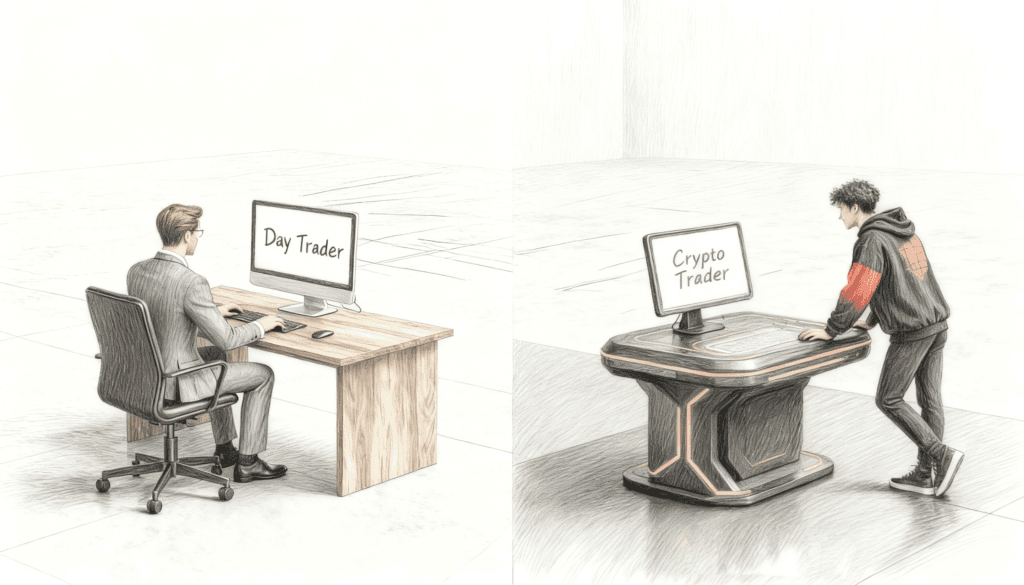
These two communities trade for a living. They both stare at charts and believe price action tells a story. They both lose sleep over positions. But they operate inside completely different structures, and those structures have shaped them into fundamentally different animals.
The Architecture of the Casino
Here is something most people never think about: the rules of the game change who you become as a player.
A day trader in regulated markets operates inside a system built over a century of trial, scandal, and legislation. There are circuit breakers that halt trading when things fall too fast. There is a pattern day trader rule that requires a minimum account balance. There are margin requirements, settlement periods, and an entire bureaucratic ecosystem designed to slow things down just enough that total chaos does not break out before lunch.
The crypto market has almost none of this. It runs all day, every day, across every time zone. There is no closing bell. There are no circuit breakers. An asset can drop forty percent at 3 AM on a Sunday while you are asleep, and by the time you wake up, the conversation has already moved on to the next coin. The infrastructure is not designed to protect you. It is barely designed at all.
This difference sounds technical. It is not. It is psychological. The structure of the market you trade in does not just affect your strategy. It affects your nervous system.
What the Clock Does to a Person
Day traders in regulated markets have something crypto traders do not: enforced rest. The market closes. You cannot trade. You are forced, by the architecture of the system itself, to stop.
This sounds like a limitation. It is actually a gift.
Forced downtime creates space for reflection. When the market is closed, a day trader can review trades, evaluate mistakes, and reset emotionally before the next session. The structure imposes discipline from the outside. You do not need to be a monk. You just need the market to be closed.
Crypto traders have no such luxury. The market never stops, which means the temptation never stops. There is always another candle forming. Always another move happening on some exchange in some corner of the world. The result is that crypto trading selects for a very specific personality type: someone who can impose their own boundaries with no external help. Or, more commonly, someone who does not impose boundaries at all and slowly melts into a 24/7 state of alert that resembles less a trading career and more a hostage situation.
There is a parallel here to something in behavioral science. Researchers have found that people make better decisions when choices are constrained. Unlimited options do not produce freedom. They produce fatigue. The paradox of choice applies to consumer products, career decisions, and apparently, to how many hours per day you are allowed to lose money.
The Tribe and the Lone Wolf
Day trading communities in regulated markets have a surprisingly structured social culture. There are chat rooms with morning prep sessions. There are mentors who teach specific setups. There is a shared language around market open, the first hour, the midday chop, the power hour. The rhythm of the trading day creates a shared experience that bonds people together. Everyone goes through the same hours, the same emotional arc, the same closing routine.
Crypto trading culture is more fragmented. Because the market runs continuously and spans every time zone, there is no shared clock. One trader’s morning is another trader’s middle of the night. The community still exists, but it is more scattered, more asynchronous, more chaotic. Telegram groups light up at random hours. Discord servers never truly sleep. The social fabric is thinner because there is no common rhythm holding it together.
This matters more than it seems. Humans are social animals, and shared rituals build trust. A day trading room that goes through the same opening bell every morning has something in common with a sports team that practices at the same time each day. The crypto world, by contrast, is more like a pickup basketball court that is always open. You can show up whenever you want. But there is no team. There is no schedule. And nobody is keeping score for you.
The Regulation Question Nobody Wants to Hear
Day traders complain about regulation constantly. The pattern day trader rule is seen as elitist. Margin requirements feel restrictive. The SEC is viewed as an overbearing parent who does not understand that their child is a grown adult capable of making terrible decisions independently.
But here is the part that stings: those regulations work. Not perfectly, and not without creating their own problems. But the basic framework of regulated markets prevents some of the most spectacular forms of financial self destruction that crypto enables on a daily basis.
In crypto, you can trade with extreme leverage on unregulated platforms. You can put your life savings into a token that was created forty five minutes ago by an anonymous developer. You can wake up to discover that the exchange holding your assets has simply vanished, along with every dollar you deposited.
The day trader who complains about the SEC has never had to explain to their family that their money is gone because an exchange operator fled to a country without extradition treaties. Regulation is annoying right up until the moment you realize what the world looks like without it.
And yet. The crypto trader would argue, not entirely without merit, that regulation also protects incumbents, stifles innovation, and creates barriers that keep ordinary people out of opportunities reserved for the wealthy. The pattern day trader rule does not protect small traders. It excludes them. The accredited investor rules around private markets are not about safety. They are about gatekeeping.
Both sides are right. Both sides are also blind to the ways their own system fails them. The day trader is protected but constrained. The crypto trader is free but exposed. Each one looks at the other and sees a cautionary tale.
The Speed of Pain
There is one more difference that deserves attention, and it is about the tempo of consequences.
In regulated markets, losses tend to be bounded by structure. Circuit breakers halt extreme moves. Settlement times slow the velocity of bad decisions. The worst case scenario in a single day, while painful, has guardrails.
In crypto, the worst case scenario has no floor. Flash crashes happen in seconds. Liquidation cascades wipe out leveraged positions faster than a human can react. The speed of pain is different. Not just faster, but more sudden, more total, more disorienting.
This creates a different relationship with loss. Day traders in regulated markets tend to talk about risk management in measured, almost clinical terms. Stop losses. Position sizing. Risk per trade. There is a language of control.
Crypto traders talk about loss differently. The language is more existential. They talk about being “rekt.” They talk about surviving. The vocabulary is not about managing risk within a system. It is about enduring chaos that has no system. It is closer to the language soldiers use than the language accountants use. Which tells you something about what 24/7 unregulated markets actually do to the people inside them.
The Irony at the Center
Here is what neither side fully appreciates. The day trader who craves more freedom and less regulation is essentially asking to become a crypto trader. And the crypto trader who wishes for more stability and fewer rug pulls is essentially asking for regulation. They are both slowly inching toward the other’s world while insisting they want nothing to do with it.
The regulated market is evolving toward longer hours and more access. Some brokers now offer extended trading sessions. Futures markets already run nearly around the clock. The walls are coming down, slowly.
Meanwhile, crypto is evolving toward more structure. Major exchanges are adopting compliance frameworks. Governments worldwide are building regulatory infrastructure for digital assets. The wild west is getting a sheriff, whether the residents like it or not.
These two worlds are converging. Not because either side chose it, but because markets have a gravitational pull toward the middle. Pure chaos is unsustainable. Pure control is uncompetitive. The equilibrium is somewhere in between, and both the day trader and the crypto trader are being dragged toward it whether they signed up for the trip or not.
The day trader looks at the crypto trader and sees recklessness. The crypto trader looks at the day trader and sees a person in a cage. They are both half right. And in ten years, they might just be trading in the same market, under the same rules, complaining about the same things.
At which point they will need to find something new to argue about.