Table of Contents
There is a question nobody in traditional finance wants to answer honestly. It is not about interest rates or valuations or whether the market is overpriced. It is simpler and more dangerous than any of those things.
Who gets to shape how millions of people think about money?
For most of the twentieth century, the answer was obvious. Newspapers, television anchors, and a small circle of analysts decided what mattered. Information flowed one way. The audience listened.
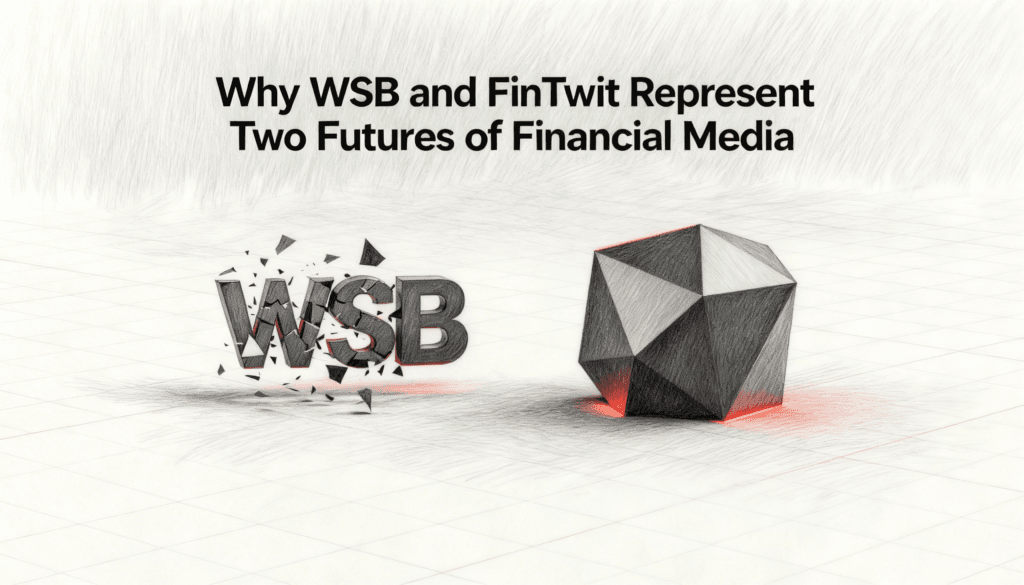
Then two very different communities emerged online and broke that system apart. WallStreetBets and Financial Twitter both replaced the old gatekeepers. But they replaced them with two completely different models that could not be more opposed. One runs on collective identity. The other runs on individual reputation. And the tension between these two models is not just a fun internet story. It is a preview of where all financial media is heading.
The Hive vs. The Name
WallStreetBets does not have a leader. That is the whole point. Nobody speaks for the group because the group does not want to be spoken for. The culture runs on shared language, inside jokes, and a kind of deliberate absurdity that makes it impossible for outsiders to tell who is serious and who is performing. This is not a flaw. It is a feature. The anonymity is protective. When nobody is in charge, nobody can be held accountable, and nobody can be co opted.
FinTwit works on the opposite principle entirely. The entire ecosystem is built on individual names. People build audiences by staking personal credibility on specific calls, frameworks, or areas of expertise. A macro analyst with a strong track record becomes a brand. A portfolio manager who shares their reasoning in public becomes a personality. The currency is not collective energy. It is personal reputation, cultivated tweet by tweet over months and years.
These are not just different communities. They are different theories about how information should move through a crowd.
Authorship and Its Discontents
There is a concept in literary theory called the death of the author. The idea is that once a work is released, the creator’s intentions stop mattering. The audience makes their own meaning. It was a controversial idea in literature. WallStreetBets turned it into a trading strategy.
When someone posts a thesis on WSB, the original reasoning often becomes irrelevant within hours. The crowd takes the ticker symbol and runs with it. The analysis might be brilliant. It might be a joke. It does not matter. Once it catches momentum, it belongs to everyone and no one. The memes mutate. The narrative shifts. The original poster watches their idea get remixed into something they may not even recognize.
FinTwit could not be more different. Authorship is everything. If a well known macro commentator makes a call and it works, their follower count grows. If it fails, they either explain why or lose credibility. The individual name carries weight precisely because it carries risk. You cannot hide behind the crowd.
This maps onto a much older tension that shows up far outside finance. Open source software works the same way as WSB. Nobody owns the code. The collective improves it, forks it, breaks it, fixes it. Meanwhile, the tech industry simultaneously worships founder mythology, the idea that a single visionary drives everything. Both models produce real results. Neither has won definitively.
The Economics of Attention
Here is where things get interesting in ways that neither community likes to admit.
FinTwit pundits need to be right often enough to maintain their audience. But they also need to be interesting enough to grow it. These two goals are not always compatible. The most accurate view in any given market environment is often boring. “Stay the course, nothing has changed” does not generate engagement. So there is a constant gravitational pull toward overcomplicating things, finding drama where there may not be any, and making calls that sound bold even when the smart move is to say nothing.
WSB has the opposite problem. The collective does not need to be right. It needs to be entertaining. The loss posts that go viral are celebrated with the same enthusiasm as the wins. The culture treats a spectacular failure as content, which is genuinely unusual in finance. But this also means there is no mechanism for filtering good ideas from bad ones. Everything gets the same treatment. The brilliant analysis sits next to the post from someone who bet their savings on a stock because they misread the ticker symbol. And both get upvoted.
So FinTwit is pulled toward fake precision. WSB is pulled toward real chaos. Neither impulse is healthy in isolation.
Trust Without Verification vs. Verification Without Trust
FinTwit operates on what you might call a reputation ledger. Over time, the community develops a rough consensus about who is worth listening to. This is not perfect. People are biased toward confident voices. They remember big wins and forget quiet losses. They confuse being articulate with being correct. But the system does create some accountability. If someone is consistently wrong, their audience eventually notices.
WSB operates on something closer to the opposite. Nobody trusts anyone individually, and that is considered a strength. The phrase “this is not financial advice” is posted so often it became a joke, then became sincere again, then became a joke about being sincere. There is no reputation to protect because the whole culture treats reputation as a liability. If you care what people think of you, you are playing the wrong game.
The strange result is that FinTwit, for all its emphasis on individual credibility, is full of people quietly following pundits into trades without doing their own homework. And WSB, for all its chaotic anonymity, sometimes produces better collective due diligence than any single analyst could manage. The GameStop saga was many things, but buried inside the memes was research into short interest and market mechanics that turned out to be largely accurate. The crowd found something the professionals missed.
So the system built on trust sometimes enables laziness. And the system built on distrust sometimes enables discovery. This is counterintuitive enough that it deserves sitting with for a moment.
What Each Gets Wrong About the Other
FinTwit looks at WSB and sees reckless gambling disguised as a community. This is partially true and partially a failure of imagination. Yes, many people lose money on WSB. But dismissing the entire phenomenon as stupidity misses the part where a generation of people locked out of traditional wealth building decided to create their own financial culture from scratch. You do not have to approve of the methods to acknowledge that the impulse is rational.
WSB looks at FinTwit and sees self important pundits repackaging obvious information for clout. This is also partially true. There are absolutely people on FinTwit who dress up simple observations in enough complexity to seem profound. But dismissing all of FinTwit as performance misses the part where some of those individual voices are genuinely excellent at what they do and share valuable analysis for free that would have cost thousands of dollars a decade ago.
Both communities are guilty of defining themselves against each other rather than examining their own weaknesses. Which is, if you think about it, just how politics works. And maybe that is the real insight here. These are not investing communities anymore. They are identities.
The Media Model That Wins
Traditional financial media is watching both of these communities very carefully, and it is terrified. Not because either one is better than CNBC or Bloomberg. But because both have demonstrated that audiences will organize themselves around financial content without needing permission from anyone.
The FinTwit model suggests that the future of financial media is individual creators with direct audiences. No network needed. No editorial board. Just a person, a track record, and a platform. This looks a lot like what happened to journalism more broadly. The institutions lost their monopoly and the individual voices stepped in.
The WSB model suggests something more radical. That the future is not individual creators at all. It is communities that generate their own content, their own narratives, and their own momentum without any central voice. This looks less like media and more like a movement. And movements are much harder for traditional institutions to compete with because there is no one to hire away, no one to discredit, and no one to negotiate with.
The honest answer is that both futures will coexist. Some people want an expert they trust. Others want a crowd they belong to. The market for financial information is big enough for both. But the tension between these models will keep producing friction, because they operate on fundamentally incompatible assumptions about what makes information valuable. Is it the quality of the source or the energy of the crowd?
Finance has never had to answer that question before. Now it does not have a choice.