Table of Contents
There is an old idea in value investing that the best opportunities exist precisely because most people are not paying attention. The logic is simple. If everyone sees it, the price already reflects it. If nobody sees it, the price might be wrong. The entire discipline is built on the premise that the crowd is occasionally, usefully, incorrect.
Now consider Financial Twitter. It is a platform specifically engineered to make sure everyone sees everything at the same time.
You can already sense the problem.
The Contradiction at the Core
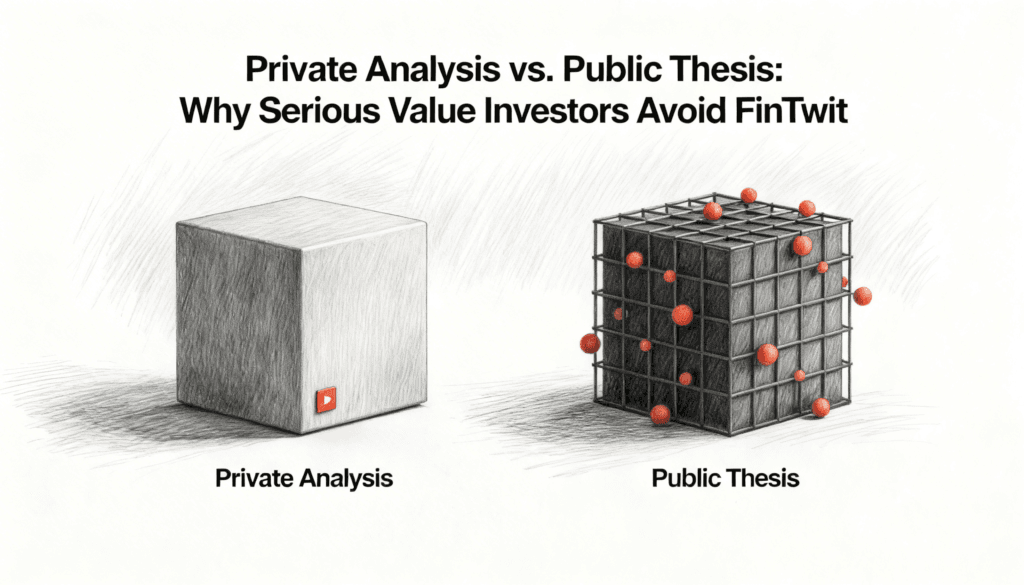
Value investing is, by nature, a private act. You read financial statements. You build models. You estimate what a business is worth. You compare that number to the price. If there is a gap, you buy. Then you wait. You do not need an audience for any of this. In fact, an audience is the last thing you want. Every person who agrees with your thesis and acts on it narrows the gap you are trying to exploit.
FinTwit inverts this completely. The entire platform runs on sharing. Sharing ideas, sharing positions, sharing conviction. The incentive structure rewards the person who broadcasts their thesis the loudest and the earliest. But here is the part nobody likes to discuss: if you have genuinely found something mispriced and you tell thousands of people about it, you have just started to erase the very mispricing that made the idea valuable.
This is not a minor tension. You cannot simultaneously exploit an information advantage and give it away for free. The value investor who posts their full thesis on Twitter is doing charity work for their own competition.
The Spectacle of Conviction
There is something seductive about the public thesis. When someone posts a deep analysis of an obscure company, complete with valuation ranges and risk factors, it looks like serious work. It often is serious work. The problem is not the quality of the analysis. The problem is what happens to that analysis once it enters the arena of public attention.
A private thesis lives or dies on one thing: whether it was right. A public thesis lives or dies on something else entirely. It has to survive the crowd. The moment you post your investment case on FinTwit, you are no longer just an investor. You are a performer defending a position. And defending a position in public creates a kind of psychological trap that almost nobody escapes.
Once you have stated your view in front of an audience, reversing it carries a social cost. Admitting you were wrong in your own notebook is a minor disappointment. Admitting you were wrong in front of ten thousand followers is a small identity crisis. So people hold on longer than they should. They find reasons to stay committed. They interpret new information through the lens of their existing public position rather than the other way around.
The irony is sharp. A discipline built on independent thinking becomes compromised the moment it enters a space designed for social validation.
What FinTwit Actually Selects For
Here is something that gets overlooked in the debate about quality on Financial Twitter. The platform does not select for the best investors. It selects for the best communicators who also happen to invest.
These are not the same thing. Warren Buffett is a gifted writer, but he is the exception that proves the rule. Most of the greatest investors in history have been remarkably boring in public. They did not need to be interesting. They needed to be right. And being right, in value investing, often means sitting still for years doing nothing while your thesis plays out. That is not content. That is a screen saver.
FinTwit rewards the opposite. It rewards frequency, novelty, and provocation. If you post one idea per year, you will have no followers. If you post ten ideas per week, you might build an audience, but you are almost certainly not doing the kind of patient, concentrated work that value investing demands. The cadence of social media and the cadence of deep fundamental analysis are running at different clock speeds. Something has to give, and it is usually the analysis.
There is a parallel here to academia. The most published researchers are not always the ones making the deepest contributions. The incentive to publish frequently can erode the incentive to think carefully. Publish or perish creates volume. It does not necessarily create insight. FinTwit has its own version of this dynamic: post or disappear.
The Information Paradox
Value investors traditionally gained their edge from doing work that others would not do. Reading obscure filings. Visiting factories. Talking to customers and competitors. The information was not secret, but it was inconvenient enough to access that most people did not bother. The edge was not in having private information. It was in having the patience and the discipline to process public information more thoroughly than anyone else.
FinTwit has made this harder. Not because the information changed, but because the distribution changed. Twenty years ago, if you found something interesting buried in a footnote of a quarterly filing, you might have days or weeks before anyone else noticed. Now, someone screenshots it and posts it. Within hours, thousands of people have seen it. The insight gets priced in before you finish your coffee.
This is genuinely good for market efficiency. And it is genuinely bad for the value investor who was planning to exploit that inefficiency. Progress for the market as a whole can be a loss for the individual who was doing the work.
It creates a strange situation where the people most capable of doing deep analysis have the least incentive to share it. And the people most eager to share are often working from shallower analysis. The feed ends up full of confident takes built on incomplete work, while the serious work stays hidden in private research files and never reaches the public.
The Social Identity Trap
There is a deeper issue at play, and it has nothing to do with information or returns. FinTwit turns investment positions into identity markers. When someone describes themselves as a value investor in their bio, follows other value investors, and posts regularly about their holdings, their portfolio stops being a collection of financial positions and becomes part of who they are.
This is dangerous for a reason that goes beyond ego. Good investing requires the ability to change your mind quickly and completely. You need to be able to look at a position and say: I was wrong, the thesis is broken, I am selling today. That is hard enough in private. It is almost impossible when your entire online identity is built around that position.
There is a reason the most successful hedge fund managers tend to be almost pathologically private. It is not just about protecting their positions. It is about protecting their ability to think clearly. When nobody knows what you own, changing your mind costs nothing. When everyone knows, it costs.
The Counter Argument Worth Acknowledging
To be fair, FinTwit does provide something that private analysis cannot. It provides stress testing. When you post a thesis in public, smart people will find the holes. They will challenge your assumptions, point out risks you missed, and question your reasoning. This is valuable. It is essentially a free peer review process run by thousands of participants who have a financial incentive to be right.
The problem is that this stress testing comes bundled with all the other dynamics: the social pressure, the identity formation, the information leakage, the performance anxiety. It is like getting a free gym membership that requires you to work out on a stage in front of a crowd. The exercise is real. But the conditions change the experience entirely.
Why the Best Work Stays Quiet
There is a final point that ties this together, and it is almost too simple to feel profound. The best value investing is boring. It involves reading documents that nobody else wants to read. Waiting for things that nobody else is waiting for. Being right about a company that nobody else is watching, for reasons that nobody else has bothered to figure out.
None of this translates to social media. You cannot make a thread out of patience. You cannot make a post go viral with the insight that nothing has changed and you are continuing to hold. The very qualities that make someone a good value investor make them a bad content creator. And the very qualities that make someone a good content creator on FinTwit make them vulnerable to the exact mistakes that value investing is designed to avoid.
This does not mean FinTwit is useless. It means it is a different game. The investors who understand this use it as a source of ideas to investigate privately, not as a stage to perform on. They read far more than they post. They treat the feed like a newspaper, not a diary. They take the inputs and leave the identity behind.
The serious value investor does not need an audience. They need a spreadsheet, a filing, and the willingness to be bored for years at a time. That will never trend. Which, if you think about it, is exactly the point.