Table of Contents
There is a strange kind of symmetry in finance that nobody talks about. Every investing community has someone they look down on. And almost always, that someone is looking down on somebody else. The contempt travels in one direction, like a river that only flows downhill. At the top sits whoever thinks they are working the hardest for their returns. At the bottom sits whoever they think is being lazy, lucky, or delusional.
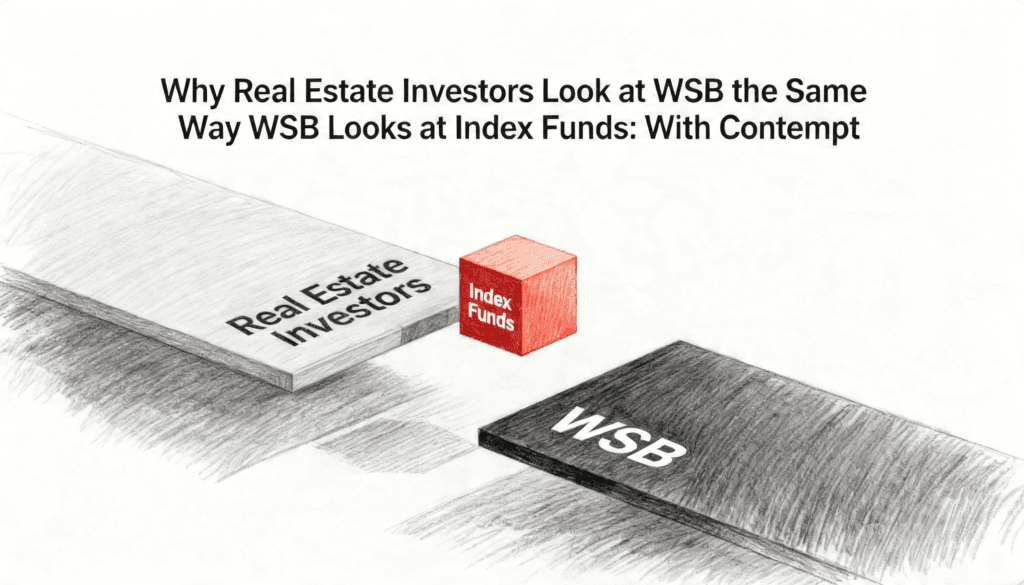
Real estate investors sit near the top of this river. They look down at the WallStreetBets crowd with the same expression WallStreetBets reserves for index fund investors. The facial expression is identical. Only the target changes. And the fact that nobody notices this is the most interesting part of the whole thing.
The Contempt Pyramid Nobody Admits Exists
If you listen carefully to how investors talk about other investors, you start to hear a pattern. It sounds something like this.
Index fund investors think everyone else is wasting their time. Just buy the whole market and go to sleep. Stock pickers think index fund investors are sheep who have given up. Dividend investors think stock pickers are chasing mirages. Options traders think dividend investors are old. WallStreetBets thinks options traders who use risk management are cowards. Real estate investors think WallStreetBets is a roulette table with better lighting. And the people who own entire apartment buildings think single family landlords are playing house.
Everyone is standing on the shoulders of someone they have decided is beneath them. And everyone has someone standing on their shoulders calling them the same thing.
This is not a financial hierarchy. It is a moral one. Or at least it pretends to be.
What Real Estate Investors See When They Look at WSB
To the average real estate investor, WallStreetBets looks like a sped up version of everything they have worked to avoid. No ownership of anything real. No control over outcomes. No cash flow. No tax benefits. No tenant calling at midnight, sure, but also nothing that exists when the screen turns off.
A landlord can drive past a property they own. They can point at it. They can fix a leaky faucet and feel like they did something. Their money has taken a physical form that occupies space in the world. When they talk about their investments, they use nouns. Houses. Buildings. Units. Doors.
WallStreetBets talks in verbs and screenshots. You bought. You sold. You held. You lost. You won. The entire experience is weightless. A trade exists only as long as you have the app open. Close the app and the position is still there, somewhere, but you cannot walk around it. You cannot show your father in law. You cannot paint it a different color.
The real estate investor looks at all of this and sees a person who has confused motion with progress. Lots of activity. Lots of feeling. No permanence.
This is the exact same complaint WallStreetBets has about index fund investors, by the way. A Boglehead buys the total market fund and waits forty years. No activity. No feeling. No story to tell at the dinner table. To the options trader, this looks like surrender. To the landlord, options trading looks like surrender too, just surrender at a different speed. Surrender to what? To the idea that you can build something real with your money.
The irony is almost too clean. Both groups accuse the other of giving up. They just define giving up in opposite directions.
What WSB Sees When It Looks at Index Funds
Now flip the telescope around. To the WallStreetBets trader, the index fund investor is the one missing the point entirely. Why would you accept the average return of the entire market when you could pick the winners? Why would you wait forty years when you could compress the same wealth into a few lucky quarters? Why would you buy the haystack when you can go find the needle?
To an options trader, patience is not a virtue. It is a symptom. A symptom of someone who has accepted the terms offered to them instead of negotiating better ones. The Boglehead is not wrong exactly. Just small. Safe in a way that feels embarrassing if you think about it too long.
Notice that this is almost the exact framing the real estate investor uses against WallStreetBets. Why would you accept the outcome of a gamble when you could build a real business? Why would you compress your decisions into minutes when you could make careful ones over years? Why would you rent exposure to the market when you could own the thing itself?
Three different groups. One sentence structure. “Why would you accept X when you could have Y.” The answer each group gives just depends on where they happen to be standing.
The Hidden Rule of Financial Contempt
There is a rule running quietly underneath all of this, and once you see it, you cannot unsee it.
Contempt in investing almost always flows from whoever feels they are working harder toward whoever they think is working less. It is not about returns. It is not about intelligence. It is about effort. Or more precisely, about the appearance of effort.
The real estate investor is not necessarily making more money than the WSB trader. In many years they are not. But the real estate investor feels like they earned it. They found the deal. They negotiated the price. They managed the rehab. They dealt with the tenants. To them, that is what makes it real.
WallStreetBets traders feel the same way about their wins, incidentally. They did the research. They watched the charts. They had the conviction to hold when everyone else folded. They see themselves as active participants in a market, not passive recipients of it. And they look at the index fund investor the same way the landlord looks at them: as someone who did not earn the outcome because they did not work for it.
Meanwhile, the index fund investor has arguably made the most rational choice of all three. Historically, broad market indexes beat most active traders over long periods. The research here is not contested. It is boring because it is settled. And yet the index fund investor gets the least respect in the investing world, precisely because they did the least visible work. Their contempt, when it comes, flows upward at everyone else for refusing to accept the evidence. But it rarely reaches them first. They are at the bottom of the river, getting rained on by everybody upstream.
This is the quiet joke at the center of financial culture. The returns and the respect are almost completely disconnected.
Why This Matters Beyond Finance
You can find this same pattern in any field where outcomes depend on a mix of skill, luck, and time. It shows up in writing, where novelists look down on bloggers, bloggers look down on tweeters, and tweeters look down on people who just read. It shows up in fitness, where powerlifters look down on bodybuilders, bodybuilders look down on runners, and runners look down on people who walk. Each rung is sure the rung below does not understand what real effort looks like. And each rung is about to be mocked by the rung above for the exact same reason.
Finance is just a louder version of this because the scoreboard is money, and money is something everyone agrees exists. But the contempt has nothing to do with the money. It has to do with the story people need to tell themselves about how they got it.
The real estate investor needs the WSB trader to look reckless. Otherwise the landlord has to face an uncomfortable question. If someone can make the same money in a month that takes me ten years, what exactly am I being rewarded for? The answer might be discipline. The answer might also be slowness dressed up as discipline. Neither side wants to look at that question directly, so they keep pointing at each other instead.
The Thing Everyone Is Actually Afraid Of
Strip away the contempt and you find the same fear underneath every group in the river. The fear that the method you chose was not the best one. That someone else figured out a shortcut. That your effort was not rewarded because it was effort, but because the world happened to be shaped in a certain way for a certain amount of time. That the story you tell yourself about why you deserve your money might not survive close inspection.
Contempt is how we keep that fear quiet. If the people making money differently are idiots, then they cannot be evidence against your method. They can only be exceptions, outliers, fools who got lucky. And since markets keep producing people who get lucky, there will always be fresh targets for contempt, no matter which tribe you happen to belong to.
The real estate investor and the WSB trader will never get along. Not because they disagree about finance but because they agree on something far more threatening. They both believe their way of making money says something about who they are as a person. And if the other side is also right, then maybe it does not.
Somewhere downstream, the index fund investor quietly reinvests their dividends and pretends not to notice.