Table of Contents
There is a special kind of math people do at three in the morning. It involves years, not dollars. It counts anniversaries, shared apartments, the dog you adopted together, the funeral of their mother you stood through, the holidays where you learned to smile at an uncle who never learned your name. You add it all up and arrive at a number too large to walk away from. So you stay. And you call it love.
It is not love. It is accounting.
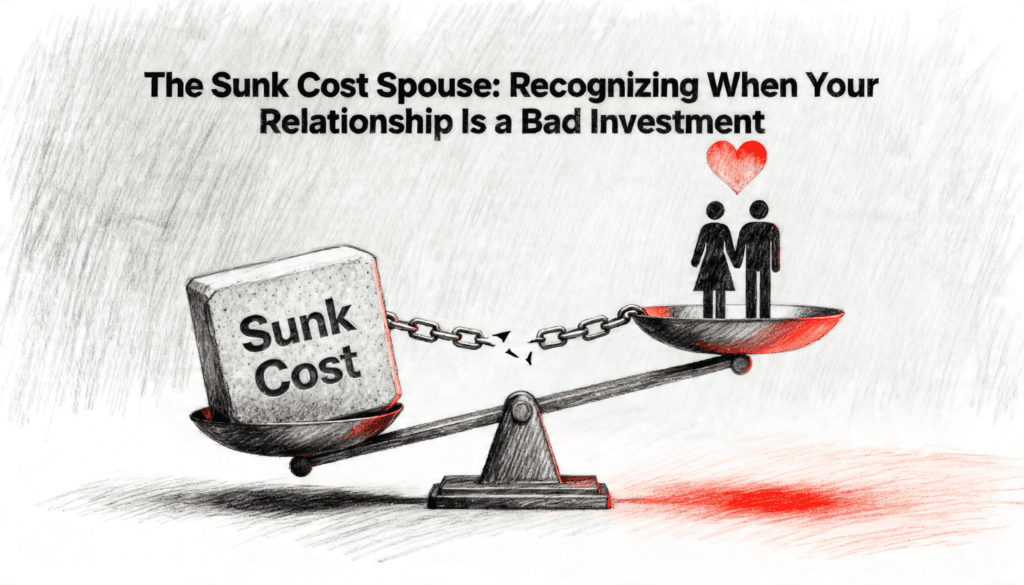
Economists have a clean little phrase for this confusion. They call it the sunk cost fallacy, and it describes the very human habit of throwing good money after bad because we cannot stand the thought of losing what we already spent. A business keeps a failing product on the shelf because of the millions already poured into it. A gambler doubles down because walking away would make the previous losses real. And a person stays in a relationship that drained them years ago because leaving would mean admitting the investment did not pay off.
The cruel irony is that the longer you stay, the harder it becomes to leave. Each additional year is not a reason to stay. It is the bill for staying.
The Portfolio You Did Not Mean to Build
Think of your emotional life as a portfolio. You have only so much capital to invest. Time is finite. Attention is finite. The energy you wake up with each morning is a budget that gets spent whether you mean to spend it or not. Where you put it determines what grows.
A healthy relationship is a position that compounds. You put in care and you get back trust. You put in vulnerability and you get back intimacy. The returns are not always immediate, and they are not always linear, but over time the position appreciates. You are richer in the ways that matter than you were when you started.
A bad relationship is the opposite. You put in care and you get back suspicion. You put in honesty and you get back contempt. You put in years and you get back a slow erosion of the person you used to be. The position is not just flat. It is bleeding.
The problem is that nobody hands you a quarterly statement on your marriage. There is no app that pings you when your emotional net worth drops below a threshold. You have to calculate it yourself, and most people are terrible at it because they refuse to mark the position to market. They keep valuing the relationship at the price they paid for it years ago, when it was promising, when it was new, when there was reason to believe it would grow.
Why Smart People Stay in Bad Deals
Anyone who has worked in finance long enough has watched a brilliant analyst hold a losing stock past every reasonable exit point. They know the fundamentals have changed. They have seen the warning signs. They could write the case for selling better than anyone in the room. And yet they hold, because selling means admitting they were wrong, and being wrong feels worse than being poor.
Relationships work the same way. The smartest people stay the longest in the worst situations, because intelligence is excellent at building stories that justify staying. You can talk yourself into almost anything if you are clever enough. He is going through a hard time. She did not mean it. We just need to communicate better. Things will improve once the kids are older, once the job changes, once the house is finished, once the pandemic ends, once, once, once.
A useful question to ask yourself is the one venture capitalists ask about their portfolio companies. If I were not already invested in this, would I invest today? If a stranger described this exact relationship to you, with all its current dynamics and none of the history, would you tell them to sign up for it? Would you congratulate them?
If the answer is no, you are not in love. You are trapped by your own past decisions.
The Sunk Cost of Holding
There is a concept in investing called opportunity cost. It is the value of the thing you did not do because you were doing something else. Every dollar tied up in a bad investment is a dollar that cannot be in a good one. Every hour spent defending a position that is not working is an hour not spent finding one that does.
In relationships, opportunity cost is the most invisible expense and the most devastating. It is the friendships you did not deepen because your partner did not like them. It is the career move you did not make because it would have rocked the boat. It is the version of yourself that never got to exist because the relationship needed you to be smaller, quieter, more agreeable, less ambitious. You will never see that version of you on a balance sheet, but they are gone, and their absence is the real price.
People often say that leaving a long relationship means losing years. This is backwards. Staying in a bad relationship means losing years. Leaving means stopping the loss.
The Diversification Problem
Here is where the metaphor gets a little uncomfortable. In finance, the cardinal rule is to never put all your eggs in one basket. Diversify. Spread risk. Do not let a single position determine your entire net worth.
In love, we are told to do the opposite. We are told that the right person becomes the center of everything. They are the partner, the best friend, the co-parent, the financial collaborator, the emotional support, the future planner, the witness to your life. One person, all roles, forever. It is the most concentrated position most people will ever hold.
This is not an argument against monogamy. It is an argument for understanding what you are doing when you commit. You are choosing to put an enormous portion of your wellbeing into a single asset. That asset had better be sound. And if it is not, the fact that you concentrated everything into it is not a reason to stay. It is a reason the stakes of leaving feel so high. Those are not the same thing, even though they feel identical from the inside.
What the Market Is Telling You
Markets give you signals if you pay attention. Earnings reports. Insider selling. Sudden silence from people who used to talk a lot. Relationships give you signals too, and they are not subtle if you stop ignoring them.
You feel relief when they travel for work. You rehearse conversations in your head before having them out loud. You have stopped sharing good news because you know it will somehow become a problem. You catch yourself fantasizing about a quiet apartment, a different city, a life where you do not have to explain yourself. You are tired in a way that sleep does not fix.
None of these are necessarily reasons to leave. Every long relationship goes through stretches of difficulty, and difficulty is not the same as wrongness. But these signals are data, and the worst thing you can do with data is pretend you did not see it. The point is not to act on the first bad quarter. The point is to actually look at the numbers instead of looking away.
The Myth of the Turnaround
Every bad investment has a turnaround story attached to it. The new product is going to launch next year. The CEO is finally going to be replaced. The market is going to come back. People hold and hope, because hope is cheaper than action.
Bad relationships have turnaround stories too, and they are even more seductive because they involve the person you once loved. Therapy will fix it. The new job will calm them down. Once we move, once they get sober, once the depression lifts, once they realize what they have. And sometimes, occasionally, these stories come true. People do change. Couples do reinvent themselves. The market does come back.
But hope is not a strategy, and a turnaround that requires the other person to fundamentally become someone else is not a turnaround. It is a fantasy with an exit date that keeps moving. The honest question is not whether change is possible. It is whether change is happening, right now, in observable ways, on a timeline you can actually live with. If the answer is no, you are not waiting for a turnaround. You are paying rent on a delusion.
Cutting Losses Is a Skill
Nobody teaches us how to leave. We get books on how to fall in love, how to date, how to commit, how to communicate. We get a thousand wedding planners and exactly zero divorce planners. The infrastructure of our culture is built around staying, which is lovely when staying is the right answer and devastating when it is not.
Knowing how to cut a loss is one of the most underrated skills a person can develop, in money and in love. It requires you to separate your identity from your decisions. The fact that you chose this once does not mean you have to keep choosing it. The fact that you were wrong does not make you a failure. It makes you someone who learned something, which is the only thing that being wrong is good for.
The traders who last are not the ones who never lose. They are the ones who lose small and win often, who exit positions before the loss compounds, who treat each decision as a new decision rather than a defense of the old one. The same is true in love. The people who end up in good relationships are not the ones who never picked badly. They are the ones who could tell when a position was no longer working and had the discipline to close it.
The Real Question
So here is the question worth sitting with. If you knew you would live to be ninety, and you took the relationship as it is right now, with no fantasies about how it might improve and no nostalgia for what it used to be, would you want to spend the next fifty/sixty years inside it? Not the next year, where you can grit your teeth. The next fifty/sixty.
If your answer is yes, then everything you have invested was worth it, and everything you continue to invest will compound. You are in the right position.
If your answer is no, then the years you have already spent are not a reason to spend more. They are a reason to stop. The losses are real either way. The only question is whether you keep adding to them.
Love is not a sunk cost. But sometimes the relationship is, and confusing the two is the most expensive mistake a person can make. Not in dollars. In the only currency that ever actually mattered, which is the time you have left and what you choose to do with it.