Table of Contents
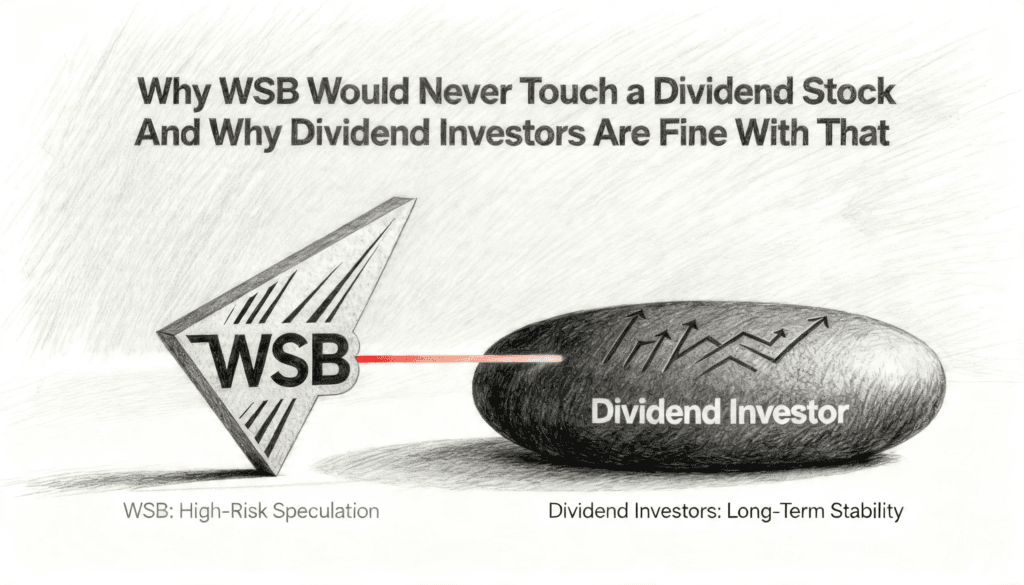
There is a specific type of silence that falls over WallStreetBets when someone mentions dividends. It is not hostility. It is not disagreement. It is something closer to confusion, like a room full of skydivers being asked if they have considered gardening. The activities are technically both done by humans, but beyond that, the overlap is hard to find.
Meanwhile, in a parallel universe of spreadsheets and quarterly payment schedules, dividend investors are watching all of this with the mild, unbothered expression of people who have already decided what the rest of their lives will look like. They know WSB exists. They just do not care. And this mutual indifference, more than any real argument, is the most interesting thing about the whole situation.
Because when two groups occupy the same market and somehow never even brush against each other, something bigger is going on. They are not just using different strategies. They are playing different games with different definitions of winning.
The Philosophy of the Coupon
Dividend investing is, at its heart, a deeply conservative idea dressed up as a financial strategy. The premise is simple. You buy a share of a business. That business makes money. The business sends you a portion of that money on a regular schedule. You do not need to sell anything. You do not need the stock price to go up. You do not need the market to agree with you. You just need the company to keep doing what companies are supposed to do, which is make a profit and share it with its owners.
There is something almost old fashioned about this. It echoes a time when owning a business meant you actually expected to receive money from that business, not just hope that someone else would pay more for your piece of it later. Dividend investors are, in a sense, the last remaining people who take the original deal of the stock market seriously. You give me capital. I give you a share of the profits. That was the whole idea once.
The mindset that follows from this is slow, patient, and borderline boring. Dividend investors talk about things like payout ratios, dividend growth streaks, and how many decades a company has managed to keep raising its payment without cutting it. They get excited about companies nobody else finds exciting. Utilities. Toothpaste makers. Companies that sell things people buy during recessions without thinking about it.
The goal is not to beat the market this year. The goal is to build something that pays you while you sleep for the next forty years.
The Philosophy of the Jackpot
WallStreetBets is operating on a completely different premise. The core belief there is not that companies slowly create value over time. It is that the market occasionally presents situations where a small amount of money can be transformed into a large amount of money very quickly. Finding those situations, and having the stomach to act on them, is the entire skill.
This is not really investing in the way your grandfather would have recognized it. It is closer to a form of asymmetric betting. You risk an amount you can afford to lose, in exchange for a chance at a return that could change your life. The vast majority of these bets do not work. The ones that do work occasionally, famously, spectacularly. And the culture is built around celebrating the wins loudly while treating the losses as proof you were brave enough to try.
Dividends are completely useless inside this framework. A two percent yield is not interesting when you are looking for a two hundred percent move. A quarterly payment is not meaningful when your entire position might be closed in four days. Dividend stocks tend to be stable, which is exactly the problem. Stability is the enemy. If a stock is not moving, there is nothing to bet on. If a company is predictable, there is no story to tell.
You cannot make a meme out of Procter and Gamble. And on WSB, if you cannot meme it, it does not exist.
The Real Disagreement Is About Time
What looks like a strategy difference is actually a disagreement about time, and specifically about how much of it you believe you have.
Dividend investors are behaving as if they have decades. They are not trying to get rich. They are trying to become financially independent by a certain age, and they have figured out that the most reliable way to do that is to collect growing streams of income from many different sources and let them accumulate. The clock is their friend. Every year that passes, the compounding works a little harder on their behalf.
WSB is behaving as if time is the enemy. The assumption underneath the memes is that waiting forty years to be comfortable is not actually a solution for most people. Forty years is a long time. A lot can happen. Inflation can eat your savings. You could get sick. You could die. The rational response to a long, uncertain timeline is to try to compress it, which means taking bigger risks for bigger rewards. It is not irrational. It is a different bet on what the future holds.
This is why the two groups cannot really argue with each other. They are not disagreeing about what works. They are disagreeing about what the word “work” means. For one side, working means reaching a quiet life of financial security. For the other, working means a chance at a life that skips the quiet part entirely.
A Strange Echo From Another World
There is a useful comparison here from somewhere completely different. Think about how people approach physical fitness. One group goes to the gym three times a week for thirty years. They do not look dramatic. They do not post before and after photos. They just keep showing up, and eventually, without anyone noticing, they become the sixty year old who can still carry their own groceries up three flights of stairs. Another group does extreme challenges. They try to lose fifty pounds in three months. They do viral workouts. They post dramatic transformations. Sometimes it works. Sometimes they get hurt. Sometimes they gain it all back.
Neither group is wrong. They are optimizing for different things. The first group is optimizing for a life. The second group is optimizing for a moment. Finance has exactly the same split, and it shows up most clearly in the gap between the dividend crowd and WSB. One is building a life. The other is chasing a moment. Both can be rational, depending on what you actually want.
Why the Indifference Is Mutual
The thing that surprises outsiders is that dividend investors are not offended by WSB. Not really. They might shake their heads at a particularly bad trade, but they do not feel threatened, and they certainly do not feel the need to convert anyone. This is because dividend investing, more than almost any other strategy, is emotionally self sufficient. The whole point is that you do not need external validation. You do not need the market to agree with you. You do not need anyone else to understand what you are doing. The payments arrive whether the internet approves or not.
WSB, for its part, does not think dividend investors are wrong. It just finds them boring, and boring is the one unforgivable sin in a culture built on entertainment value. The dividend investor who slowly builds a portfolio of utility companies is not the villain of the WSB story. The dividend investor is a character that does not exist in the WSB story at all.
This is the actual clash, and it is more unusual than a normal financial disagreement. Most disagreements in finance are fights over who is right. This one is a mutual shrug. They are not enemies. They are strangers who happen to share the same building.
What Each Side Quietly Knows About the Other
If you press hard enough, both sides will admit something interesting.
Dividend investors secretly know that their approach is emotionally dependent on the boring parts being boring. The day dividend investing becomes exciting is probably the day something has gone wrong. The strategy needs to be quiet to work. If a dividend stock is suddenly getting pumped on social media, the dividend investor is not happy. They are worried.
WSB, in its rare moments of honesty, knows something too. It knows that the culture is not really about making money. It is about being part of something. The memes, the loss porn, the diamond hands, the shared language. These are not the side effects of trading. They are the actual product. The trades are the excuse to be in the room. Some people have made enormous amounts of money there, but most participants are paying tuition to a community that happens to be shaped like a casino.
Once you see this clearly, the whole situation becomes less confusing. Dividend investors are buying financial freedom. WSB participants are buying belonging, with a lottery ticket stapled to it.
The Quiet Truth Underneath It All
Here is what is interesting, and it might be the only useful insight in this entire conversation. Both strategies can work. Both strategies can fail. The factor that determines which outcome you get has very little to do with which strategy you chose, and almost everything to do with whether you actually understood what you were signing up for.
The dividend investor who panics when the market drops and sells at the bottom is not going to reach financial independence, no matter how good the payout ratios looked on paper. The WSB participant who treats bets like investments and refuses to cut losses is not going to find a jackpot, no matter how bold the entries were. In both cases, the failure is not the strategy. The failure is the mismatch between the strategy and the person.
Which means the real question is never “which side is right.” The real question is simpler and much less fun. What kind of life are you actually trying to build, and are you honest enough with yourself to admit it?
The dividend investors have answered this question, usually in a very quiet voice, and they have stopped worrying about what anyone else is doing. WSB has answered it too, in a much louder voice, and has stopped worrying about whether anyone approves. The mutual indifference is not rudeness. It is the sound of two groups who have each decided what they want and are no longer open to being recruited.
And if there is any lesson here worth taking home, it might be that deciding clearly is the part that matters. The strategies are just the vehicles. The destination was chosen long before the trade was placed.