Table of Contents
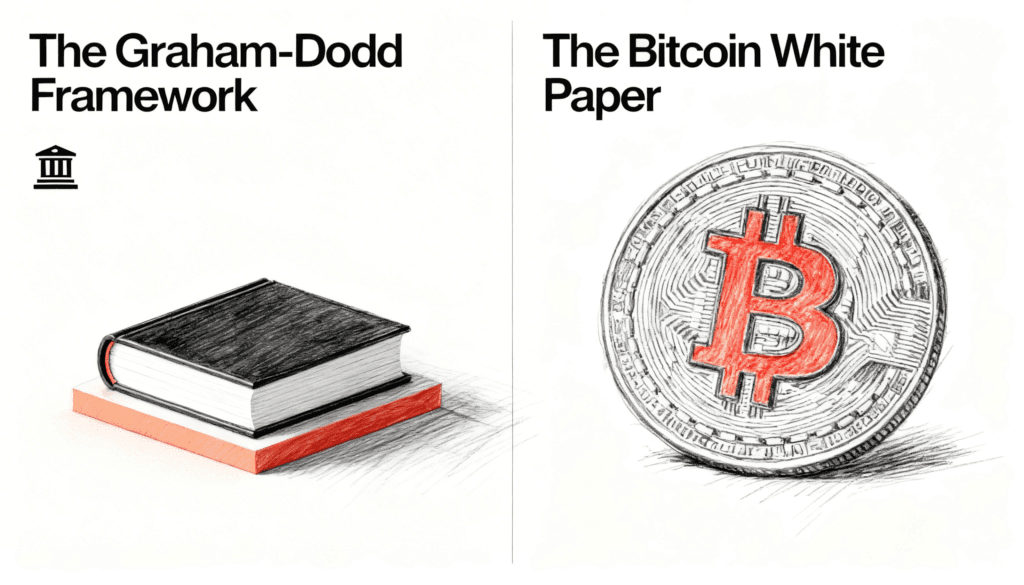
In 1934, two professors at Columbia Business School published a book that would quietly define how serious people think about money for the next ninety years. In 2008, an anonymous figure who may or may not exist published a nine page PDF that would loudly redefine it for everyone else. Benjamin Graham and David Dodd wrote Security Analysis during the wreckage of the Great Depression. Satoshi Nakamoto wrote the Bitcoin white paper during the wreckage of the Global Financial Crisis. Both documents were responses to the same problem: people had stopped trusting what they owned. Both proposed a solution. And the solutions could not be more different if they tried.
One says value lives inside a thing. The other says value lives in the agreement about a thing. That sounds like a small philosophical distinction until you realize the entire modern debate about money, investing, and wealth is basically a long argument over which one of them is right.
The Professors and the Ghost
Graham and Dodd were empiricists in a world drunk on speculation. The 1920s had been a carnival of stock tips, margin loans, and confidence posing as analysis. When the music stopped, ordinary people discovered that what they thought they owned was mostly vapor dressed up in certificates. Graham and Dodd responded the way professors do. They wrote a very long book telling everyone to calm down and look at the numbers.
Their argument, stripped to its bones, is this: a business is worth what it can produce over time. You figure out what it produces, discount the future a little because the future is uncertain, and then you buy it for less than that. The gap between what something is worth and what you pay for it is called the margin of safety. It is the whole game. Everything else is noise.
Satoshi, writing from somewhere in the ether, was not interested in businesses. The white paper is not a theory of value in the traditional sense at all. It is a theory of trust. Its central claim is that the problem with money has never really been calculation. It has been the middleman. Every time two people exchange value across distance or time, some third party has to verify that nobody is cheating. Banks, governments, clearing houses, notaries. Satoshi proposed that this verification could be handled by math and collective computation instead of by institutions. The value of Bitcoin, in the original document, is almost an afterthought. The breakthrough was the protocol.
This is the first and most overlooked difference between the two frameworks. Graham and Dodd start with the question what is this worth? Satoshi starts with the question who decides?
Two Definitions of Real
There is a beautiful and slightly ridiculous tension between these worldviews. Graham and Dodd assume that somewhere beneath all the market noise there is a true number. They may not know it exactly, but they believe it exists. The market is like a moody friend who sometimes overreacts and sometimes underreacts, and your job is to be patient enough to buy when they are sad and sell when they are giddy. This assumes a bedrock of reality under the mood swings. A factory makes widgets. Widgets sell for money. Money comes back to shareholders. Real things, producing real things, generating real flows.
Satoshi does not argue with this. Satoshi just sidesteps it. The white paper is not making a claim about intrinsic value at all. It is making a claim about coordination. If enough people agree that a scarce digital record is worth something, and if the rules that govern its scarcity are impossible to break, then that agreement itself becomes the value. The thing is worth what the network says it is worth. There is no deeper layer.
This is where people usually start shouting at each other. The Graham and Dodd camp says Bitcoin produces nothing, pays no dividends, has no earnings, and therefore has no value. The Bitcoin camp says gold also produces nothing, pays no dividends, has no earnings, and has been treated as value for five thousand years. The Graham and Dodd camp says gold is at least physical. The Bitcoin camp says physicality has nothing to do with monetary premium. And around and around it goes, usually at dinner parties, usually until someone changes the subject.
But the interesting thing is not who wins the argument. The interesting thing is that both sides are using the word “value” to mean completely different concepts. Graham and Dodd use value the way an engineer uses it. Satoshi uses it the way an anthropologist uses it. They are not really disagreeing. They are speaking past each other in two languages that happen to share a dictionary.
The Invisible Assumption Nobody Mentions
Here is where it gets uncomfortable for everyone. The Graham and Dodd framework secretly depends on something it never admits. It depends on the stability of the unit you are measuring in. When you calculate that a company is worth ten dollars per share, you are quietly assuming that the dollar itself is a trustworthy ruler. If the ruler shrinks, your calculation means nothing. You can be the world’s best value investor and still watch your returns evaporate if the currency you measured them in quietly loses its shape.
This is the crack in the foundation that Satoshi walked through. The white paper is not really an attack on stocks or businesses or fundamental analysis. It is an attack on the idea that the measuring stick itself can be taken for granted. And once you see this, the two frameworks stop looking like opposites and start looking like different answers to different questions. Graham and Dodd ask how to measure value inside the system. Satoshi asks whether the system itself is a reliable measure.
You can hold both questions in your head at the same time. Most people do not. Most people pick a tribe and spend the rest of their lives defending it.
What You Are Really Buying
Here is something worth sitting with. When you buy a share of a company under the Graham and Dodd framework, you are buying a claim on future flows of cash. You are betting on managers you do not know to run a business you cannot see to produce outcomes you cannot predict. The margin of safety is the acknowledgment that your forecast is probably wrong. You are compensating yourself in advance for being incorrect.
When you buy Bitcoin under the white paper framework, you are buying a position in a shared agreement. You are betting that the network will continue to exist and that enough other people will continue to want what you have. There is no underlying business to analyze. There is only the protocol and the people who believe in it. The margin of safety, if there is one, is the belief that the agreement is durable.
This distinction reveals something most investors never quite articulate. Every form of ownership is a bet on something. Graham and Dodd bet on productivity. Satoshi bets on consensus. A rental property is a bet on the local housing market. A bond is a bet on the borrower. A painting is a bet on future taste. The difference is not whether you are speculating. The difference is what you are speculating on.
People who say Bitcoin is pure speculation while stocks are real investment have not thought carefully about what makes a stock real. A stock is a legal construct. Legal constructs require institutions. Institutions require trust. The whole edifice sits on agreements just like Bitcoin does. They are simply older agreements, and we have forgotten that they were ever agreements at all. Familiarity turns agreements into furniture. We stop noticing what we are sitting on.
Borrowing From Physics for a Second
There is a concept in physics called a frame of reference. It says that motion only makes sense relative to something else. If you are on a train reading a book, the book is not moving from your perspective. From the perspective of someone standing on the platform, you and the book are moving together at sixty miles an hour. Neither view is wrong. They are just different frames.
Graham and Dodd operate in the frame of the existing financial system. Inside that frame, their tools work beautifully. You can calculate cash flows. You can compare ratios. You can find companies that are mispriced. Satoshi operates in a frame that steps outside the financial system and looks at it from the platform. Inside that frame, the question is not which companies are mispriced. It is whether the currency doing the pricing is itself stable enough to trust.
Both frames are useful. Both are correct within their own assumptions. The mistake is assuming that one frame contains the whole picture.
What the White Paper Actually Changed
The surprising thing about the Bitcoin white paper is how modest its ambitions were on paper. Satoshi was not trying to replace Graham and Dodd. Satoshi was trying to solve a narrow problem about electronic cash and double spending. The philosophical implications came later, drawn out by readers who saw something in the document that maybe even the author did not fully see. This is often how important ideas work. The person who writes them rarely understands their full reach.
Graham and Dodd probably did not fully understand theirs either. Security Analysis was a technical handbook. It became a philosophy only in retrospect, when disciples like Warren Buffett turned its tools into a worldview. Satoshi released a protocol. It became a philosophy when early adopters turned the code into a creed.
Both texts started as practical documents. Both became foundational myths. This is not a coincidence. Humans tend to mythologize whatever framework rescues them from the previous framework’s failures. Graham and Dodd rescued investors from the speculative insanity of the 1920s. Satoshi rescued them from the institutional failures of 2008. Each text was born from a specific disillusionment and grew into a general theory of how to avoid being fooled again.
The Quiet Punchline
If you read both documents carefully, you notice something strange. They agree on more than their followers do. Both are deeply suspicious of crowds. Both insist on rules that cannot be bent by moods. Both are really about protecting yourself from human weakness. Graham and Dodd do it by anchoring you to numbers. Satoshi does it by anchoring you to code. The enemy in both cases is the same. It is the tendency of people, including you, to believe whatever feels good at the moment.
The true disagreement is not about value. It is about where to put the anchor. In the ground of fundamentals, or in the web of consensus. And the honest answer for most people is probably that you need a little bit of both, which is the most unsatisfying conclusion in investing and usually the correct one.
Graham and Dodd will teach you to ask what something is worth. Satoshi will teach you to ask what makes anything worth anything at all. The first question is useful. The second one is unsettling. And unsettling questions, as any good philosopher knows, tend to be the ones that matter most.