Table of Contents
There is a question that most investors never ask themselves, probably because the answer is uncomfortable. At the end of the day, what did you actually touch? Not metaphorically. Literally. Was there a thing in the world that was different because of your money? A door that opened. A roof that kept rain off someone. A wall that had paint on it. Or did a number change on a screen, and then change again, and then you went to bed?
This is the quiet divide between real estate investors and day traders. Both groups want to get rich. Both groups study their craft obsessively. Both groups think the other is doing something faintly ridiculous. But the real argument between them is not about returns. It is about whether wealth has to be made of something you can stub your toe on.
Two Very Different Relationships With Reality
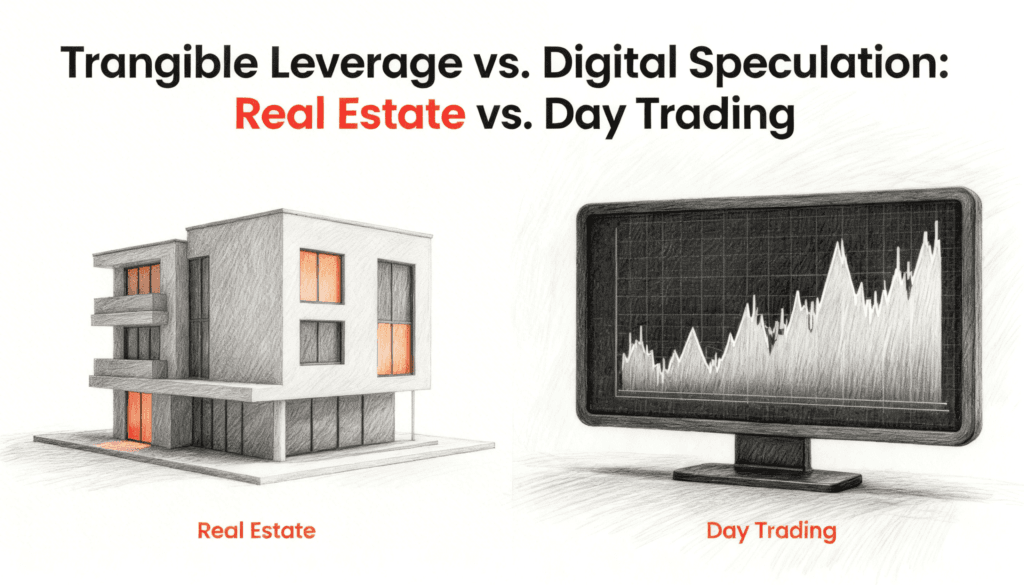
The real estate investor wakes up and owns a building. It is there whether the market is open or closed. It exists on weekends. It exists during power outages. Someone is, right now, living inside the thing this person owns and sending them money for the privilege. The investment has a smell. It has a furnace that breaks. It has a tenant who keeps a cat even though the lease said no cats.
The day trader wakes up and owns nothing, which is the point. By the end of the day, they will own nothing again. In between, they will have rented exposure to price movements for a few hours. Their investment has no smell. It has no furnace. It has no cat. It has a chart, and on that chart are lines, and the lines either go where the trader wants them to go or they do not.
These are not just different strategies. They are different philosophies about what counts as being involved in the world.
The Illusion of Control, Sold Two Different Ways
Here is where it gets interesting. Both groups believe they are in control of their investments in a way that lazier investors are not. Both are partially wrong in exactly opposite ways.
The real estate investor feels in control because they can physically do things to their asset. Repaint it. Renovate it. Raise the rent. Evict somebody. The building responds to them in a direct, stubborn, measurable way. But this feeling of control is a little bit of a trick. Because the actual value of that building depends almost entirely on things the investor cannot touch at all. Interest rates. Local employment. Zoning laws. Whether the neighborhood becomes cool. Whether a factory closes. The investor sands the floors while tectonic plates move underneath them.
The day trader feels in control because they can see everything happening in real time. Every tick. Every candle. Every little twitch of the order book. They can exit a position in a second. They can change their mind constantly. But the thing they are actually trying to predict, which is what thousands of other traders are about to do, is not something they can see or touch at all. They are staring at a screen that is, in effect, a mirror reflecting other people’s guesses about other people’s guesses. The feeling of precision is enormous. The actual control is thin.
One group polishes what they cannot fully control. The other group watches what they cannot actually predict. Both call it mastery.
The Time Thing Nobody Talks About
Day trading and real estate treat time in almost opposite ways, and this is where the real culture clash lives.
For the real estate investor, time is the ally. Almost every good thing that happens to their investment takes years. Appreciation. Loan paydown. Tenant turnover improvements. The longer they hold, the more forgiving the math becomes. Patience is not a personality trait here. It is a profit center. The investor who does nothing for a decade often does better than the one who tinkers constantly.
For the day trader, time is the enemy. Every extra minute in a position is an extra minute of exposure to things they did not plan for. The whole craft is about being in the market only as long as necessary and not a second more. Patience is punished. Holding overnight is considered a form of laziness that respectable traders warn each other about. The goal is to be in, be right, and be gone.
Think about what this means for the person’s life. The real estate investor has built a machine that rewards them for going on vacation. The day trader has built a job that punishes them for going to the bathroom. Both can make money. But one of them is building something that works while they sleep, and the other one has to stay awake.
This is the part that rarely comes up in the usual debates about risk and return. We talk about which strategy makes more money, when the more interesting question might be which one lets you live a life that is not shaped around a screen.
The Philosopher’s Corner
There is an old idea from philosophy that wealth is really about having options. Not options the financial instrument. Options the general concept. The ability to say yes or no to things without money being the reason. By that definition, the two strategies produce very different kinds of wealth even when they produce the same amount of money.
The landlord who owns twelve units has twelve streams of income that mostly take care of themselves. Their money is slow and durable. It survives them being distracted, tired, or wrong about things for long stretches. The day trader who makes the same amount has to keep making it. Stop trading and the income stops. Their money is fast and conditional. It requires their attention to exist.
Both are rich. Only one is free in the particular way that owning a thing makes you free. This is why the most successful day traders almost always end up buying real estate with their winnings. They are not diversifying. They are translating one kind of wealth into another kind of wealth, the kind that does not disappear the moment they look away.
It is a little like the difference between being a touring musician and owning the royalty rights to a song. The first is thrilling and exhausting. The second is boring and permanent. Most people who do the first eventually try very hard to arrange for the second.
The Honest Thing Each Side Will Not Say
If we got both groups to be fully honest, they would probably admit something uncomfortable about themselves.
The real estate investor would admit that most of their returns come from forces they had nothing to do with. They bought in a decent area and held on while the world did its thing. Their discipline was real. Their toilet repairs were real. But the heavy lifting was done by time and by a currency that loses value every year, which makes their fixed rate debt quietly shrink in real terms while they sleep. They are being paid for showing up and not panicking.
The day trader would admit that their edge is narrower than they think, and that most of the money in the community is made by people selling courses about day trading rather than by day traders. They would admit that the screens are addictive in a way that has nothing to do with making money. They would admit that the rush of a winning trade is doing something to their brain that no landlord has ever felt while collecting rent, and that this feeling might be part of why they are really there.
Neither of these admissions would settle the argument. But they would move it to more honest ground. One group is slowly getting rich on inflation and gravity. The other is fast and sharp and mostly getting paid in feelings that look like dollars from a distance.
What The Clash Is Really About
Strip away the spreadsheets and the charts and what you find underneath is a difference in temperament, not strategy. Real estate attracts people who want their money to be quiet. Day trading attracts people who want their money to be loud. Neither is morally superior. But they produce very different kinds of humans over the course of a decade. One becomes someone who fixes things and waits. The other becomes someone who watches and reacts.
The real question is not which one works. Both work for somebody. The real question is what you want your relationship with money to feel like when you are sixty. Do you want to walk past a building you own and remember the year you bought it? Or do you want to remember a particularly good Tuesday in March when the chart did exactly what you thought it would?
Both are forms of wealth. Only one of them leaves a mark on the world that someone else can see. The other leaves a mark only on the person who made it. And when you think about it that way, the argument stops being about returns at all. It starts being about whether you want your money to exist outside of you, or only inside of you.
Most people never ask themselves that question. Which is probably why most people are neither rich landlords nor successful day traders. They are just passengers in somebody else’s strategy, wondering why neither tribe quite speaks to them.