Table of Contents
Ask a dividend investor what they did last Tuesday and they will probably say nothing. Ask a day trader the same question and you will get a story involving three screens, a ruined lunch, and a moment of either triumph or quiet self loathing. Both people are in the market. Both want to make money. But they are not really playing the same game. They are not even playing in the same century.
This is the oldest clash in personal finance, and it refuses to die because it is not actually about money. It is about time, identity, and what a person believes work is supposed to look like.
Two Machines, Two Blueprints
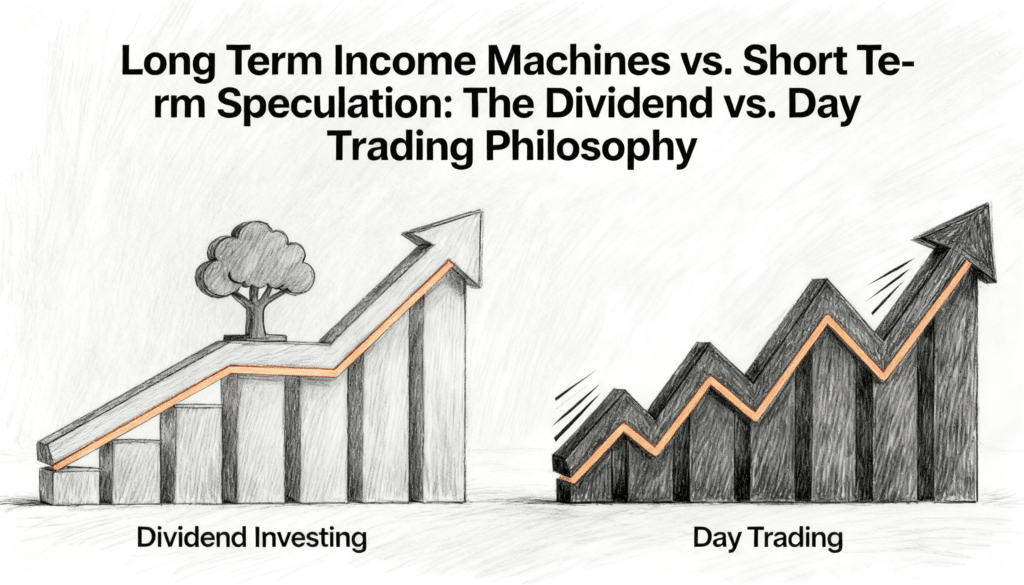
A dividend investor is trying to build a machine. The machine is slow, boring, and mostly invisible. You feed it capital over years, and eventually it starts spitting out small checks on a schedule. The checks get slightly bigger each year if the machine is well made. The whole point is that once the machine is built, you do not have to touch it. In fact, touching it is considered a sin. The machine works precisely because you leave it alone.
A day trader is also trying to build a machine, but the machine is themselves. The screens, the charts, the alerts, the hotkeys, the trading journal, the morning routine. All of it exists to turn a human being into a disciplined executor of setups. The day trader is not building something that will one day work without them. The day trader is the machine. Stop showing up and the income stops the same afternoon.
This is the quiet difference that almost nobody names out loud. One group is building something that will outlive their attention. The other group is renting income from their own nervous system.
The Philosophy Hiding in Plain Sight
There is a concept from philosophy that fits here almost too well. The Stoics used to draw a line between things you control and things you do not. The dividend investor and the day trader have both read this line and come to opposite conclusions about which side of it to stand on.
The dividend investor has decided that you cannot control price, you cannot control news, you cannot control what the market does tomorrow, so the only rational move is to stop trying. Buy something that pays you regardless of the mood of the room, then go live your life. The market becomes background noise. Control is surrendered on purpose, because surrender is cheaper than vigilance.
The day trader has decided the opposite. Yes, most things are out of your control, but there is a narrow window each day where discipline, pattern recognition, and reflexes can extract something real from the chaos. Control is not abandoned. It is squeezed out of the only place it can be found, which is your own behavior in the moment. The market is not background. It is the arena.
Both positions are coherent. Both can be defended by serious people. But they lead to completely different lives, and this is the part that almost no article about investing ever gets around to saying.
What You Are Really Buying
When a dividend investor buys a share, they are not really buying a share. They are buying a small claim on a company that, if things go well, will keep sending them money long after they have forgotten why they bought it. The holding period, as Warren Buffett famously suggested, is forever. That is not a strategy. That is a marriage.
When a day trader buys a share, they are not buying a claim on anything. They are renting a ticker for a few minutes or hours because they believe the price is about to move in a direction they can identify. Ownership is not the point. Ownership is actually a liability, because ownership means you are still holding the thing when the move is over. The day trader wants to be gone before the music stops. Every single time.
This is why the two groups have such a hard time talking to each other. They are using the same words to describe completely different activities. “I bought Apple” means one thing to a person who plans to hold it for twenty years and collect dividends through three recessions. It means something else entirely to a person who plans to sell it in forty five minutes because the five minute chart made a shape they liked.
The Income Question
Here is where it gets interesting, and slightly uncomfortable for both sides.
Dividend investors love to talk about passive income. And the word passive is doing an enormous amount of work in that phrase. Because the income is passive, yes, but only after years of active saving, active research, and active restraint. The passivity is the reward for a very long stretch of non passivity. You do not stumble into a dividend portfolio. You build one slowly, while everyone around you is doing more exciting things with their money.
Day traders, on the other hand, talk about freedom. The freedom to work from anywhere, set their own hours, be their own boss. And this freedom is also real, but it comes with a footnote that rarely gets read aloud. The freedom lasts exactly as long as your focus does. Take a week off and the income takes a week off with you. Get sick, get distracted, get older, get a little slower, and the machine starts making fewer good decisions. The freedom is genuine, but it is leased, not owned.
So the dividend investor has income without freedom from the past, and the day trader has freedom without income from the future. Both are carrying a debt. They just carry it in different directions.
The Counterintuitive Bit
You would assume the dividend investor is the cautious one and the day trader is the risk taker. And in terms of daily volatility, that is true. But step back and something strange comes into view.
The day trader is taking the safer bet in one specific sense. If they are wrong about a trade, they find out in minutes. The feedback is brutal but fast. They can adjust, learn, or quit. The whole system is designed for quick correction.
The dividend investor can be wrong for a decade and not know it. You can hold a slowly rotting company for fifteen years, reinvesting dividends that are being paid out of a business that is quietly dying, and only discover the mistake when the dividend finally gets cut and the stock collapses. Slow strategies have slow error messages. The patience that makes compounding work is the same patience that lets bad decisions hide.
This does not mean dividend investing is worse. It just means the risk has been moved somewhere harder to see. Every strategy pays a price. The only question is whether you prefer your price in cash or in years.
The Thing Neither Side Wants to Admit
Both groups privately suspect something about the other, and both suspicions are half true.
Day traders suspect dividend investors are just bored people who have given up on the idea of getting rich and are dressing up that surrender as wisdom. And sometimes, yes, that is exactly what it is. There are dividend investors who are not patient. They are simply tired.
Dividend investors suspect day traders are gamblers wearing the costume of professionals, mistaking adrenaline for skill and calling it strategy. And sometimes, yes, that is exactly what it is too. There are day traders who are not traders. They are simply addicted.
But the honest versions of each group are doing something real. The honest dividend investor has made a genuine peace with slowness and has built a life that does not require the market to perform for them. The honest day trader has built a real skill, accepted the daily cost of deploying it, and is extracting income from a place most people cannot even see.
The dishonest versions of each group are the ones writing the loudest content about why the other side is stupid.
What You Are Actually Choosing
In the end, the choice between these two philosophies is not a choice about returns. It is a choice about what you want your relationship with time to feel like.
If you pick dividends, you are saying that you want your future self to be the beneficiary of your current self. You are willing to be a little bored now so that later you will not have to pay attention at all. You are trading excitement for eventual freedom from the whole question.
If you pick day trading, you are saying that you want your current self to be the beneficiary of your current self. You want the feedback now. You want the skill to be yours, not the machine’s. You are willing to keep showing up forever because showing up is, in some way, the point.
Neither of these is wrong. But they are not compatible, and the people who try to do both usually end up doing neither well. The dividend investor who starts day trading on the side tends to break their own compounding. The day trader who starts buying dividend stocks for safety tends to get bored and sell them at the first dip.
Pick one. Commit to it. And then stop reading articles about the other one, including, if you have the self control, this one.