Table of Contents
There is a particular kind of argument that happens at dinner parties when someone mentions real estate. One person leans back and says they own a few rental houses. Another person, slightly smug, says they own real estate too, but without the tenants, the toilets, or the phone calls at midnight. They own REITs. Shares in a fund that owns buildings. Same asset class, they insist. Better life.
The first person smiles the way a farmer smiles at someone who says they understand agriculture because they shop at a grocery store.
This is the debate. And like most debates in personal finance, it pretends to be about math when it is actually about something much stranger. It is about how much of your own time, attention, and identity you are willing to hand over in exchange for the feeling of ownership. That is a philosophical question dressed in a spreadsheet.
The surface argument
On the surface, the two camps line up their case like lawyers.
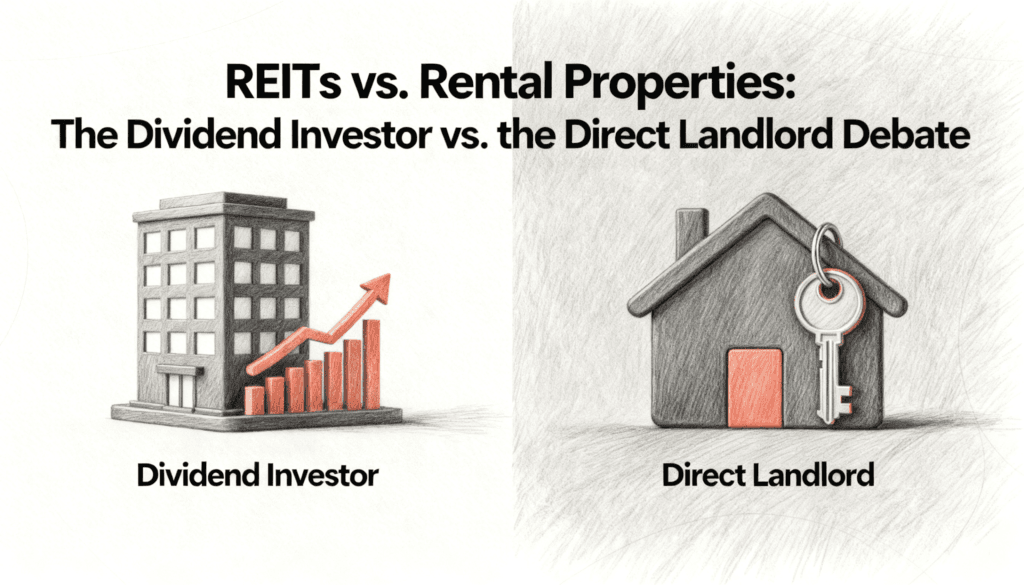
The REIT investor says: I get exposure to real estate without lifting a finger. I can buy a hospital in Texas and a warehouse in Rotterdam before lunch. My money is liquid. If I need it back, I sell. No closing costs, no lawyers, no tenant who decided that paying rent was optional this month. I collect dividends. I reinvest them. I sleep.
The landlord says: I own something real. I can drive past it. I can improve it. I can use leverage in a way no stock investor ever could, borrowing most of the purchase price from a bank that would laugh at the idea of lending me the same amount to buy an index fund. I control the outcome. I am not at the mercy of a fund manager in a glass tower who might decide to dilute my shares tomorrow.
Both arguments are true. That is what makes the debate survive. It is not that one side has facts and the other has feelings. It is that both sides have facts, and the facts happen to point in different directions depending on what kind of life you want to live.
What nobody wants to say out loud
Here is the part that does not get said at dinner parties.
Most of the disagreement has nothing to do with returns. Over long stretches, well chosen REITs and well chosen rental properties tend to land in roughly the same neighborhood of outcomes. Sometimes one wins. Sometimes the other. The spread is not dramatic enough to justify the religious fervor.
So why the fervor?
Because the real difference is not financial. It is about labor. And specifically, it is about whether you consider labor a cost or a reward.
The REIT investor treats labor as a cost. The whole point, for them, is to not do the work. They have calculated, correctly, that their time is better spent on their career, their family, or a hobby that does not involve explaining to a tenant why the water heater is making a noise. They have outsourced the work to a management team and paid a fee for the privilege. The fee is the price of freedom.
The landlord treats labor as a reward. Not consciously, usually. If you ask them, they will tell you they do it for the returns. But watch them talk about their properties and you will notice something. They know the paint color of every room. They know which unit has the squeaky step. They are not just investors. They are builders of something. The work is not a tax on the return. It is part of the return.
This is the real split. One side wants the building without the building. The other side wants the building because it is a building.
The hidden costs nobody prices in
The REIT side tends to win the argument on paper because paper is cruel to the landlord. Paper does not have a column for the Saturday afternoon you spent on the phone with a plumber. Paper does not track the mental weight of knowing that somewhere, a toilet might be leaking without your knowledge. Paper does not understand that your tenant is a person who might be having a bad year, and that being their landlord is going to put you in a moral position whether you want to be there or not.
Landlords who are honest will tell you that the hardest part of the job is not the money. It is the emotional labor of being a small time authority figure in a stranger’s life. You are not just collecting rent. You are deciding whether to raise it on someone who just had a baby. You are deciding whether to evict someone whose grandmother just died. These are not spreadsheet decisions. They are human decisions, and they leave marks.
The REIT investor has paid a fee to avoid all of this. They never meet the person whose apartment they partially own. The moral distance is built in. That distance is either a bug or a feature, depending on who you ask. Some people find it cowardly. Some people find it civilized. A few find it both.
The leverage problem
There is one spot where the landlords have a point that is genuinely hard to argue with, and it is leverage.
A bank will let you borrow most of the price of a house because the house is collateral the bank can understand. The same bank will not let you borrow eighty percent of the price of a REIT. This asymmetry is not a small thing. It is the main reason that real estate, done directly, has produced so many quiet millionaires. It was not because the asset was magical. It was because the banking system was willing to amplify small amounts of capital into large positions on it.
REIT investors can replicate some of this with margin, but margin is a very different animal. It can be called at the worst possible moment. A mortgage cannot. A mortgage just sits there, boring and patient, while the tenant pays it down and you pretend to be doing something.
This is the counterintuitive part. The lazy, sleepy, unglamorous mortgage is one of the most powerful wealth building tools ever invented for ordinary people. And it is only available to you if you are willing to be a landlord. The REIT investor has traded access to that tool for peace of mind. Whether that was a good trade depends on how much peace of mind costs you.
Who should do what
If you find yourself needing a clean answer, here is one, though I do not entirely trust clean answers.
If you love the idea of real estate but hate the idea of real people, buy REITs. You have correctly identified that you do not want the job. Pretending otherwise will make you miserable and make your tenants miserable. A bad landlord is a worse outcome than no landlord.
If you find a strange satisfaction in driving past a building you own, even if it is ugly, even if it has problems, buy rental property. The satisfaction is part of your return. You will not find it on any chart, but it will show up in your life in ways that matter.
And if you are not sure, it probably means you want the feeling of being an owner without the reality of being one. That is a respectable position, and REITs were literally invented for it.
The part the debate hides
The thing the debate hides, and the thing both sides rarely admit, is that neither strategy is the real decision. The real decision was made much earlier, when you decided what kind of person you wanted to be. The REIT investor wanted to be free of the building. The landlord wanted to belong to the building. Everything after that is implementation.
The returns will take care of themselves, roughly. The life you build around the choice will not. That is the part to pay attention to. That is the part the dinner party argument is really about, even when nobody in the room knows it.