Table of Contents
There is a certain kind of question that sounds like it has an answer and does not. “Who wins, the dividend investor or the day trader?” is one of them. It feels like a math problem. It is actually a question about what winning even means.
Because these two people are not playing the same game. They are not even playing on the same board. And the moment you try to compare their scores, you realize you are holding two different scorecards written in two different languages.
So let us stop pretending this is a horse race. It is something stranger and more interesting than that.
Two Very Different Definitions of a Good Day
Ask a dividend investor what a good day looks like, and you will get a boring answer. A good day is a day when nothing happened. The market did whatever it did. The portfolio sat there. Somewhere in the background, a company they own quietly sent them a small amount of money, the way a tenant slides rent under the door. That is the whole event.
Ask a day trader what a good day looks like, and you will get a story. There was a setup. There was a moment. There was a decision made in under a minute that worked out. There was coffee. There was tension. There was a small personal victory that no one else saw but that felt, for about ten seconds, like proof of something.
Already you can see the problem with comparing them. One of them is trying to make days disappear. The other is trying to make days matter. These are not strategies. These are temperaments dressed up as strategies.
The Long Game and the Every Game
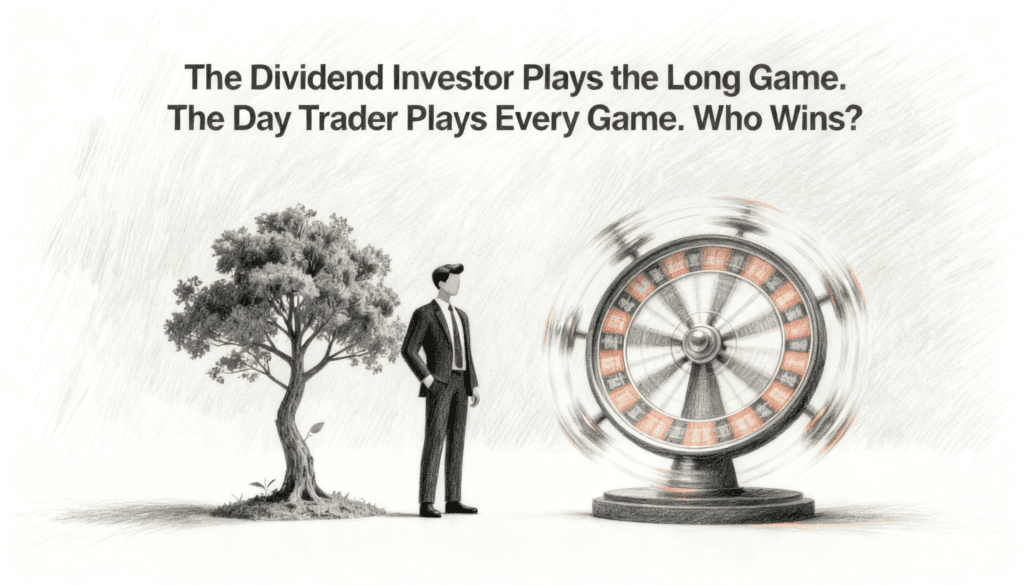
The dividend investor plays the long game in the most literal sense. The plan is to still be here in twenty years, owning more of the same boring businesses, receiving slightly larger checks. The strategy is almost embarrassing in its simplicity. Buy. Hold. Reinvest. Wait. The hardest part is not the buying. It is the waiting. Most people cannot do it, which is the entire reason it works for the ones who can.
The day trader plays every game. Every open. Every close. Every gap. Every news event. Every nervous little movement on a five minute chart. The strategy is not simple at all. It requires attention, reflex, pattern recognition, and the emotional stability of someone who can lose money without turning into a different person by lunchtime. The hardest part is not the trading. It is the staying sane while trading.
Here is the thing nobody mentions. Both approaches are demanding. They are just demanding in opposite directions. One asks you to do almost nothing for a very long time. The other asks you to do almost everything for a very short time. If you are bad at stillness, the first one will break you. If you are bad at intensity, the second one will break you.
Most people are bad at both, which is why most people do neither well.
The Casino Is Not Where You Think It Is
There is a lazy version of this debate that says day trading is gambling and dividend investing is not. This is almost true and therefore misleading.
Gambling is not defined by speed. Gambling is defined by the relationship between skill, edge, and outcome. A professional poker player is not gambling in the way a tourist at a slot machine is gambling, even though they are sitting in the same building. A disciplined day trader with a real edge is not doing the same thing as someone opening random trades on their lunch break, even though they are using the same software.
And here is the part the dividend crowd does not love hearing. Dividend investing has its own quiet form of gambling. It is the bet that the companies you picked will still be paying, still be growing, still be around, decades from now. History mostly rewards this bet. But history is full of old dividend darlings that are now footnotes. Slowness does not make a decision safe. It just makes the mistake take longer to show up.
The real difference between the two is not gambling versus not gambling. It is about where the uncertainty lives. The day trader meets uncertainty every morning and wrestles with it in public. The dividend investor pushes uncertainty into the future and lets it quietly accumulate out of sight. Both are exposed. Only one of them notices.
A Detour Through How Athletes Think
There is a useful parallel here, and it comes from sports. Consider the difference between a marathon runner and a sprinter. They are both runners. They both train. They both compete. But if you put them in each other’s events, they would both lose, and they would both look silly doing it.
Nobody argues about which one is the “real” runner. Everyone understands that they are built differently, trained differently, and measured differently. The marathon runner is not more disciplined than the sprinter. The sprinter is not more skilled than the marathon runner. They are optimizing for completely different physical realities.
Finance somehow forgets this. In finance, we keep insisting that one style must be objectively better than the other, as if the market were a single event with a single winning technique. It is not. The market is more like an entire sport with many categories, and each category rewards a different body, a different mind, and a different tolerance for suffering.
The dividend investor is training for distance. The day trader is training for speed. Asking who wins is like asking whether a marathon medal is worth more than a sprinting medal. The question only makes sense to people who do not run.
What Each One Is Secretly Paying For
Every financial strategy charges a hidden fee, and the fee is rarely money. It is usually something you did not realize you were giving up.
The dividend investor pays in excitement. There is almost none of it. The portfolio does not provide stories. It does not give you anything to talk about at dinner. The returns show up on quarterly statements that feel more like utility bills than victories. You trade the thrill of participation for the slow relief of not having to participate. For some people, this is peace. For others, it is a slow form of boredom that eventually makes them sell everything and buy something exciting just to feel alive again. That moment, by the way, is when the strategy dies. Not when the market falls. When the investor gets bored.
The day trader pays in attention. All of it. The job is mentally expensive in a way that is hard to describe until you have done it. Every decision costs a little piece of focus. Every loss costs a little piece of confidence. Every win costs a little piece of humility, because winning makes you feel smarter than you are, and feeling smarter than you are is how traders blow up accounts. The day trader trades freedom of time for the illusion of control, and the bill comes due in the form of mental exhaustion that no vacation fully fixes.
Neither fee is visible in a brokerage statement. Both are very real.
So Who Actually Wins
Here is the honest answer. The dividend investor usually wins against the version of themselves that would have tried day trading and failed. The day trader usually wins against the version of themselves that would have tried dividend investing and quit out of boredom. Each one is winning against their own worst instincts, not against the other.
If you force a comparison on pure returns, the answer is unsatisfying. A tiny minority of day traders can beat the long term dividend investor. A larger minority break even. Most underperform, sometimes spectacularly. The dividend investor, meanwhile, plods along and finishes somewhere between modest and quietly impressive, depending on the decades involved and the companies chosen.
But the returns are not really the point. The point is that one group has built a life that can survive their own psychology, and the other group has built a life that depends on mastering it. The first is easier. The second is riskier. Both can work. Neither is automatic.
The real winner in this whole debate is the person who figured out which one they actually are before the market figured it out for them. Because the market will figure it out. It always does. The only question is whether you saved yourself the tuition by being honest in advance, or whether you paid full price to learn the same lesson the slow way.
And that, in the end, is the quiet joke of this entire clash. Both sides think they are winning a contest against each other. They are actually in a private contest against their own temperament. The scoreboard is internal. The prize is a financial life that does not quietly destroy the person living it.
Everything else is just decoration.