Table of Contents
There is a question that almost nobody in the trading world wants to answer honestly. If you had to choose between making real money in private and losing money in public while being celebrated for your takes, which would you pick?
Most people would say the first. Most people would be lying.
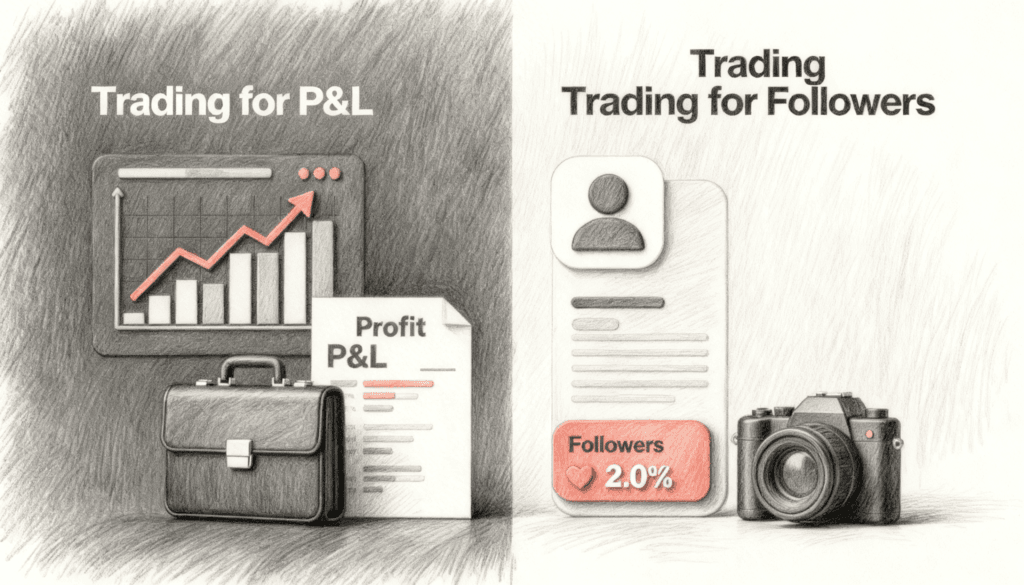
This is the quiet identity crisis sitting at the center of modern trading culture. On one side, the day trader who closes the laptop at four in the afternoon and checks the account balance. That number is the whole scorecard. It is cold, it is honest, and it does not care how many people liked the morning chart. On the other side, the FinTwit personality, who may also trade, but whose real product is the trade itself as content. The call. The thread. The screenshot. The follower count that grows every time a prediction lands and somehow does not shrink when one does not.
These are not the same job. They look similar from the outside. They use the same charts, the same tickers, the same jargon. But they are playing two completely different games with two completely different win conditions, and the confusion between them has quietly ruined more portfolios than any bad trade ever did.
Two Scoreboards, Only One Is Real
The day trader has one scoreboard. It is the account. Everything else is noise. A good week is a green week. A bad week is a red week. There is no story to tell, no narrative to spin, no audience to please. The market does not care if you are charming. The market does not care if your thesis was elegant. It cares whether you were right and whether you sized it properly. That is the entire relationship.
The FinTwit personality has a different scoreboard, and this is where things get interesting. The visible scoreboard is followers, impressions, engagement, and the occasional viral call that gets screenshot and passed around. The invisible scoreboard is still the account, somewhere in the background, doing whatever it is doing. But the visible scoreboard pays in attention, and attention is its own currency. Attention can be converted into paid newsletters, courses, affiliate links, sponsorships, and speaking gigs. Which means that for a certain kind of trader, the account does not actually need to perform. The persona does.
This is not a small distinction. It is the whole thing.
The Goodhart Problem Wearing a Trading Costume
There is an idea from the world of management and measurement that fits here almost too perfectly. It is called Goodhart’s law, and the short version is this: when a measure becomes a target, it stops being a good measure. The moment you start optimizing for the number, the number stops meaning what it used to mean.
Follower count was originally supposed to be a rough signal of credibility. If a lot of people follow you, presumably you have something worth listening to. But the second traders started optimizing for followers directly, the signal broke. Now follower count measures how good you are at growing a follower count. It has nothing necessarily to do with whether you can actually trade. You can grow followers by being loud, by being early, by being confident, by being contrarian, by posting a lot, by picking fights, by calling tops and bottoms with the swagger of a prophet and the memory of a goldfish. None of that requires a green P&L.
And here is the part that should make people uncomfortable. The incentives do not just allow this. They reward it. A trader who posts every loss honestly will grow slower than one who quietly deletes the bad calls and pins the good ones. A trader who says “I do not know what happens next” will lose to one who says “this is going to 10x.” The algorithm does not reward accuracy. It rewards certainty, frequency, and emotion. Accuracy is actually a competitive disadvantage on a timeline.
The Poker Player and the Magician
Think about the difference this way. A real day trader is like a poker player. The cards are private. The results are private. The only thing that matters is whether the stack at the end of the night is bigger than the stack at the start. Nobody claps. Nobody knows. The poker player does not care.
The FinTwit trader, at least the pure version, is more like a magician. The trick is the whole product. If the audience is amazed, the show is a success, regardless of whether anything real happened behind the curtain. The magician does not need the rabbit to actually disappear. The magician needs you to believe the rabbit disappeared. And in a world where nobody audits the hat, belief is enough.
This is not to say every FinTwit account is a magic show. Some of the best educational trading content online comes from people who post publicly. Some of them trade beautifully. But the structure of the platform does not require them to. And that is the problem. When the structure does not require honesty, honesty becomes a personal choice rather than a professional necessity. And personal choices erode under pressure.
The Identity Crisis
Here is where it gets genuinely sad. A lot of traders start out wanting to be the poker player. They want the quiet green account. They want the discipline. They want the number at the end of the day to be bigger than the number at the start. That is the whole dream.
Then they start posting. At first it is for accountability. Then it is for community. Then they get a few hundred followers and the posts start feeling good in a way the trades never quite did. Trades are lonely. Posts are social. A winning trade gives you money. A winning post gives you money and validation. Validation is the more addictive of the two. Most people do not realize this until they are already optimizing for it.
At some point, and this happens quietly, the trader becomes the content creator. The account stops being the scoreboard and starts being the raw material for the scoreboard. Trades are taken partly because they will make a good thread. Positions are held slightly longer than they should be because exiting would spoil the narrative. Losses are reframed as learning moments because raw losses do not perform as well as redemption arcs. The craft decays. The brand grows.
The worst part is that nobody notices the switch. Not even the trader. There is no moment where you wake up and decide to stop trading for money and start trading for followers. You just drift. And the drift feels like success the whole way.
The Uncomfortable Symmetry
Now for the slightly contrarian part. The day trader camp likes to pretend it is morally superior here, and it is not entirely. A lot of serious day traders are also running from something. The market becomes a private room where they do not have to talk to anyone. The account balance becomes the only relationship they can fully control. That is not necessarily healthy either. It is just a different flavor of the same problem. One group performs for an audience. The other performs for themselves. Both are performances.
The difference is that the day trader’s performance has a built in reality check. The market will eventually tell you the truth whether you want to hear it or not. The FinTwit performance does not have that check. You can be wrong for years and still gain followers, as long as you are wrong in an entertaining way. There is no margin call on a personal brand. There is only the slow, invisible erosion of people who used to trust you and quietly stopped.
What This Means for Anyone Watching
If you are reading FinTwit to learn how to trade, the most useful question you can ask is not “is this person smart.” It is “what is this person optimizing for.” If the answer is followers, then the advice is shaped by what grows followers, which is not the same thing as what grows accounts. If the answer is P&L, then the advice will often be boring, cautious, and unsexy, because real trading mostly is.
The trick is that the two can look identical on any given day. A good post can come from either. The only way to tell them apart is over time, and time is the one thing attention platforms are designed to make you forget.
Somewhere, a day trader is closing a position, logging it in a spreadsheet, and going for a walk. They will not tweet about it. You will never hear of them. Their account is probably doing better than most of the accounts you follow. That is not a coincidence. That is the whole point.