Table of Contents
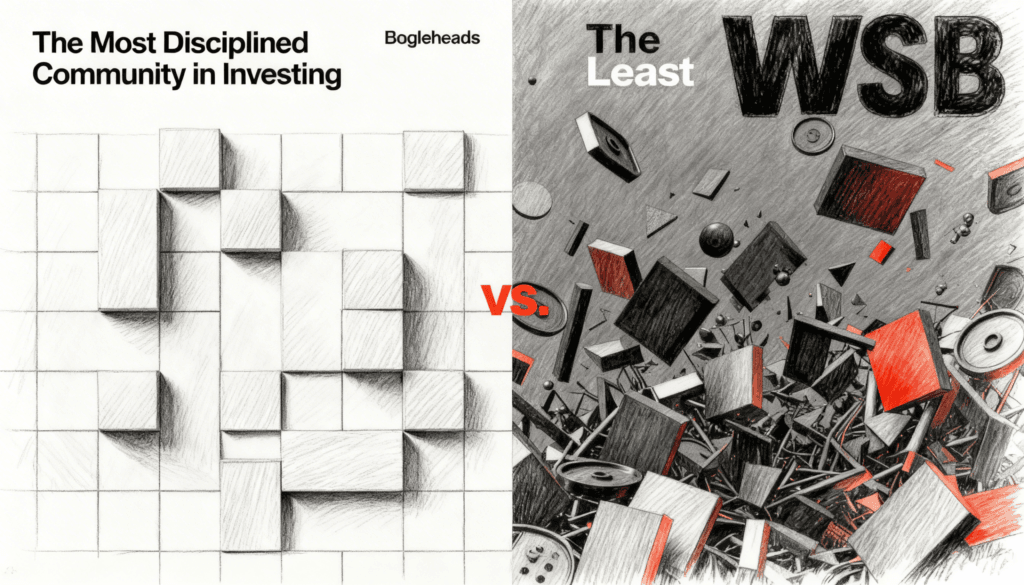
There is a particular kind of comedy that only finance can produce. It happens when you put two groups in the same room who technically do the same thing, buying pieces of public companies, and discover they might as well be practicing different religions. The Bogleheads and the WallStreetBets crowd are that comedy. They both use brokerage accounts. They both press buttons that say buy and sell. And that is roughly where the similarities end.
One group treats investing like brushing your teeth. The other treats it like skydiving without checking the parachute.
What makes this clash interesting is not the obvious part, which is that one strategy works and the other mostly does not. That is a boring observation and everyone already knows it. The interesting part is what each group reveals about a much older human question. Namely, what is discipline actually for, and is a life spent avoiding mistakes the same thing as a life well lived?
The Monks and the Gamblers
If you have never wandered into the Bogleheads forum, imagine a library where everyone is whispering about expense ratios. The culture is built around the ideas of Jack Bogle, the founder of Vanguard, who basically argued that trying to beat the market is a fool’s errand and that the smartest thing most people can do is buy the whole market cheaply and then go do something else with their lives. Gardening, perhaps. Or raising children. Or anything at all besides staring at charts.
The Bogleheads took this advice and turned it into a way of life. They have rules. They have rituals. They have an almost monastic suspicion of excitement. If you post a question on their forum about a hot stock tip, the response will be polite, patient, and firmly designed to talk you out of it. They are the designated drivers of investing. They are never the most fun person at the party, but they are the reason you got home safely.
WallStreetBets is the party. It is also the hangover, the broken lamp, and the regret text you send at 4 a.m. The subreddit calls itself “like 4chan found a Bloomberg terminal,” and that is probably the most honest self description in finance. The culture runs on memes, options trades that would give a professional risk manager a stroke, and a willingness to post screenshots of six figure losses with captions that read like suicide notes written by a comedian.
The two groups, in theory, are both participating in the same market. In practice, they are not even playing the same game.
Discipline as a Personality Trait
Here is where it gets philosophical, and I promise to keep the philosophy painless.
Discipline is usually framed as a virtue. We admire it. We tell children to develop it. We write books about how to get more of it. The Bogleheads have it in concentrated form, which is why financial advisors love to point at them as the grown ups in the room. And they are. A Boglehead who started investing at 25 and simply kept doing the boring thing will, by 55, probably be wealthier than most of their louder peers. The math is almost cruel in how well it works.
But discipline has a strange feature that nobody talks about. It is only recognized as a virtue in hindsight. While you are practicing it, discipline looks almost identical to boredom. It looks like saying no to things. It looks like watching other people get rich on meme stocks while you buy the same index fund you bought last month and the month before and the month before that. Discipline, in the moment, feels like you are doing nothing. It is only when you look back across thirty years that it reveals itself to have been doing everything.
WSB represents the opposite philosophy, though its members would probably not call it a philosophy. They would call it vibes. The culture treats the market as a casino, except with the honest twist that everyone admits it is a casino. There is no pretense about beating inflation or securing a comfortable retirement. The goal is to win big, fast, and publicly, or to lose in a way that is at least entertaining. One user famously lost nearly everything on a single trade and posted about it with such dark humor that he became a folk hero. The community does not reward prudence. It rewards stories.
And stories, it turns out, are what humans are actually wired to care about.
The Uncomfortable Truth About Boring
Here is the part that Bogleheads do not want to hear. Their approach works, but it wins no arguments at dinner parties. You cannot tell a thrilling story about dollar cost averaging. Nobody gathers around the fire to hear the tale of how you held VTSAX through three recessions and retired with dignity. The strategy is correct and the strategy is also, in a very literal sense, unmarketable as drama.
Meanwhile, WSB produces legends on a weekly basis. The guy who turned five thousand dollars into six figures on Tesla calls. The guy who lost his entire savings on a bad earnings bet. The GameStop uprising, which was briefly the most interesting thing happening on Earth and which briefly made hedge funds look like the cornered ones for once. These are stories. Real ones. People remember them and retell them.
This creates a strange cultural imbalance. The correct way to invest is deeply undramatic. The dramatic way to invest is deeply incorrect. And humans, being humans, will almost always pay more attention to drama than to correctness. That is not a failure of finance. That is a feature of the species.
What Each Group Gets Wrong About the Other
The Bogleheads think WSB members are reckless idiots gambling their futures away. Some of them are. But some of them are also young people with small accounts who have done the grim math and realized that slow and steady, applied to a twenty thousand dollar salary with no family wealth, does not actually get you to retirement. It gets you to a slightly less poor retirement. For someone in that position, a YOLO trade is not irrational. It is the only shot at changing the trajectory. The lottery ticket is a bad investment for the middle class and a mathematically reasonable one for the genuinely stuck. WSB, for all its memes, contains a lot of people who have quietly run this calculation.
WSB, for its part, sees Bogleheads as cowards. People too afraid of life to take a swing. This is also wrong. What Bogleheads have actually done is notice that most swings miss, and that the compounding of boring decisions is itself a kind of courage. It takes a particular kind of nerve to watch your neighbor get rich on a coin you also could have bought and simply not care. That is not cowardice. That is something much rarer. It is the ability to not be recruited.
The mutual misunderstanding is the most interesting part of the whole clash. Each group is solving a different problem. The Bogleheads are solving the problem of how to become quietly wealthy over decades without having to think about it much. WSB is solving the problem of how to feel alive while dealing with a financial system that many of its members do not believe was built with them in mind. Both problems are real. The strategies just answer different questions.
The Part Nobody Says Out Loud
If you have been reading carefully, you might have noticed that this is not really about investing. It is about what you think the point of money is.
Bogleheads have decided that money is a tool for buying freedom from worrying about money. Their endgame is boredom, in the best sense. A life where your portfolio is handled, your spending is calibrated, and your attention is free to go elsewhere. That is a legitimate and, frankly, pretty beautiful answer to the question of what wealth is for.
WSB has decided that money is a way to feel something. The trade is not really about the return. It is about the rush, the community, the shared experience of watching a candle chart with a thousand strangers at 9:30 a.m. eastern time. The profit, when it comes, is almost incidental. The losses, when they come, are absorbed into the folklore. What they are really buying is participation in something that feels bigger than them, even when it is destroying them.
Neither of these is wrong. They are just different theories of what a human life is supposed to contain.
So Who Is Right
If you are asking who has the better investment strategy, the Bogleheads win and it is not close. If you are asking who is having more fun, WSB wins and it is also not close. If you are asking who will still be here in thirty years, the Bogleheads win again, possibly wealthier, possibly wiser, and almost certainly calmer.
But if you are asking who has better understood the strange emotional truth that markets are not just math problems but theaters where people come to feel things, WSB might actually have the more honest answer. They never pretended otherwise. They walked into the casino, called it a casino, and ordered a drink.
The Bogleheads have the correct strategy. WSB has the correct diagnosis. The tragedy, and the comedy, is that almost nobody manages to hold both of those truths at the same time. You either surrender to the slow path and accept that it will never feel exciting, or you chase the excitement and accept that it will probably never make you rich.
The rare person who can look at both communities without contempt, take the discipline from one and the emotional honesty from the other, might end up with something neither group has figured out. A life where the money is handled correctly and the hunger to feel alive is fed somewhere else entirely. Somewhere that does not require a margin account.
That person, incidentally, is the one this whole argument was supposed to help. It is worth asking whether either tribe is actually trying to become them.