Table of Contents
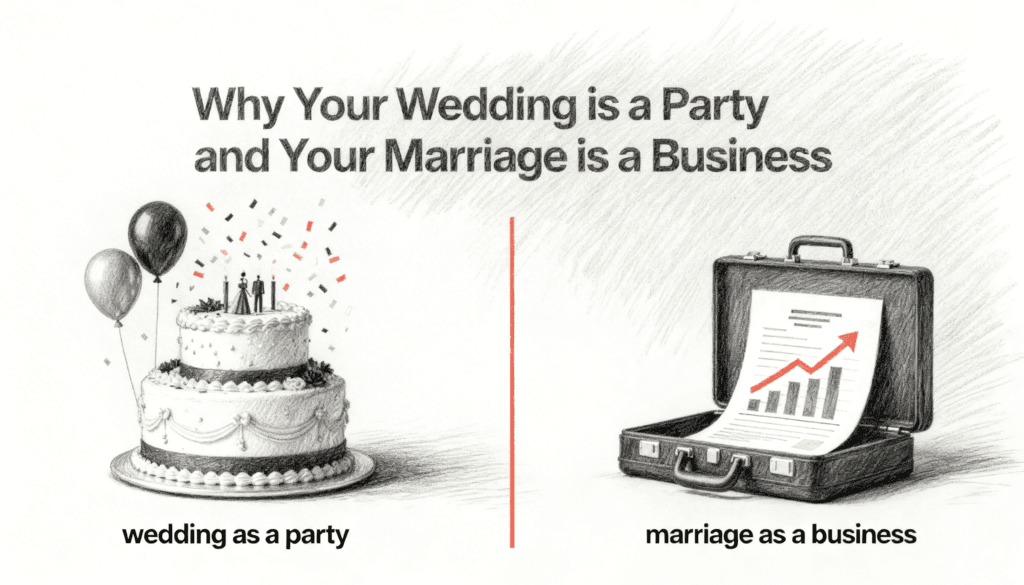
Somewhere between the cake tasting and the seating chart, a strange thing happens. Two people who would argue for an hour about splitting a dinner bill suddenly sign off on a forty thousand dollar single day event without flinching. They will spend more on flowers that die in three days than they have ever spent on a financial advisor. And nobody finds this odd.
The wedding industry has done something remarkable. It has convinced millions of otherwise rational adults that the quality of a marriage can be previewed through the quality of its opening ceremony. As if the dove release predicts the divorce rate.
Meanwhile, the actual marriage, the thing that will consume the next several decades of your financial life, gets almost no planning at all. You will spend nine months choosing a venue and roughly nine minutes discussing how you will handle a joint checking account. You will interview three photographers and zero accountants. You will write vows about love and patience and forever, and you will never once write down what happens if one of you wants to quit your job to start a pottery business.
This is the great misallocation of modern romance. The party gets the budget. The business gets the leftovers.
The Merger Nobody Calls a Merger
Here is something worth sitting with. When two companies combine operations, they hire lawyers, accountants, and consultants. They run something called due diligence, which is a polite term for digging through every drawer to find out what they are actually buying. They negotiate terms. They write contracts that anticipate disagreement.
When two people combine operations, they buy a ring.
A marriage is, in the most boring and accurate sense, a merger. Two balance sheets become one. Two income streams pool. Two sets of debts, credit scores, spending habits, retirement accounts, and risk tolerances get mashed together and expected to function. The legal system treats it this way. The tax code treats it this way. Your mortgage lender certainly treats it this way.
But the culture treats it like a feeling. And feelings, while wonderful, do not pay for a roof when someone loses a job.
The irony is that we have invented elaborate rituals to celebrate the merger and almost no rituals to operate it. The wedding has a script. The marriage does not. You know exactly what to do during the first dance. You have no idea what to do during the first recession.
Why Money Fights Are Not Really About Money
If you ask couples what they argue about, money tops the list almost everywhere it has been studied. But this is misleading. Couples do not fight about money. They fight about what money represents. And what it represents is almost never the same thing for both people.
For one person, money is safety. They grew up watching a parent count coins at the kitchen table, and a savings account is a kind of emotional insulation. Spending feels like exposure. Saving feels like love.
For the other person, money is freedom. They grew up watching a parent work a job they hated to pay for things they did not enjoy, and the whole point of earning is to use it before life gets in the way. Spending feels like living. Saving feels like delay.
Now put these two people in a Target. Watch them argue about a forty dollar lamp. They are not arguing about the lamp. They are arguing about childhood, fear, freedom, and meaning. The lamp is just standing there, confused.
This is the insight that financial advisors miss and therapists undercharge for. Your money story was written long before your spouse appeared, and theirs was too. A marriage is the place where two of these stories try to share one budget. If you have never told each other your money story, you are not having a financial disagreement. You are having a translation problem in two different languages while both pretending to speak the same one.
The Hidden Cost of the Romantic Frame
There is a useful idea borrowed from how investors think about businesses. They look at something called optionality, which is just a fancy word for how many doors are still open. A company with optionality can pivot, expand, retreat, or wait. A company without it has to keep doing exactly what it is doing, regardless of whether that is working.
Marriages have optionality too, and most couples spend it without realizing it. The decision to buy a house in a specific suburb closes a door. The decision for one partner to leave the workforce closes another. The decision to take on a particular debt, or to skip building an emergency fund, or to merge every account so that nothing belongs to anyone, all of these quietly reduce the number of moves available later.
None of this is bad on its own. Closing doors is part of building a life. The problem is doing it without noticing. Couples who frame every financial decision purely through the romantic lens, we are in this together, what is mine is yours, tend to lose track of the fact that they are also making strategic decisions with long term consequences. By the time something goes wrong, every door has been quietly shut, and the only one left is the one labeled exit.
The Wedding as a Test You Are Not Supposed to Notice
Here is something almost nobody says out loud. The wedding planning process is the most useful financial preview a couple will ever get, and most couples treat it as a hassle to push through rather than data to study.
Watch what happens during those months. Who tracks the budget. Who avoids it. Who quietly upgrades line items hoping the other will not notice. Who folds under pressure from family. Who can say no to a vendor and who cannot. Who treats compromise as collaboration and who treats it as defeat. Who apologizes after a fight about money and who pretends the fight did not happen.
This is not a rehearsal dinner. This is a rehearsal marriage. And the data is free if you bother to collect it.
Most couples do not. They treat every wedding disagreement as an exception, a stress response to a hard season, something that will disappear once the band stops playing. It will not. Whatever pattern shows up while planning the wedding will show up again, in a higher stakes form, when planning a mortgage, a child, a career change, or a parent moving in. The wedding is the trial run. The marriage is the actual deployment.
What a Marriage Actually Needs to Operate
If a marriage really is a business, then it needs the same boring infrastructure that any functioning business needs. Not because love is not enough. Because love does not file taxes.
It needs a regular meeting. Call it whatever you want. The point is that money conversations should not only happen during emergencies, because emergencies are the worst possible context for thinking clearly. Couples who talk about money once a month, briefly and without drama, almost never have the kind of explosive money fight that defines couples who only talk about it when something is on fire.
It needs a shared understanding of what the money is for. Not a budget exactly. A purpose. Are you optimizing for early retirement, for travel, for stability, for giving, for the kids, for keeping options open. You can have different answers, but you cannot have no answer. A business with no strategy still spends money. It just spends it badly.
It needs honesty about asymmetry. Almost every marriage has a higher earner, a more frugal partner, a better negotiator, a more anxious spender. Pretending these differences do not exist is the relationship equivalent of cooking the books. Acknowledging them lets you design around them.
And it needs an exit clause that nobody plans to use. Prenups have a terrible reputation, mostly because we have decided they are romantic poison. But every business partnership in the world has an agreement about what happens if it ends, and nobody thinks this means the partners are planning to fail. They think it means the partners are adults. Marriage is the only major contract we sign while actively refusing to read the part about what happens if it does not work out.
The Real Connection to Investing
There is one more borrowed idea worth mentioning. Long term investors talk a lot about the difference between volatility and risk. Volatility is the daily up and down, the noise, the thing that makes you check your phone too often. Risk is the chance of permanent loss, the thing that actually matters.
Marriages confuse these constantly. A bad week is volatility. A bad fight is volatility. A stressful month after a job loss is volatility. None of this is risk. Risk is what happens when small problems are ignored long enough to become structural. Risk is the slow accumulation of unspoken resentment, undisclosed debt, unaddressed mismatch in goals. The couples who survive are not the ones who avoid volatility. They are the ones who can tell the difference between a bad Tuesday and a real problem, and who deal with the real problem before it compounds.
Compounding works on the bad things too. This is the part nobody mentions. A small lie about a credit card, left alone, becomes a habit. A habit becomes a pattern. A pattern becomes the reason somebody calls a lawyer eight years later. The same force that builds wealth slowly, builds dysfunction slowly. Which one your marriage compounds is mostly a function of which one you pay attention to.
The Quiet Point
The wedding is not the problem. Throw the party. Cry during the toasts. None of this is wrong. It is one of the few rituals modern life still does well, and there is real value in standing in front of everyone you love and saying out loud that you mean it.
But understand what you are doing the next morning. You are not on a honeymoon. You are on day one of a long, complicated, jointly operated venture with no board of directors, no quarterly reports, and no one to fire but each other. The party is over. The business has opened.
The couples who treat it that way, with a little structure, a little honesty, a little willingness to talk about boring things on purpose, tend to end up with something the wedding could only promise. The ones who keep treating the marriage like an extended afterparty tend to end up wondering where the money went, and eventually, where the marriage went too.
The vows are the easy part. The spreadsheet is the love letter nobody told you to write.

Comments are closed.