Table of Contents
There is a particular kind of person you meet at dinner parties who, within twelve minutes, will tell you about their index fund allocation. They did not ask what you do. They did not comment on the wine. They simply waited for a pause, any pause, and slid their portfolio into the conversation like a debit card into a chip reader. You nod. You sip. You wonder if you are allowed to leave yet.
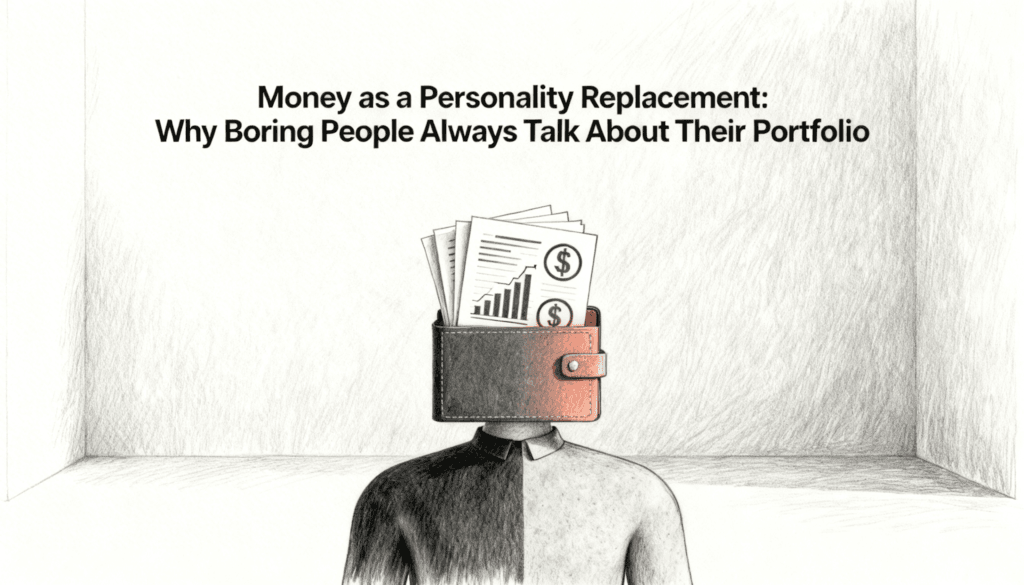
We tend to think these people are just rude, or socially miscalibrated, or perhaps slightly drunk on their own returns. But something more interesting is happening. Money, for a certain kind of adult, has quietly taken the place of a personality. And once you notice the swap, you cannot unsee it.
The Convenient Identity
Building a personality is genuinely hard work. It requires reading things that do not pay you, having opinions that might be wrong, developing taste in something useless like architecture or jazz, and risking the embarrassment of caring about something other people find silly. It requires, in short, exposing yourself.
A portfolio does none of this. A portfolio is a personality you can buy off the shelf. It signals discipline without requiring any. It signals intelligence without requiring you to be interesting. It signals taste without requiring you to actually have any. And best of all, it comes with a number attached, which means you can compare yourself to other people with mathematical precision, which is the dream of every insecure adult who has ever lived.
This is why the same person who cannot name a single book they enjoyed in the last year can speak for forty minutes about expense ratios. The portfolio is doing the heavy lifting that hobbies, friendships, and curiosity used to do. It is the identity equivalent of a frozen meal. Not nourishing, but reliably warm.
Why Numbers Feel Safer Than Opinions
There is a reason finance bores hold court at parties while the painter in the corner says nothing. Numbers cannot be argued with in the same way taste can. If you tell someone your portfolio is up fifteen percent, they cannot really push back. If you tell them you love a particular novelist, they can wrinkle their nose and you will feel it for three days.
Money offers what almost nothing else in adult life offers, which is a scoreboard. And humans, especially those who never quite figured out who they were supposed to become, love a scoreboard. It tells you where you stand. It tells you if you are winning. It removes the existential vertigo of wondering whether your life means anything by replacing the question with a smaller, friendlier one. Did the S&P close up today.
The Quiet Tragedy of the Optimizer
There is a specific subtype here worth noting. The optimizer. This is the person who has read every personal finance blog, listens to three podcasts about wealth building, and can tell you the tax efficiency of every account type ever invented. They are not wrong about any of it. They are, in fact, often correct in ways that will make them objectively richer than their peers.
And yet, talk to them long enough, and you start to notice something. The optimizing has become the point. The destination has dissolved. They are saving aggressively for a retirement they cannot describe, building a portfolio for a life they have not imagined, and accumulating freedom they have no plans to spend. The means has eaten the end.
This is the financial version of a phenomenon writers have noticed in other domains. The hobbyist who spends more time organizing their tools than building anything. The runner who tracks every metric but no longer remembers why they started running. The reader who curates an enormous to be read pile and reads almost none of it. Money optimization scratches the same itch. It feels productive. It feels intelligent. It feels like progress. But progress toward what, exactly, tends to be a question the optimizer politely declines to answer.
The Portfolio as Conversation Insurance
There is also a social mechanic at play that nobody talks about. Bringing up your investments is a low risk way to seem substantive. It signals that you are a serious adult engaged with serious adult concerns. It is the conversational equivalent of wearing a watch to a job interview. You may not actually need it, but it suggests you understand the rules.
Compare this to other things you could discuss. Your feelings about your job are too revealing. Your views on politics are too dangerous. Your interest in something genuinely weird, such as medieval cooking or birdwatching or the history of canals, risks marking you as a person with an inner life, which is awkward in most rooms. But your Roth IRA. Ah. Your Roth IRA is unimpeachable. It is the small talk equivalent of beige.
This is why portfolio talk thrives in environments where actual intimacy would be inappropriate. Work happy hours. Suburban barbecues. Brunches with people you tolerate more than enjoy. The portfolio is a way to participate in conversation while disclosing nothing. It is performance without vulnerability, which is, when you think about it, the dominant aesthetic of our era.
The Borrowed Self
There is a concept in psychology called the false self, originally developed by the analyst Donald Winnicott. The false self is the version of you that you build to fit in, to avoid the discomfort of being your actual unguarded self. Most people develop one to some degree. It becomes pathological only when the false self crowds out the real one entirely, when there is nothing underneath the performance.
Money, in our current moment, is a remarkably efficient false self construction kit. It comes with prefabricated values such as discipline, ambition, and prudence. It comes with a community of other people performing the same self, who will validate yours in exchange for you validating theirs. It comes with content, endless content, in the form of news and analysis and podcasts that let you feel engaged without ever requiring you to engage with anything that might actually change you.
The boring person at the party is not boring because they care about money. They are boring because they have outsourced their selfhood to a spreadsheet. There is no friction in them. Nothing they have wrestled with. Nothing they are uncertain about. Just the smooth, frictionless surface of someone who has decided that net worth is a sufficient answer to the question of what kind of person they are.
The Counterintuitive Part
Here is where it gets strange. The people who are genuinely good at money, in the deeper sense of using it well, almost never talk about it like this. They tend to be quiet about their finances in the way that genuinely confident people are quiet about their accomplishments. They have made peace with money as a tool, which means they do not need it to also be a personality. The bragging tends to come from the middle of the pack. The truly wealthy are often shockingly normal in conversation, partly because they have nothing to prove and partly because, having achieved the financial life, they have noticed it does not actually answer any of the interesting questions.
This is the cruel trick the portfolio plays on its devotees. The whole point of accumulating wealth, supposedly, is to free you to become the person you want to be. But if you have spent decades letting the portfolio do the work of being a person for you, then arriving at the destination just reveals the absence. There is money. There is no one home to enjoy it.
What This Has to Do With You
You do not have to be the dinner party bore to fall into a milder version of this. Most of us do, occasionally. We check the account when we are feeling unmoored. We feel briefly better when the number is up and briefly worse when it is down, even though our actual lives have not changed in either direction. We let the score sneak in and start coloring our mood.
The fix is not to ignore money. Money matters. Money buys time, options, and a certain freedom from the more grinding kinds of suffering. But money was always supposed to be in service of a life, not the other way around. The question worth sitting with, which the portfolio is very good at helping you avoid, is what you would actually do with yourself if the financial question were already solved. What would you read. Who would you call. What would you make. What would you risk being bad at. What would you care about that does not pay.
If you cannot answer those questions, no amount of compounding will rescue you. You will just become a wealthier version of someone who does not know what to do with themselves, which is, if you watch carefully, an extremely common kind of person and not a particularly happy one.
The Quiet Test
There is a small test you can run on yourself, and on the people around you. Listen to what someone talks about when they are relaxed and nothing is at stake. Not what they perform at parties. Not what they post online. What surfaces when they are tired and unguarded and there is no one to impress.
If money keeps showing up there, in the absence of any real reason for it, that is worth noticing. It might mean the scoreboard has eaten the game. It might mean the spreadsheet has become the self. And it might mean that somewhere along the way, the question of who you are got quietly answered by your brokerage statement, which is a sad way to find out.
The boring people at the party are not villains. They are just casualties of an era that made it very easy to confuse a number with a soul. The good news is that the confusion is reversible. The bad news is that reversing it requires the one thing the portfolio was helping you avoid, which is the hard, embarrassing, unprofitable work of becoming someone in particular.
Nobody is going to compound that for you.