Table of Contents
There is a strange ritual happening in cities around the world. A man walks into a boutique, spends the equivalent of a small car on a mechanical object strapped to his wrist, and walks out feeling like he has become someone. Not someone who does something new. Just someone who owns something new.
This is the quiet trade that nobody talks about in finance. People do not just buy watches, handbags, or sports cars. They buy the feeling of being a person with a story. And often, that purchase is covering for something that is missing underneath.
The Shortcut That Does Not Work
Hobbies are expensive in a way that has nothing to do with money. They cost time, patience, and the willingness to be bad at something for a long stretch before you get good. Learning to sail, to paint, to cook seriously, to play an instrument, or to restore old engines requires you to sit with your own incompetence for months or years. Most people do not want to do that. It is uncomfortable. It is slow. There is no audience for the early stages.
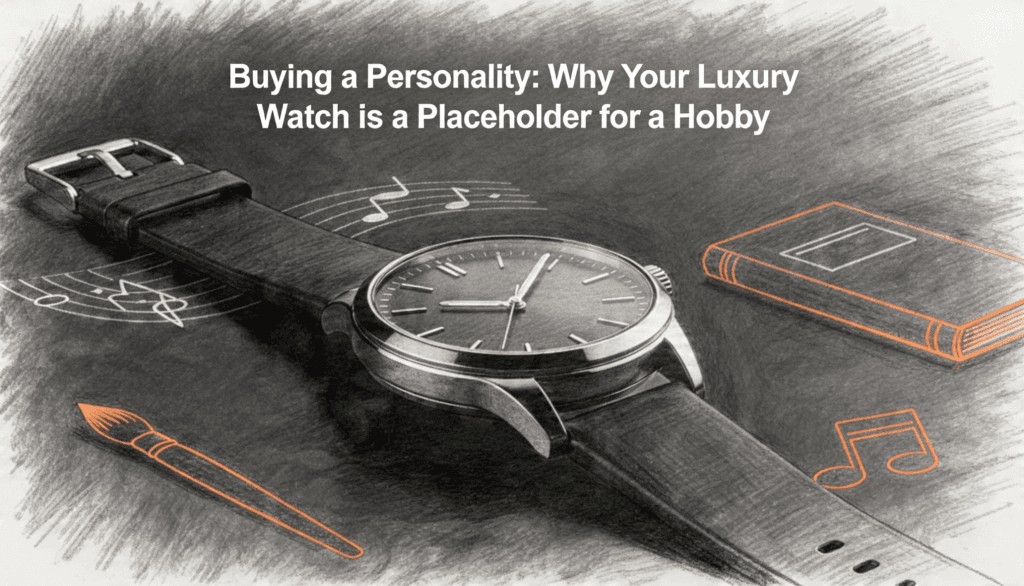
A luxury watch solves this problem in about twenty minutes at a counter. You walk out with a signal that says, I am the kind of person who appreciates craftsmanship, history, engineering, and taste. You did not have to learn anything. You did not have to build anything. You just had to have the money, or the credit, or the willingness to pretend you had either.
The irony is that the watch was originally designed to reward people who did difficult things. Pilots, divers, racers, explorers. Now it rewards people who made a wire transfer.
The Personality Gap
There is a concept in psychology called identity foreclosure. It happens when someone adopts an identity without actually going through the process of building it. They skip the exploration, the failure, the reshaping, and land directly on the label. The label feels good because it arrives without the bruises.
Luxury goods operate in this exact territory. They offer a finished identity for sale. The watch tells people you are serious and successful. The handbag tells people you have arrived. The car tells people you are powerful or daring. You did not have to become those things. You just had to buy their symbols.
The problem is that symbols without substance wear thin. Other people sense it, even when they cannot name what they are sensing. And more importantly, you sense it. The hit of owning something fades within weeks. Researchers who study the psychology of consumption call this hedonic adaptation, but you do not need a term for it. You have felt it. The thing that thrilled you in the store is now just a thing in your drawer.
So you buy another one. And another. Because the feeling you were chasing was never really about the object.
Why Hobbies Quietly Outperform
Here is where it gets interesting. A genuine hobby, the kind where you get worse before you get better, produces something that no purchase can produce. It gives you a private sense of self that does not depend on anyone noticing.
When you learn to fly fish, or weld, or write poetry that nobody reads, or grow vegetables in a stubborn patch of soil, you build what psychologists call internal locus of control. Your sense of who you are comes from inside you, not from what is strapped to your wrist. This is not a small thing. People with a strong internal sense of self are measurably more resilient to financial shocks, social setbacks, and the general noise of modern life.
Luxury goods give you the opposite. They tie your self worth to things that can be lost, stolen, damaged, or quietly mocked at a dinner party by someone with a better one. The more you stake your identity on what you own, the more fragile you become. It is a form of leverage, and like all leverage, it cuts both ways.
The Finance Angle Nobody Mentions
Personal finance advice usually frames luxury purchases as a math problem. The watch costs too much. The depreciation is brutal. You could have invested the money and retired earlier. All true, but this misses the deeper issue.
The deeper issue is that you are paying a premium for something you could have built for free. You are outsourcing the work of becoming a person to a brand. And brands, being businesses, are happy to take that work off your hands at a healthy margin.
Think about it this way. If you spent the cost of a luxury watch on pottery classes, a woodworking setup, or a year of serious language study, you would end up with skills, a community, and a sense of quiet pride that compounds over decades. The watch gives you a brief thrill, a photograph or two, and a small knot of anxiety every time you travel.
The return on investment on becoming a person with actual depth is, without exaggeration, one of the best deals available to a human being. Almost nobody takes it, because it does not come wrapped in a velvet box.
A Strange Parallel With Index Funds
There is an odd connection here with how people approach investing. The financial industry has spent decades convincing ordinary people that picking individual stocks makes them sophisticated. It rarely does. Most people who pick stocks underperform a boring index fund, but they enjoy the feeling of being someone who picks stocks. They are buying an identity, not a return.
The same trick happens with luxury goods. You think you are buying a watch. You are actually buying the feeling of being a watch person. The object is the delivery mechanism for a story about yourself.
Index funds are boring for the same reason hobbies are boring in the early stages. Both require you to be patient, unremarkable, and willing to let time do the heavy lifting. The flashy alternative feels better in the moment and costs more in the long run. This pattern shows up everywhere once you start looking for it.
The Social Contract Underneath
Part of the reason this whole system works is that other people play along. When someone flashes a luxury watch, the social script says you are supposed to nod approvingly. You are supposed to treat the object as evidence of the person. This is a quiet agreement that benefits the luxury industry enormously. It would collapse overnight if people started asking, what do you actually do with your time?
That question is unfair to ask out loud, but it is worth asking yourself. Because the honest answer is what your life actually consists of. Not the objects near your body, but the hours you spend using your mind and hands on things that interest you.
People who have genuine hobbies tend to talk about them. People who have purchases tend to display them. One generates stories. The other generates photographs. There is a reason a conversation with a serious amateur astronomer or a home cook or a cyclist feels different from a conversation with someone showing you their collection. You can sense the difference between someone who has done something and someone who has bought something.
What the Watch Is Actually Hiding
If you strip away the marketing, most luxury purchases are answers to a question the buyer has not quite asked out loud. The question is, how do I prove to myself and others that my life has meaning. The purchase is a quick, tangible, socially approved answer.
But the purchase does not actually answer the question. It postpones it. The question comes back, usually within a few months, and the only tool the buyer has learned to use on it is another purchase. This is how collections start. Not out of passion, but out of the failure of the last object to do what objects cannot do.
A hobby works differently. It does not answer the question either, but it makes the question less urgent. When you spend your Saturday afternoon actually absorbed in something, the meaning question goes quiet. Not because you solved it, but because you were too busy living to ask it.
This is, in a strange way, one of the best arguments for hobbies as a financial strategy. They reduce the compulsion to spend money on identity. A person who is genuinely interested in birdwatching or chess or gardening does not need a watch to tell people who they are. They already know, and they do not particularly care if you know.
The Quiet Wealth of Being Uninteresting
There is something worth saying that runs against the usual advice. The goal is not to become an interesting person by collecting better hobbies the way you might collect better watches. That just moves the same problem sideways.
The goal is to become comfortable being uninteresting to strangers. To have a life that is rich to you and mostly invisible to everyone else. This is not a popular message because it does not sell anything. Nobody is going to put it on a billboard. But it happens to be how most people who are actually content with their lives seem to operate.
Luxury goods sell you the opposite. They sell visibility as a substitute for satisfaction. The deal sounds good until you notice that the most visible people are not usually the most content ones, and the most content ones are usually doing something that would bore a marketing department to tears.
The Practical Take
None of this means you should not buy nice things. Things can be genuinely well made, and enjoying craftsmanship is a perfectly reasonable pleasure. The issue is not the purchase. The issue is what the purchase is being asked to do.
If you are buying a watch because you love mechanical watches, have read about them, understand the movements, and would still want it if nobody ever saw it, that is a hobby expressing itself through an object. That is fine. That is actually great.
If you are buying a watch because you want other people to see it, or because you want to feel like a certain kind of person without doing the work of becoming one, the watch will not deliver what you want. It cannot. No object can. And the money would go further, in every sense that matters, if it were spent on the slow, unglamorous work of building a self that does not need decoration.
The most expensive thing in the luxury industry is not the watch. It is the illusion that you can skip the part where you actually become someone. That illusion has a price tag, and it gets renewed every few years, for life.
The cheaper path is quieter. You pick something you are drawn to, you get embarrassingly bad at it for a while, and you keep going. One day you look up and realize you have become a person with a life, not a person with a collection. That is the trade nobody in the boutique will ever offer you.