Table of Contents
The idea of making money while you sleep is ancient. Landlords figured it out centuries ago. Bond holders figured it out not long after. Dividend investors turned it into a religion sometime in the twentieth century, complete with sacred lists, initiation rituals, and heretics.
But something strange has happened in the last decade. The concept of passive income, once owned almost entirely by traditionalists in khakis reading annual reports, has been hijacked, remixed, and uploaded to the blockchain. What used to be a quiet philosophy about owning shares of Procter and Gamble has become an entire spectrum that stretches from century old consumer goods companies to anonymous protocols paying you in tokens you have never heard of.
The question is not whether passive income still matters. Everyone agrees it does. The question is whether its newest forms are an evolution or a hallucination.
The Cathedral of Dividends
Dividend aristocrats are companies that have increased their dividend payments for at least 25 consecutive years. Think about that for a moment. Twenty five years of uninterrupted, growing cash payments to shareholders through recessions, wars, pandemics, and whatever else the world decided to throw at the economy.
This is not just a financial metric. It is a statement of institutional character. A company that has raised its dividend for a quarter century is telling you something about its priorities, its cash flows, and its relationship with the people who own it. It is the corporate equivalent of someone who has shown up to every family dinner for 25 years straight. You may not find them exciting, but you trust them.
The dividend aristocrat community treats this track record the way sommeliers treat vintage. The longer the streak, the better. There is a hierarchy. Aristocrats have 25 years. Kings have 50. Champions have a different list maintained by different people with different criteria, and if you confuse the lists in the wrong forum, you will hear about it.
This obsession with streaks reveals something deeper about the psychology of income investing. It is not really about the yield. A company paying a 3% dividend is not going to make anyone rich quickly. What it offers instead is predictability. It is the financial equivalent of a heartbeat. Regular, expected, and deeply alarming when it stops.
The Ritual of Reinvestment
Here is the part that makes dividend investing almost spiritual for its followers. You take the dividends you receive and you buy more shares. Those shares pay more dividends. You use those dividends to buy even more shares. Repeat for decades.
This is compounding. Everyone talks about compounding. Einstein may or may not have called it the eighth wonder of the world. But dividend investors do not just understand compounding intellectually. They feel it. They track it in spreadsheets with color coded tabs. They post screenshots of their growing income streams the way other people post vacation photos.
The counter intuitive part is that dividend reinvestment works best when stock prices fall. Lower prices mean your dividends buy more shares. More shares mean more future dividends. This turns market crashes from disasters into something almost welcome. The dividend investor watching the market drop is like a shopper watching prices fall at a store they visit every week. The experience is fundamentally different from the growth investor who watches the same crash and sees only destruction.
This psychological inversion is not trivial. It changes behavior during the moments when behavior matters most.
Enter the Machines
Then crypto showed up and decided that the entire concept of passive income needed to be rebuilt from the ground up, preferably in 18 months and without any regulation.
Yield farming, for those who have managed to avoid this particular corner of the internet, is the practice of depositing your cryptocurrency into decentralized protocols that use it for lending, trading, or liquidity provision. In return, you earn yields. Sometimes modest yields. Sometimes yields that would make a loan shark uncomfortable.
The basic mechanic is not actually new. Banks have done something similar forever. You deposit money. They lend it out. They pay you interest. The difference is that yield farming removes the bank entirely. The lending and borrowing happen through code. Smart contracts replace loan officers. Algorithms replace credit committees.
On paper, this is a beautiful idea. Remove the middleman. Let the code handle it. Pay the depositor more because there is no marble lobby or CEO salary to fund.
In practice, it created one of the most chaotic financial environments in recent memory.
The Casino Disguised as Innovation
The early days of yield farming had protocols advertising annual percentage yields of 1,000%. Let that number sit for a moment. A thousand percent per year. Dividend aristocrats were offering 2 to 4 percent and feeling good about it, and suddenly some protocol named after a vegetable or a ghost was promising returns that would make a Ponzi scheme blush.
The dirty secret, which was not really a secret to anyone paying attention, was that many of these yields were paid in newly created tokens. You deposited real value and received new tokens as your yield. Those tokens had value only because other people were also depositing real value into the same protocol. When new deposits slowed down, the token price collapsed, and your 1,000% yield turned into a 1,000% yield on something worth nothing.
This is not a technology problem. It is a human nature problem wearing a technology costume. The desire for passive income is so strong that people will ignore obvious structural risks if the numbers on the screen are large enough. Dividend investors do this too, chasing high yield stocks without examining whether the payout is sustainable. The difference is one of degree. A dividend trap might cost you a painful drawdown. A yield farming implosion could cost you everything.
What the Two Worlds Actually Share
Here is where it gets interesting. Strip away the aesthetics, the language, and the technology, and dividend aristocrats and yield farming protocols are trying to solve the same problem. They are both attempting to create reliable income from capital without selling the underlying asset.
The dividend investor does not want to sell their shares of Johnson and Johnson. They want Johnson and Johnson to send them a check. The yield farmer does not want to sell their Ethereum. They want their Ethereum to generate more Ethereum. Same desire. Radically different execution.
Both communities also share an obsession with one specific concept: sustainability. The dividend investor asks whether the payout ratio is safe. The yield farmer asks whether the protocol is solvent. Different vocabulary, identical anxiety. Can this thing keep paying me?
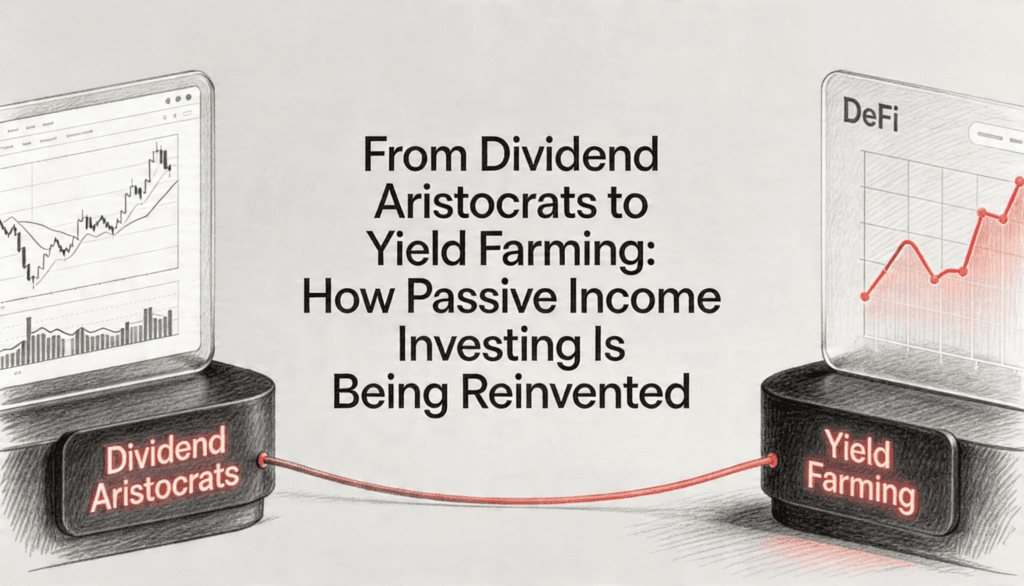
This parallel is worth noticing because it suggests that passive income investing is not being replaced. It is being forked. Like a road splitting into two paths that lead to the same general area through very different terrain.
The Middle Ground Nobody Talks About
Between the cathedral of dividend aristocrats and the wilderness of yield farming, there is a growing middle territory that borrows from both worlds.
Real world asset tokenization is putting traditional income producing assets like bonds, real estate, and receivables onto blockchain infrastructure. Suddenly you can own a fraction of a Treasury bond through a protocol. The yield comes from the same place it always did, the US government paying interest, but the delivery mechanism is new.
This is not as dramatic as either the traditionalists or the crypto evangelists would like. It does not vindicate the idea that everything must be decentralized. Nor does it confirm that blockchain is irrelevant. It suggests something more mundane and more useful: that the infrastructure of passive income is changing even while the underlying economics stay the same.
Think of it like music. The song is the same whether you hear it on vinyl, CD, or streaming. The delivery system changed completely. The melody did not.
The Generational Fault Line
There is a reason these two approaches to passive income map roughly onto age demographics. It is not just that younger investors are more comfortable with technology. It is that they have a fundamentally different relationship with institutions.
A dividend aristocrat represents institutional trust. You are trusting a corporation to keep paying you, trusting auditors to verify the books, trusting regulators to enforce the rules, and trusting the stock exchange to let you sell if needed. This trust is earned over decades and requires believing that the system, broadly speaking, works.
Yield farming represents institutional skepticism. You are trusting code instead of corporations. You are trusting math instead of management. You are trusting transparency, because the blockchain is public, instead of trusting regulation.
Neither of these positions is fully rational. Institutions fail. Code has bugs. But the emotional orientation is different, and emotions drive investment behavior far more than spreadsheets do.
This mirrors a pattern visible across entirely different fields. In media, the split between legacy journalism and independent creators follows the same trust fault line. In education, the divide between traditional degrees and online credentials runs along identical territory. Passive income investing is not unique in experiencing this fracture. It is just one more arena where the old question of whom do you trust is being answered in new ways.
Where This Actually Goes
The future of passive income is probably boring. The most likely outcome is convergence. Traditional finance adopts some of the infrastructure that makes decentralized systems efficient. Crypto protocols adopt some of the safeguards that make traditional income investing survivable. The dividend aristocrat of 2035 might pay you through a smart contract. The yield farming protocol of 2035 might require audited financials.
This is usually what happens when a new technology collides with an established practice. The revolutionaries claim everything will change. The traditionalists claim nothing needs to. And then both sides quietly steal each other’s best ideas while pretending they thought of them first.
The investor who understands both worlds, who can evaluate a payout ratio and a smart contract audit, who knows why a 25 year dividend streak matters and also why transparent, permissionless infrastructure matters, will have an advantage. Not because they picked the right side. Because they realized there are no sides. There is only the question that has always mattered.
Can this keep paying me?
Everything else is aesthetics.