Table of Contents
There are two ways to use other people’s money to get rich. One takes thirty years. The other takes thirty minutes. Both are forms of leverage. Both can make you wealthy. Both can ruin you. The only real difference is the speed at which the consequences arrive.
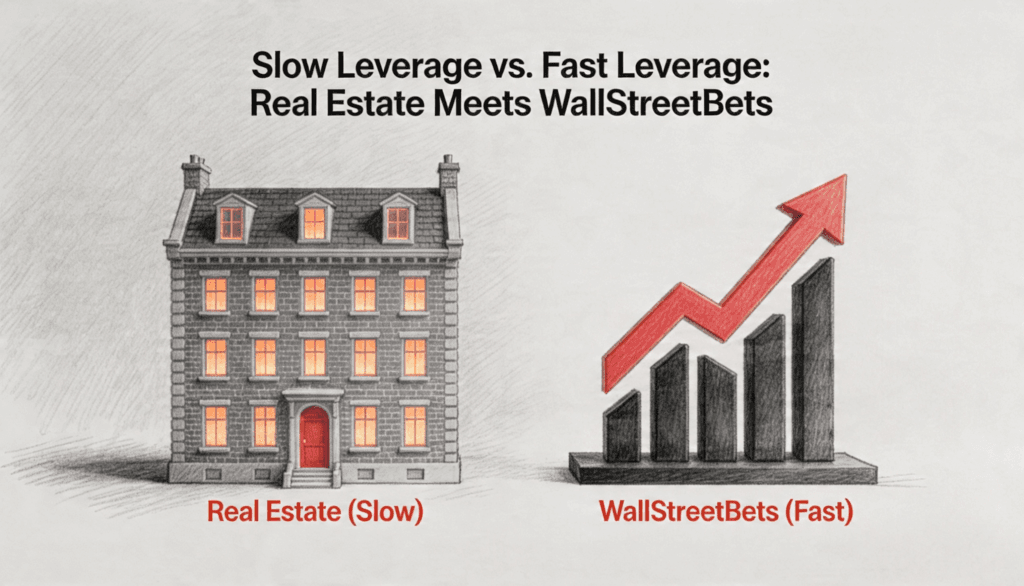
The real estate investor borrows from a bank, buys a property, and waits. The WallStreetBets trader borrows from a brokerage, buys options, and refreshes. Same principle. Wildly different vibes. One community celebrates patience, cash flow, and getting a good deal on a duplex. The other celebrates screenshots of six figure gains made during a lunch break. And yet the underlying mechanics are closer than either side would ever want to admit.
This is a clash between two tribes that are doing the same thing at very different speeds. And speed, it turns out, changes everything.
The Oldest Trick in the Book, Played Two Ways
Leverage is one of the few financial concepts that does not need a textbook to understand. You borrow money. You invest it. If the investment goes up, you make more than you would have with just your own cash. If it goes down, you lose more. That is it. Everything else is decoration.
Real estate investors have been doing this for generations. You put a fraction of the purchase price down, a bank covers the rest, and you control an asset worth far more than what you actually paid. The math is not complicated, but its effects compound in ways that feel almost unfair to people who are not doing it. A property worth five times your initial investment only needs to go up a modest amount for you to double your money. This is not a secret. It is how most of the quietly wealthy people in your neighborhood got there.
WallStreetBets found the same math and asked a very reasonable question. Why would you wait decades for that to play out when options contracts let you do the same thing in days?
It is a fair question. It also happens to be the most dangerous one in finance.
The Psychology of the Clock
Here is something the real estate world understands intuitively that the options trading world has collectively decided to ignore: time is not just a variable in the equation. It is a safety mechanism.
When a landlord makes a bad purchase, the clock is generous. Property values dip. Rents stagnate. The roof needs replacing. None of this feels good. But the timeline gives you room to recover, to adjust rents, to refinance, to wait for a cycle to turn. The feedback loop between a decision and its consequences stretches over years. You have time to be wrong and still end up fine.
Options trading compresses that entire timeline into days, sometimes hours. The feedback is instant. The margin calls do not wait for you to come up with a plan. There is no refinancing a contract that expires worthless on Friday. The clock that protects the landlord is the same clock that destroys the trader.
This creates a strange irony. The real estate investor can afford to be mediocre. Make a slightly bad deal, overpay a little, underestimate repairs, and still come out ahead over twenty years. The options trader has to be right about the direction, the magnitude, and the timing. Being right about two out of three is often the same as being wrong about all three.
Compounding Patience vs. Compounding Adrenaline
There is a concept in psychology called intermittent reinforcement. It is the reason slot machines are more addictive than vending machines. If you got a reward every time, it would be satisfying but boring. If you got a reward at unpredictable intervals, it becomes almost impossible to walk away.
Real estate operates like a vending machine. You put in the effort. You collect rent. It is predictable, steady, and psychologically unremarkable. Nobody has ever lost sleep from excitement about a rental payment hitting their account.
WallStreetBets operates like a slot machine. The gains are spectacular and random. The losses are equally spectacular and equally random. The screenshots of someone turning a few thousand into a few hundred thousand are the reason new people keep joining. The screenshots of someone turning a few hundred thousand into zero are the reason the forum stays entertaining.
The reinforcement pattern matters because it shapes behavior. The real estate investor is trained by the market to be patient. The options trader is trained by the market to keep pulling the lever. One system builds wealth slowly and boringly. The other generates stories. Stories are more shareable than spreadsheets, which is exactly why WallStreetBets has millions of followers and your local landlord association does not.
The Hidden Cost of Speed
Something counterintuitive happens when you speed up leverage. You do not just increase the risk. You change the nature of it entirely.
A real estate investor with a mortgage faces a risk that is, in a strange way, collaborative. The bank does not want you to fail. They gave you a thirty year loan specifically because they expect you to pay it back. The incentives are roughly aligned. Your lender is your partner, a reluctant and slightly annoying partner, but a partner nonetheless.
A brokerage offering margin to an options trader has no such relationship. If your position moves against you, they will liquidate it without a phone call. There is no restructuring a margin call. There is no calling the brokerage to explain that the market will come back next quarter. The relationship is transactional in the purest sense. You are not a partner. You are a position.
This distinction matters more than any difference in returns. The real estate investor is playing a game where the other players would prefer everyone to succeed. The options trader is playing a game where the other players are indifferent to your outcome. Same leverage. Very different games.
What Each Side Gets Right
It would be easy to frame this as responsible adults on one side and reckless gamblers on the other. That framing is popular because it is simple.
The real estate community has genuine blind spots. They undercount the cost of their own time. They pretend that managing properties is passive income when it is often a second job with worse hours. They dismiss liquidity as if never being able to sell something quickly is a feature rather than a limitation. And they have a remarkable ability to ignore the fact that their returns often look less impressive once you subtract all the unpaid labor they contributed.
WallStreetBets, for all its chaos, understands something important that the real estate community refuses to acknowledge. Capital efficiency matters. Tying up hundreds of thousands of dollars in a single asset in a single neighborhood is a form of concentration risk that would horrify any portfolio manager. The idea that you can get leveraged exposure to markets without signing a thirty year contract, without dealing with tenants, without geographic concentration, that idea is not stupid. The execution is often catastrophic, but the underlying logic has merit.
The real estate investor is right that slow leverage is safer. The WallStreetBets trader is right that fast leverage is more capital efficient. They are both wrong that the other approach is simply foolish.
The Dinner Party Theory of Wealth
There is a theory that people judge wealth not by numbers but by narrative. How you made your money determines how people react to it. This applies perfectly here.
Tell someone at a dinner party that you own rental properties and they will nod approvingly. You are a landlord. You are building something. You are serious. Tell the same person that you made the same amount trading options on meme stocks and watch their expression change. You got lucky. You are gambling. You are not serious.
The money is identical. The social reception is not. This is not a coincidence. It reveals something about how we process financial risk. We forgive leverage when it is wrapped in something tangible. A building feels like an investment. A derivative contract feels like a bet. The math does not care about this distinction, but people do. And since people are the ones who create markets, their feelings become a kind of math all on their own.
Where They Converge
Strip away the aesthetics, the Reddit posts, the property tours, the gain and loss screenshots, the landlord meetups, and you are left with two groups who believe the same core idea: ordinary income from a job is not enough. Both have decided that capital, not labor, is the way to financial freedom. Both have chosen leverage as the tool to get there faster.
The real difference is not about intelligence or discipline. It is about which kind of uncertainty you can tolerate. Some people can watch a property sit vacant for three months and not panic. Other people can watch an options contract drop by half in an afternoon and not panic. Both require emotional control. Neither is easy. They are just different flavors of the same difficult thing.
The real estate investor’s edge is time. The options trader’s edge is speed. Both are forms of leverage. One forgives mistakes. The other does not. And in a world where everyone makes mistakes, that distinction tends to be the one that decides who keeps their money.
Neither tribe is going to change the other’s mind. The landlord will keep collecting rent. The trader will keep buying calls. And somewhere in between, the actual lesson sits quietly, ignored by both sides: leverage is a tool, and tools do not care who is holding them. Only the speed at which they operate determines whether the user builds something lasting.