Table of Contents
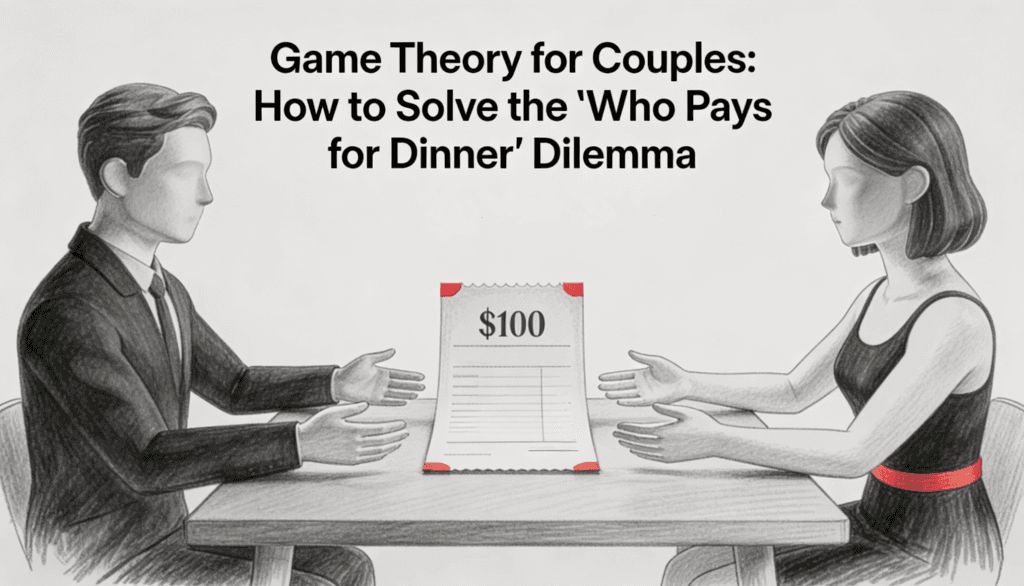
The check arrives. It sits there on the table like a small grenade with the pin already pulled. Both of you see it. Neither of you reaches for it. A silence opens up that somehow feels louder than the entire conversation you just had over pasta.
This moment, which plays out millions of times every evening across restaurants worldwide, is not really about money. It is about strategy, signaling, power, and the strange economics of love. And whether you know it or not, you are playing a game that mathematicians have been studying for decades.
The Dinner Table Is a Game Board
Game theory is the study of how rational people make decisions when the outcome depends on what someone else decides too. It was pioneered by John von Neumann, a man who helped build the atomic bomb but apparently never figured out how to drive a car without crashing it. The field was later refined by John Nash, whose life was dramatic enough to become an Oscar winning film.
The core idea is simple. When two people interact, the best move for each person depends on what the other person does. Sound familiar? That is every dinner date you have ever been on.
Let us map it out. Two people sit across from each other. The check arrives. Each person has two choices: reach for it or wait. This creates four possible outcomes, and each outcome sends a different message entirely.
If both reach for the check, you get a brief, polite tug of war. Society finds this charming. If one reaches and the other waits, the transaction is clean but the power dynamics tilt. If both wait, the check just sits there accumulating existential weight while the waiter quietly judges you from across the room.
Game theorists would call this a coordination game. The goal is not to “win” in the traditional sense. The goal is to land on an outcome that both players find acceptable. The trouble is that you are trying to coordinate without being allowed to openly discuss what you are coordinating on, because nothing kills romance faster than a spreadsheet.
The Prisoner is Dining
Most people have heard of the Prisoner’s Dilemma, the most famous problem in game theory. Two suspects are held in separate rooms. Each can either cooperate with the other by staying silent or defect by ratting the other out. The cruel twist is that the rational choice for each individual leads to the worst collective outcome.
Paying for dinner has a similar structure, but inverted. In the classic dilemma, both players are tempted to betray. At dinner, both players are tempted to perform generosity. You want to be the one who pays, not because you love spending money, but because paying signals something. It says you are generous, secure, invested. Not paying signals something too, whether you intend it to or not.
This is where it gets interesting. In a one time interaction, like a first date with someone you met on an app and may never see again, the incentives push toward a certain kind of performance. You over tip. You insist on paying. You act as if money is no object, even if your bank account would beg to differ. Game theorists call this a signaling game. You are not just buying dinner. You are buying information transfer. You are telling the other person something about yourself, and the cost of the signal is what makes it credible.
Repeated Games Change Everything
Here is where couples have an enormous advantage over first dates. You are not playing a one shot game. You are playing what game theorists call an iterated game, meaning the same interaction repeats over and over, potentially for decades.
This changes the math completely.
In a single game, the rational strategy might be to posture or signal aggressively. But when you know you will face the same person tomorrow and the day after that, cooperation becomes not just nice but mathematically optimal. The famous “tit for tat” strategy, which won a landmark computer tournament run by political scientist Robert Axelrod, works exactly this way. Start by cooperating. Then mirror whatever the other person did last time.
Applied to dinner: if your partner paid last time, you pay this time. Simple. Elegant. Fair.
Except humans are not computers, and relationships are not tournaments. The real world is messier. One person earns more than the other. One person picked the expensive restaurant. One person ordered the wine that cost as much as a small appliance. These asymmetries make the “your turn, my turn” approach feel tidy in theory and clumsy in practice.
The Solution That Is Not a Solution
If you have read this far hoping for a clean formula, I have bad news. Game theory does not hand you an answer to the dinner question. What it does, which is arguably more valuable, is show you why the question is hard in the first place.
The real problem is not arithmetic. It is that money in relationships functions as at least three things simultaneously. It is a resource, a symbol, and a scoreboard. When you pay for dinner, you are transferring resources. But you are also communicating care, establishing status, and updating an invisible ledger that both of you maintain but neither of you will admit exists.
This is why couples who say “we do not keep score” are often the ones keeping the most meticulous score of all. They have simply moved the accounting from a spreadsheet into the realm of feelings, which is a far less reliable database.
What Actually Works
The couples who handle money well tend to share one trait. They have made the implicit explicit. They have had the unsexy conversation about who pays, when, and why. They have negotiated the terms of their particular game out loud rather than leaving each person to guess the rules independently.
In game theory terms, they have moved from a non cooperative game to a cooperative one. In a non cooperative game, each player decides independently and hopes for the best. In a cooperative game, players communicate, form agreements, and commit to strategies together. The outcomes in cooperative games are almost always better for everyone involved.
This might look like a shared account for meals out. It might look like alternating who pays. It might look like the higher earner covering restaurants while the other person handles groceries. The specific arrangement matters far less than the fact that it was discussed, agreed upon, and can be renegotiated when circumstances change.
The key word there is renegotiated. A relationship is not a contract signed once and filed away. It is a living agreement that needs updating as incomes shift, priorities change, and life throws its predictable surprises. The couples who treat their financial arrangement as permanent are the ones who end up blindsided when it stops working.
The Meta Game
There is a deeper layer here that most financial advice ignores entirely. The way a couple handles the dinner check reveals how they handle disagreement in general. It is a microcosm. A small, low stakes rehearsal for the much larger negotiations that every long term partnership eventually faces. How do you decide where to live? How do you allocate savings? Who compromises on career for the family?
If you cannot navigate a dinner check without resentment, the bigger decisions are going to be brutal.
The Check Is Still Sitting There
So what do you do tonight when the waiter slides that leather folder onto the table?
You could reach for it. You could wait. You could suggest splitting it. All of these are valid moves in the game.
But the real winning strategy is not about this particular check at all. It is about recognizing that you are in a repeated game with someone you care about, that the rules are negotiable, and that the person sitting across from you is not your opponent. They are your partner in a collaboration that, if played well, makes both of you better off than either of you could be alone.
That is the entire point of game theory, actually. Not to defeat the other player. But to find the outcome where everyone wins.
Even if it means occasionally picking up the tab for a meal you did not finish.