Table of Contents
There is a particular kind of genius that only reveals itself in hindsight. It is the genius of the financial fraudster, a person who manages to look like the smartest person in the room right up until the moment everyone realizes they were the most dangerous.
Jérôme Kerviel nearly brought down Société Générale in 2008. Sam Bankman-Fried vaporized billions in customer funds at FTX in 2022. Between them sit decades, different continents, entirely different financial instruments, and what appears to be a technological revolution. And yet, if you strip away the surface details, the underlying story is almost identical. The costumes change. The script does not.
This should bother us more than it does.
The Myth of the Lone Wolf
Every major financial fraud follows a strangely predictable narrative arc. First, there is a person who seems to possess an almost supernatural ability to generate returns. Then, there is a period where everyone around them benefits too much to ask hard questions. Finally, there is a spectacular collapse, followed by a public performance of shock from the very institutions that enabled the whole thing.
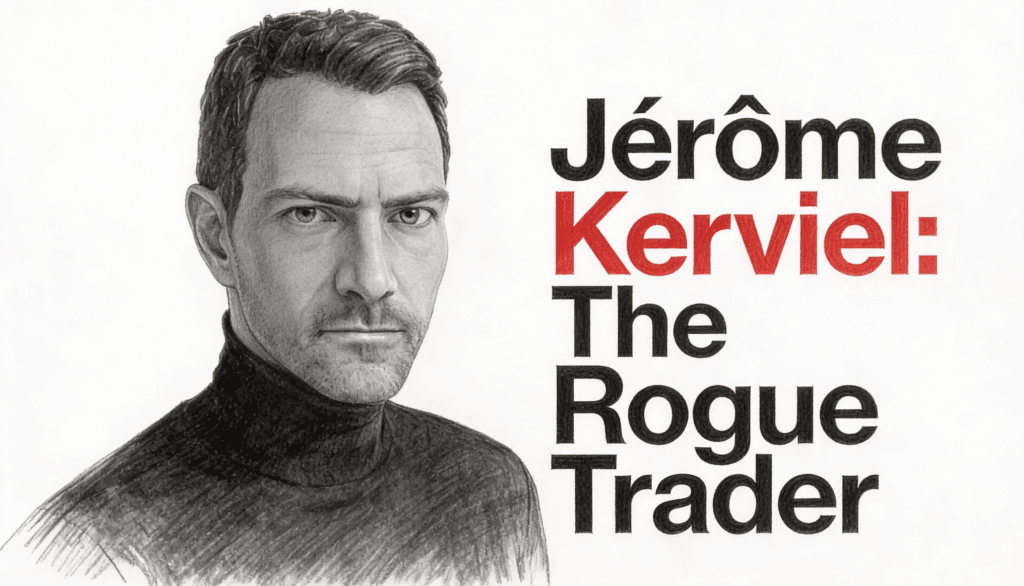
Kerviel was a junior trader who somehow accumulated positions worth more than the entire market capitalization of the bank that employed him. The official story is that he acted alone, a rogue operator who fooled everyone. This is a deeply comforting narrative for the bank. It is also, by any reasonable standard, absurd. A person does not hide 50 billion euros in exposure the same way you hide a parking ticket. Systems had to fail. People had to look away. Incentives had to be aligned in exactly the wrong direction.
Bankman-Fried operated with even less subtlety. FTX had no board of directors in any meaningful sense. Alameda Research, his trading firm, had a special exemption in the FTX code that allowed it to maintain a negative balance. This is the digital equivalent of building a casino where the owner can reach into the vault whenever he wants and calling it a minor administrative detail.
In both cases, the “lone wolf” framing serves a purpose. It localizes the failure to one bad actor so that the system itself never has to answer for its role. It is the organizational equivalent of blaming a house fire on the match rather than asking why the walls were soaked in gasoline.
Why Nobody Asks Questions When the Money Is Good
There is a concep called willful blindness. It describes the human tendency to avoid information that might create discomfort or obligation. In financial markets, willful blindness is not a bug. It is the operating system.
When Kerviel was generating enormous profits for Société Générale, nobody interrogated his methods with any real urgency. Why would they? His gains were flowing into the bonus pool. Asking tough questions would have been like interrogating the goose about its egg production methods. You do not do that. You just collect the eggs.
The same dynamic played out with FTX. Bankman-Fried was not hiding in the shadows. He was on the cover of magazines. He was testifying before Congress. He was donating to political campaigns with the kind of generosity that buys a lot of goodwill and very few follow-up questions. Sequoia Capital, one of the most sophisticated venture firms on the planet, published an adoring profile of him that they later had to delete from their website. This was not a failure of intelligence. It was a failure of incentive.
The Technology Changes, the Psychology Does Not
One of the most persistent myths in finance is that technology makes fraud harder. In reality, technology mostly makes fraud faster and more scalable. It also makes it more confusing, which is arguably more useful to the fraudster than speed.
Kerviel used relatively simple methods. He created fictitious trades to offset his real positions, exploiting his knowledge of the bank’s control systems from his previous role in the compliance department. There is a certain dark poetry in the fact that the person who understood the guardrails best was the one who knew exactly how to step around them.
Bankman-Fried had blockchain, cryptocurrency, and the vocabulary of decentralized finance. None of it mattered. The fraud at FTX was not sophisticated in any technical sense. Customer funds were sent to Alameda. Alameda spent them. The blockchain, supposedly an immutable ledger of truth and transparency, was completely irrelevant to the actual mechanism of the fraud because the fraud happened off chain, inside the company, in the place where human beings make decisions about other people’s money.
This is the part that technology evangelists consistently get wrong. They assume that better tools produce better behavior. But tools are morally neutral. A sharper knife can be used by a surgeon or a mugger. The blockchain did not prevent fraud at FTX any more than double entry bookkeeping prevented fraud at Enron. The constraint on fraud has never been technological. It has always been cultural, institutional, and deeply human.
The Psychological Profile That Keeps Repeating
If you spend enough time studying financial fraudsters, a pattern emerges that is almost unsettling in its consistency. They are not, for the most part, people who set out to commit fraud from the beginning. They are people who started with a small transgression, found that it worked, and then could not stop.
This is what criminologists call the “slippery slope” of white collar crime. It starts with a minor deviation. Maybe you mismark a position. Maybe you borrow a small amount from a fund you control. The world does not end. Nobody notices. And the absence of consequences becomes its own permission structure.
Kerviel started with small unauthorized trades. They worked out. So he made bigger ones. By the time the positions had grown to an absurd size, unwinding them would have meant admitting what he had done. The cover up became the strategy.
Bankman-Fried appears to have followed a similar trajectory. Early decisions to commingle funds between FTX and Alameda may have seemed minor at the time. But each small compromise created the conditions for the next, larger one. By the end, the hole was so large that the only options were to keep going or to confess. People almost never confess.
Regulation Always Fights the Last War
After every major fraud, there is a predictable surge of regulatory activity. New rules are written. New agencies are empowered. Politicians hold hearings. Everyone agrees that this must never happen again. Then it happens again.
The reason is structural. Regulation is, by nature, backward looking. It examines what went wrong and builds defenses against that specific failure. But fraud is adaptive. It does not repeat itself in exactly the same form. It finds the next unguarded door.
After Enron, the United States passed Sarbanes-Oxley, an extensive piece of legislation designed to improve corporate accountability. It did not prevent the 2008 financial crisis. After 2008, Dodd-Frank was enacted to address the specific failures that led to the housing collapse. It did not prevent the crypto frauds of the 2020s.
This is not because the regulations were poorly designed. Many of them were thoughtful and well intentioned. It is because regulation operates on a fundamental asymmetry. Regulators have to defend every possible entry point. Fraudsters only have to find one.
The game theorists would recognize this immediately. It is the defender’s dilemma. The cost of defense always exceeds the cost of attack. And in financial markets, where the rewards for successful deception are measured in billions, the incentive to find that one unguarded door is enormous.
The Real Lesson Nobody Wants to Hear
Here is the uncomfortable truth that twenty years of financial fraud keeps teaching us, and that we keep refusing to learn. The problem is not that we lack the tools to detect fraud. The problem is that fraud is profitable for too many people for too long before it is discovered.
Kerviel made money for Société Générale before he lost it. Bankman-Fried created wealth, influence, and status for thousands of people before it all evaporated. During the good times, everyone who benefited from the fraud had a powerful incentive to not look too closely. The compliance officers, the investors, the regulators, the politicians, the journalists. Not all of them were corrupt. Most of them were simply human, doing what humans do, which is to avoid information that threatens a comfortable arrangement.
The DNA of financial fraud does not change because the DNA of human behavior does not change. We are still the same species that responds to incentives, avoids uncomfortable truths, and confuses confidence with competence. We still defer to people who seem to be making money. We still assume that complexity equals legitimacy. We still believe, against all evidence, that the next set of rules will finally be the ones that work.
The fraudsters know this. That is why they keep winning, at least for a while.
The only real defense against financial fraud is not a better algorithm or a tougher regulation. It is the willingness to ask simple questions when everyone around you is getting rich: where is the money coming from, and does the explanation actually make sense?
It is the simplest question in finance. It is also, apparently, the hardest one to ask.