Table of Contents
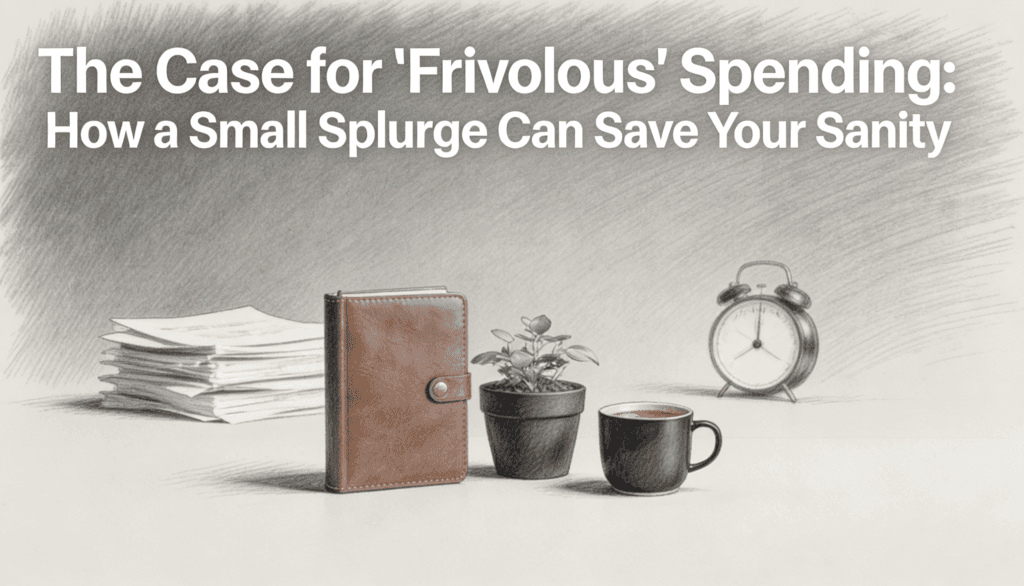
There is a particular kind of guilt that only personal finance culture can produce. You buy a coffee. Not the home brewed kind. The overpriced, oat milk, extra shot kind. And somewhere in the back of your mind, a voice that sounds suspiciously like a financial influencer whispers: that is $5.50 you will never retire on.
Welcome to the age of optimized spending, where every dollar is supposed to have a job, a performance review, and a five year plan. Where buying something simply because it makes you feel good is treated like a moral failing. Where the latte has become the most politically charged beverage since the Boston Tea Party.
But here is the thing nobody in the frugality movement wants to admit. Sometimes the “irresponsible” purchase is the most responsible thing you can do.
The Budget as a Straitjacket
Budgeting is good. Nobody is arguing otherwise. Having a plan for your money is one of the clearest markers of financial stability, and the data on that is about as controversial as gravity.
But there is a difference between a budget and a cage.
When every single dollar is accounted for, tracked, and squeezed for maximum utility, something strange happens. Money stops being a tool and starts being a source of anxiety. The budget, which was supposed to reduce stress, becomes the stress. You spend more emotional energy agonizing over a $12 impulse buy than the purchase could ever cost you financially.
This is what psychologists call the scarcity mindset, and it does not only affect people who are actually broke. It affects anyone who has internalized the belief that spending on pleasure is wasteful by definition. You can earn six figures and still feel a knot in your stomach when you buy a book you could have borrowed from the library.
The irony is sharp. The tool designed to give you control over your money ends up giving your money control over you.
The Mental Health Tax Nobody Calculates
Financial stress is not just uncomfortable. It is expensive in ways that never show up on a spreadsheet.
Chronic stress from money anxiety has been linked to sleep disruption, weakened immune response, difficulty concentrating, and strained relationships. These are not abstract consequences. They show up as sick days, lower productivity, arguments with your partner about whether you “need” that thing you bought, and doctor visits for problems that started as tension headaches and graduated into something worse.
There is a concept in engineering called a pressure relief valve. Systems that operate under constant pressure without any release mechanism do not just underperform. They break. Catastrophically.
Human beings are no different. A life of pure financial optimization, where every decision is filtered through the question “is this the most efficient use of my money,” is a system running without a valve. The pressure builds. And when it releases, it rarely does so in the form of a sensible $8 treat. It comes as a $400 online shopping binge at 2 AM, fueled by the emotional exhaustion of months of deprivation.
This is the part that makes the math interesting. The person who never allows themselves small indulgences often ends up spending more in the long run than the person who builds a little “waste” into the system. The controlled burn prevents the wildfire.
What Behavioral Economics Already Knows
Traditional economics assumes people are rational. Behavioral economics knows better.
Daniel Kahneman and Amos Tversky spent decades documenting how humans actually make decisions, and the picture is not flattering. We are loss averse, meaning the pain of losing $20 hits harder than the pleasure of gaining $20. We are subject to decision fatigue, where the quality of our choices degrades the more choices we make. And we are terrible at evaluating long term tradeoffs when our present selves are miserable.
This last point matters most.
When you are financially stressed, your brain literally narrows its focus. Research found that financial worry occupies so much cognitive bandwidth that it can reduce effective IQ by roughly 13 points. That is the equivalent of losing a full night of sleep. Not exactly the mental state you want to be in when making important life decisions.
So here is the counterintuitive truth. A small, deliberate splurge can actually improve your financial decision making. Not because the purchase itself has any financial value, but because the psychological relief it provides frees up cognitive resources for the decisions that do matter. The $7 pastry does not make you richer. But the mental bandwidth it buys back might.
The Puritan Hangover
To understand why we feel so guilty about spending on pleasure, it helps to look beyond the spreadsheet.
Western culture, particularly American culture, carries a deep inherited suspicion of enjoyment. The Puritan work ethic did not just shape how people thought about labor. It shaped how they thought about reward. Pleasure was suspect. Comfort was a slippery slope. The good life was the disciplined life, and discipline meant denial.
This might seem like ancient history, but its fingerprints are all over modern personal finance content. The language gives it away. We talk about “guilty pleasures” as if enjoyment requires confession. We call spending on ourselves “treating” ourselves, borrowing the vocabulary of exception and indulgence. The baseline assumption is that you should not be doing this, but just this once, you will allow it.
Compare this to cultures with a different relationship to money and pleasure. In Denmark, the concept of hygge, roughly translated as cozy contentment, is not considered frivolous. It is considered essential. Spending money on candles, good food, and a warm atmosphere is not a deviation from a well lived life. It is part of the definition.
Nobody is suggesting you move to Copenhagen. But it is worth noticing that the guilt you feel about buying yourself something nice is not universal. It is cultural. And cultural assumptions can be questioned.
The Difference Between a Splurge and a Problem
There is a meaningful distinction between a deliberate, small indulgence and a compulsive spending pattern. The difference is not in the dollar amount. It is in the intention and the aftermath.
A healthy splurge is something you choose consciously. You know it is not “necessary.” You buy it anyway because you have decided that your mental wellbeing has value, and this purchase serves it. Afterward, you feel lighter. The guilt, if it shows up at all, is brief and manageable.
A problematic spending pattern feels different. It is reactive rather than chosen. It is driven by anxiety, boredom, or emotional pain rather than genuine desire. And afterward, it makes you feel worse, not better. The temporary relief is followed by regret, which feeds more anxiety, which feeds more spending.
Knowing the difference is not complicated. The question is simple: are you spending this money, or is it spending you?
The Optimization Trap
We live in a culture obsessed with optimization. Every hour should be productive. Every calorie should be tracked. Every dollar should be invested. Every decision should be the best possible decision. The result is a kind of exhausting perfectionism that applies industrial logic to human life.
But humans are not factories. We do not run on efficiency alone. We run on meaning, rest, pleasure, beauty, and occasionally on things that serve no purpose at all except that they make the afternoon slightly better.
The Japanese have a concept called wabi sabi, an appreciation for imperfection and transience. A cracked bowl is not ruined. It is interesting. A life with a little “waste” in it is not a failed optimization. It is a life with room to breathe.
The personal finance world could use a little wabi sabi. Not everything needs to compound. Some money is meant to be spent now, on something that will never appreciate in value but that makes today more bearable. And that is not a flaw in your financial plan. That is the point of having money in the first place.
A Practical Framework for Principled “Waste”
If the idea of spending without guilt still makes you nervous, here is a way to think about it that might help.
Give yourself a line item. Call it whatever you want. The sanity fund. The do not ask questions budget. The “this is none of Dave Ramsey’s business” allocation. Make it a fixed amount that you can genuinely afford, even if it is small. The number matters less than the permission.
The rules are simple. This money exists to be spent on things that have no financial return. No justification required. No tracking against categories. No guilt. The only criterion is that it makes your day, your week, or your month a little better.
What you will likely find is that having explicit permission to spend actually reduces your overall spending. The restriction was creating the pressure. The pressure was creating the blowouts. Remove the restriction, and the blowouts lose their fuel.
It is the same principle behind why people who allow themselves to eat what they want often end up eating less than chronic dieters. Scarcity, even artificial scarcity, creates obsession. Permission creates calm.
The Real Cost of Never Spending
The personal finance community talks a lot about opportunity cost, the idea that every dollar spent is a dollar that could have been invested instead. And in pure mathematical terms, that is true. Your morning coffee, compounded over 30 years at 8% annual returns, is indeed a startling sum.
But this framing quietly ignores the opportunity cost on the other side of the equation. What is the cost of 30 years of low level financial guilt? What is the cost of a relationship strained by constant arguments about money? What is the cost of arriving at retirement with a robust portfolio and the vague sense that you forgot to enjoy the decades that got you there?
These costs are real. They are just harder to graph.
The richest retired person in the graveyard is not winning anything. Money is stored energy. It is potential. And potential that is never converted into lived experience is just numbers on a screen.
The Bottom Line, If You Will Forgive the Expression
Spend less than you earn. Save for the future. Invest wisely. All of this remains true.
But also: buy the coffee sometimes. Get the book. Take the slightly nicer hotel room on the trip you have been putting off. Order the appetizer.
Not because these things are financially optimal. They are not. But because you are a person, not a portfolio. And people need more than compound interest to survive. They need small, pointless, wonderful things that make the math worth doing in the first place.
The most dangerous financial advice is not “spend recklessly.” Almost nobody actually follows that advice. The most dangerous financial advice is “never spend on anything that does not build wealth,” because millions of people try to follow it, and it quietly makes them miserable.
Your sanity is not frivolous. And the money you spend protecting it is not wasted.