Table of Contents
There is something clarifying about watching a financial system collapse in real time. The fog of marketing language lifts. The promises printed on glossy brochures dissolve. And what you are left with is the rawest possible answer to a question most investors never bother to ask in good times: what actually holds?
September 2008 answered that question with uncomfortable precision. Lehman Brothers filed for bankruptcy. AIG needed a government lifeline. The S&P 500 would eventually lose more than half its value from peak to trough. Entire categories of assets that were supposed to be safe turned out to be fiction dressed in a suit.
But not everything broke. A handful of asset classes sat through the chaos like people who had already read the last page of the book. They knew how this ended, and they were not impressed.
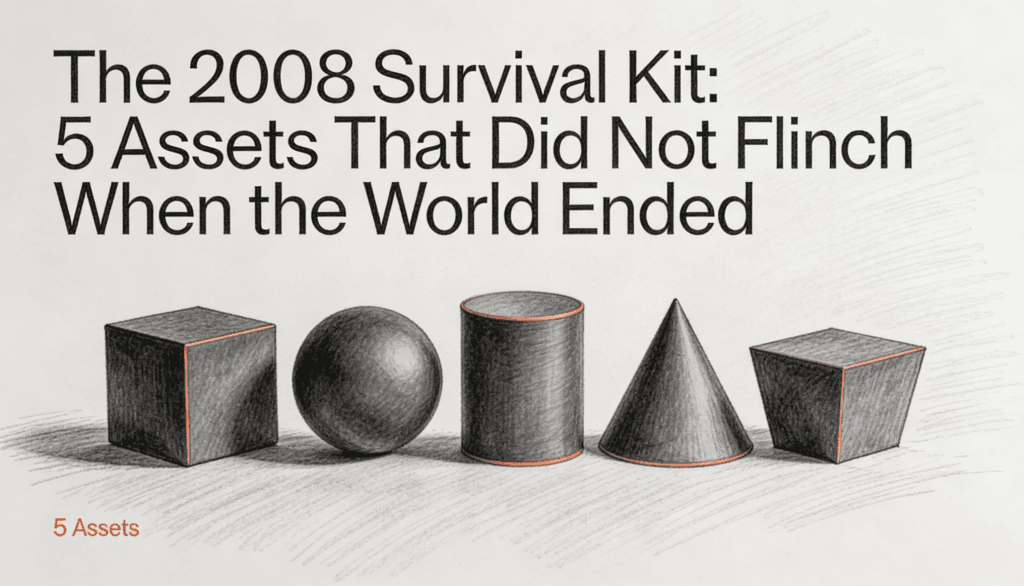
Here are five of them.
1. U.S. Treasury Bonds
Start with the most boring answer, because the most boring answer is usually the right one.
When Lehman collapsed and credit markets froze, investors did not reach for clever instruments. They reached for the financial equivalent of a concrete bunker. U.S. Treasuries, particularly long duration ones, rallied hard during the worst of the crisis. While equities were in free fall and corporate bonds were getting repriced to reflect the sudden possibility that corporations might not survive, Treasuries did what they have always done in moments of genuine panic. They went up.
This is worth sitting with for a moment, because it reveals something about how markets actually work versus how we are told they work. In theory, diversification is about spreading risk across uncorrelated assets. In practice, during a true crisis, almost everything becomes correlated. Stocks fall. Corporate bonds fall. Real estate falls. Commodities fall. The correlations all go to one. Almost everything moves together, and that direction is down.
Treasuries are one of the rare exceptions. They tend to become more valuable precisely when everything else is losing value. This is not a coincidence. It is a structural feature. When fear spikes, capital flows toward the safest, most liquid instruments available. And for better or worse, the full faith and credit of the United States government remains the floor beneath the global financial system.
The counterintuitive part is that Treasuries did this despite the U.S. government being at the center of the crisis. The American housing market caused the problem. American banks amplified it. American regulators missed it. And yet American government debt was where the world ran for safety. If that does not tell you something about the difference between absolute safety and relative safety, nothing will.
2. Gold
Gold gets a bad reputation in normal times, and it deserves some of it. It does not pay dividends. It does not generate earnings. Buffett once pointed out that all the gold in the world could be melted into a cube that would fit inside a baseball infield, and owning it would give you nothing to do but stare at it.
He is not wrong. But he is also describing peacetime behavior. And 2008 was not peacetime.
Gold ended 2008 roughly where it started, which sounds unimpressive until you remember the context. The S&P 500 lost about 38% that year. Real estate was cratering. Bank stocks were going to zero. In that environment, flat is spectacular. Flat is the equivalent of walking out of a burning building without a scratch.
What makes gold interesting from an intellectual standpoint is not that it is a good investment. It is that it is a good mirror. Gold reflects the collective confidence, or lack of confidence, that people have in the systems around them. When trust in banks, currencies, and institutions is high, gold sits quietly and underperforms almost everything. When that trust fractures, gold becomes relevant again.
There is a parallel here to how people think about insurance. Nobody brags about their homeowner’s policy at a dinner party. It feels like dead money. Until the house catches fire, at which point it becomes the most important financial decision they ever made. Gold operates on a similar logic. It is not designed to make you rich. It is designed to keep you from becoming poor at the worst possible moment.
The 2008 crisis reminded people of this. The years that followed, as central banks printed trillions in new currency, reminded them even louder. Gold doubled from its 2008 levels by 2011.
3. The Japanese Yen
This one surprises people, and it should.
Japan in 2008 was not exactly a picture of economic vitality. The country had been stuck in a low growth, deflationary environment for nearly two decades. Its stock market was still far below its 1989 peak. By most conventional measures, Japan was the last place you would expect to find a crisis safe haven.
And yet the yen surged during the 2008 meltdown. Against the dollar, against the euro, against nearly everything. It was one of the best performing currencies during the worst financial crisis in generations.
The reason has less to do with Japan’s strengths and more to do with the global financial system’s plumbing. For years leading up to the crisis, investors had been borrowing cheaply in yen, where interest rates were near zero, and investing those funds in higher yielding assets elsewhere. This was called the carry trade, and it was enormously popular. It worked beautifully as long as markets were calm and the yen stayed weak.
When panic hit, those trades unwound violently. Investors scrambled to pay back their yen denominated loans, which meant buying yen in enormous quantities. The currency spiked not because anyone suddenly loved the Japanese economy, but because a massive global trade was being run in reverse all at once.
There is something almost poetic about this. The yen’s strength during the crisis was not a vote of confidence. It was the sound of leverage snapping. It is a reminder that in financial markets, the reason an asset moves is sometimes completely disconnected from what that asset actually represents.
This matters for anyone trying to understand markets at a deeper level. Price movement and fundamental value are related, but they are not the same thing. And in a crisis, the gap between the two can become enormous.
4. Volatility (The VIX)
Here we arrive at the strangest entry on the list, because it is not really an asset at all. The VIX is a measure of expected volatility in the S&P 500, derived from options prices. You cannot buy it and put it in a drawer. But instruments tied to it existed in 2008, and they performed unlike almost anything else.
The VIX spiked from a relatively calm level near 20 at the start of the year to an intraday peak above 89 in October. To put that in perspective, numbers above 30 are considered elevated. Numbers above 40 indicate severe fear. The VIX in October 2008 was essentially measuring collective terror.
What makes volatility fascinating as a concept is that it is one of the only things in finance that reliably goes up when everything else goes down. This is because volatility is, at its core, a measure of disagreement and uncertainty. When the future is clear, or at least feels clear, volatility is low. When no one knows what happens next, volatility explodes.
This creates an interesting philosophical point about the nature of financial markets. We tend to think of markets as mechanisms for pricing assets. They are. But they are also mechanisms for pricing certainty itself. The VIX is, in a sense, the market’s confession about how much it does not know.
In 2008, that confession was loud.
For practical purposes, volatility exposure through options or related products became one of the most effective hedges available. Portfolios that included even a small allocation to long volatility strategies outperformed dramatically during the downturn. The tradeoff is that these strategies bleed money during calm periods, which makes them psychologically brutal to maintain. You are essentially paying a premium, month after month, for an event that might not happen for years. And then when it does happen, it pays for everything.
It is, in other words, the anti-portfolio. It makes money when your portfolio does not.
5. Cash
This is the answer nobody wants to hear. It is also the most important one.
Cash did not spike during 2008. It did not rally. It did not do anything dramatic. It sat there. And that was the whole point.
Investors who held meaningful cash positions going into the crisis had something that no other asset class could provide: optionality. They could buy stocks at generational lows. They could acquire distressed real estate. They could negotiate from a position of strength when everyone around them was negotiating from a position of desperation.
Warren Buffett invested five billion dollars in Goldman Sachs during the crisis, on terms so favorable they bordered on comedic. He could do that because he had the cash. The brilliance was not in the analysis. It was in the liquidity.
Cash is financial slack. It is the opposite of optimization. In a world that constantly tells investors to be fully deployed, fully leveraged, and fully committed, holding cash feels like a failure of ambition. But ambition is a peacetime virtue. In a crisis, the virtue that matters is survival. And survival belongs to those who kept something in reserve.
The irony of 2008 is that the investors who looked the most foolish in 2006 and 2007, the ones sitting on cash while everyone else was leveraging into real estate and structured products, turned out to be the smartest people in the room. They just had to wait two years for the room to notice.
The Pattern Beneath the Pattern
Look at these five assets together and a theme emerges. None of them are exciting. None of them would dominate a conversation at a cocktail party during a bull market. Treasuries are boring. Gold is a rock. The yen was a side effect of leverage. Volatility is abstract. Cash is literally nothing happening.
And that is the point.
The assets that survive a crisis are not the ones that promise the most. They are the ones that demand the least. They do not require a specific outcome to hold their value. They do not depend on credit markets functioning, or housing prices rising, or consumer confidence staying elevated. They work precisely because they are disconnected from the assumptions that everything else relies on.
This is an uncomfortable truth for an industry built on the idea that more complexity equals more sophistication. The 2008 crisis was, among other things, a monument to complexity gone wrong. The derivatives were complex. The mortgage structures were complex. The risk models were complex. And when the stress arrived, that complexity did not protect anyone. It accelerated the damage.
The things that worked were simple. They were boring. They were the assets that serious investors always keep nearby but rarely talk about.
The next crisis will not look like 2008. They never repeat in form. But they always repeat in function. Leverage will build. Confidence will stretch beyond what the fundamentals support. And when the correction arrives, the same question will surface again.
What actually holds?
The answer, most likely, will be boring. Again.