Table of Contents
Most people think inflation is about too much money chasing too few goods. They are not wrong. But they are not really right either. That textbook definition is like saying a fire is about heat. Technically accurate. Completely useless if you want to understand who lit the match.
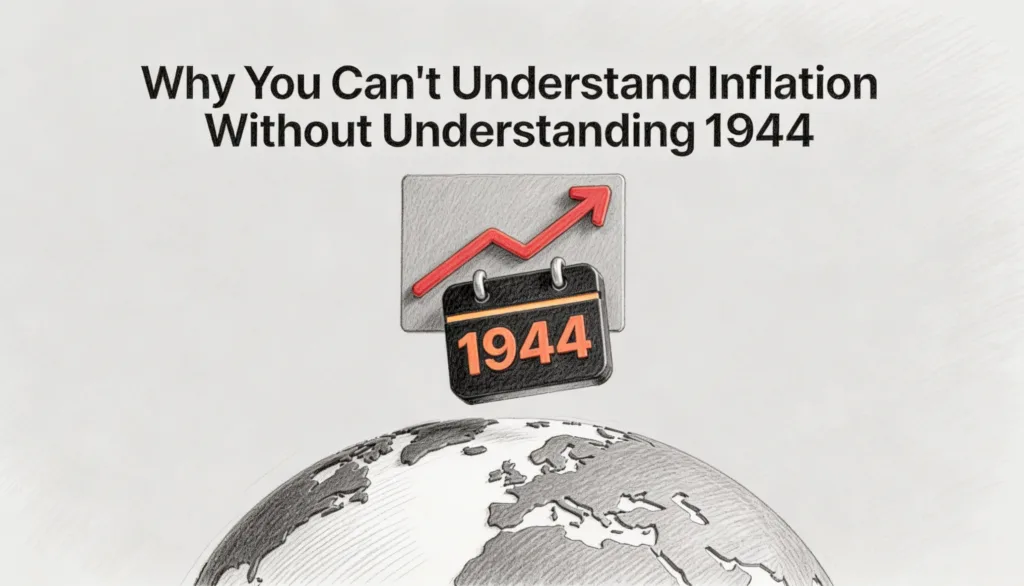
To understand why your groceries cost what they cost, why your rent moves the way it does, and why central bankers talk the way they talk, you need to go back to a hotel in New Hampshire. The year was 1944. The war was still on. And 730 delegates from 44 countries checked into the Mount Washington Hotel in Bretton Woods to redesign the global financial system over three weeks.
What they built there still shapes every price you pay today. Most people have never heard of it.
The World Before the Hotel
To appreciate what happened at Bretton Woods, you need to understand the mess that came before it.
Before 1944, the global economy ran on the gold standard. Countries pegged their currencies to gold. If you held dollars or pounds or francs, you could theoretically exchange them for a fixed amount of gold. This system had a kind of brutal elegance. Governments could not print money freely because every new unit of currency needed gold to back it up.
The problem was that this elegance came with a cost. When economies slowed down, governments could not stimulate spending by increasing the money supply. They were handcuffed to whatever gold sat in their vaults. The Great Depression made this painfully clear. Countries that stuck to the gold standard suffered longer and deeper downturns. Countries that abandoned it earlier, like Britain in 1931, recovered faster.
So by the time World War II was grinding through Europe and the Pacific, the old system was already broken. The question was not whether to replace it. The question was what to replace it with.
Two Men, Two Visions
The Bretton Woods conference was technically a gathering of dozens of nations. In practice, it was a heavyweight fight between two economists.
In one corner stood John Maynard Keynes, representing Britain. Keynes was already the most famous economist alive. He wanted to create a new international currency called the “bancor” that would sit above all national currencies. No single country would control it. Trade imbalances would be managed collectively. It was ambitious, elegant, and deeply threatening to anyone who already held power.
In the other corner stood Harry Dexter White, representing the United States. White wanted something simpler and, not coincidentally, something that would benefit America enormously. His plan was to make the US dollar the center of the global financial system. The dollar would be pegged to gold at $35 per ounce. Every other currency would be pegged to the dollar. America would become the anchor of global finance.
White won. And that outcome was not really about the strength of his argument. It was about the strength of his country. The United States held roughly two thirds of the world’s gold reserves at the time. It had the largest economy, the largest military, and the most leverage. Keynes could propose whatever he liked. The country writing the checks got to write the rules.
This is worth pausing on. The architecture of global money was not designed by consensus or by pure economic logic. It was designed by power. That pattern has not changed much since.
What They Actually Built
The Bretton Woods system created three things that still matter.
First, it made the US dollar the world’s reserve currency. Other countries would hold dollars instead of gold as their primary reserve asset. This meant the United States could essentially export its currency to the rest of the world and receive real goods and services in return. It is a privilege so enormous that a French finance minister later called it the “exorbitant privilege.” He was not being complimentary.
Second, it created the International Monetary Fund. The IMF was designed to be a kind of financial fire department, lending money to countries in short term trouble so they would not have to devalue their currencies or impose destructive trade barriers. In theory, it would keep the system stable. In practice, it became something more complicated and more controversial over time.
Third, it created what eventually became the World Bank, originally tasked with financing the reconstruction of war torn Europe and later redirected toward development in poorer countries.
These institutions still exist. The dollar is still the world’s reserve currency. And the logic that was embedded in 1944 still runs underneath the global economy like old plumbing in a renovated house. You do not see it, but everything flows through it.
The Part Where It All Falls Apart
Here is where the story gets interesting for anyone who cares about inflation.
The Bretton Woods system had a fundamental contradiction built into it. The world needed dollars to conduct trade and hold reserves. But the only way to get more dollars into the global system was for the United States to run deficits, spending more abroad than it took in. The more dollars the world needed, the more America had to spend.
But here is the catch. Every dollar was supposed to be backed by gold at $35 per ounce. As more dollars flooded the world, the ratio of dollars to actual gold in American vaults got worse and worse. It was like writing more and more checks on an account that was not growing.
This problem had a name. Economist Robert Triffin identified it in 1960, and it became known as the Triffin Dilemma. The country at the center of the system had to undermine the system in order to keep it running. It is the kind of paradox that makes economists excited and everyone else uneasy.
By the late 1960s, foreign governments started to notice. France, under Charles de Gaulle, began aggressively converting its dollar reserves back into gold. Other countries followed. The American gold supply was draining. The promise that anyone could exchange dollars for gold at a fixed rate was becoming increasingly fictional.
August 15, 1971
On a Sunday evening in August 1971, Richard Nixon went on television and announced that the United States would no longer convert dollars to gold. He called it temporary. It was not temporary. It was the end of Bretton Woods.
What replaced it was something the world had never tried before at scale. Every major currency would float freely against every other currency. No gold backing. No fixed exchange rates. The value of money would be determined by markets, central bank policy, and, ultimately, trust.
This is the world we still live in. And this is where inflation as we know it truly begins.
Why This Matters for Inflation
Under the gold standard and under Bretton Woods, there were physical limits on how much money could exist. Gold is heavy, scarce, and difficult to mine. You cannot print it. This imposed a natural discipline on governments. Not a perfect discipline, but a real one.
After 1971, those limits vanished. Money became purely a product of policy decisions. Central banks could create as much of it as they wanted. The only constraints were political will and the fear of consequences.
This is not a small change. This is the single most important structural shift in the history of modern money. Every conversation about inflation that does not acknowledge this shift is missing the foundation.
When people ask why inflation was relatively stable for long stretches of the 19th century and then became a persistent feature of the 20th and 21st centuries, this is a huge part of the answer. The rules changed. The game changed. And most people never noticed because the change happened in stages, across decades, in conference rooms and policy papers that nobody outside of economics departments was reading.
The Psychological Shift
There is a subtler point here that often gets missed.
Bretton Woods and its collapse did not just change the mechanics of money. They changed the psychology of money.
Under a gold backed system, money felt like a thing. It had weight, literally. It was connected to something physical and finite. After 1971, money became purely abstract. It became a number in a ledger, a figure on a screen, a promise backed by nothing but the credibility of the institution that issued it.
This matters more than most people realize. When money is abstract, inflation becomes easier to create and harder to feel in real time. Governments can run larger deficits. Central banks can expand their balance sheets to levels that would have been unthinkable under the old system. And for a while, nothing bad seems to happen. Until it does.
Think of it like a relationship with credit cards. The abstraction of spending, tapping a card instead of handing over cash, changes behavior. Studies in consumer psychology have shown this repeatedly. People spend more when the transaction feels less real. The same principle operates at the level of nations and central banks. When money lost its physical anchor, the psychological barrier to creating more of it dropped dramatically.
What Most People Get Wrong
The popular narrative about inflation tends to focus on proximate causes. Supply chain disruptions. Energy prices. Government stimulus checks. These things matter. But they are weather, not climate.
The climate, the underlying condition that makes modern inflation possible at the scale and persistence we see it, was set in 1944 and finalized in 1971. The system that was built at Bretton Woods, and the system that replaced it when Bretton Woods collapsed, created the monetary environment we inhabit today.
This does not mean inflation is inevitable or that it cannot be managed. It can be, and often it is. But the tools available for managing it, interest rate policy, quantitative easing, forward guidance, all of these exist within a framework that was designed by specific people, at a specific time, for specific reasons. And those reasons were not always about what was best for ordinary people trying to buy groceries.
The next time someone tells you inflation is just about supply and demand, remember the Mount Washington Hotel. Remember that 730 people in a New Hampshire resort decided how money would work for the rest of the century. Remember that the system they built had a fatal flaw that took 27 years to kill it. And remember that what replaced it was not a plan. It was an improvisation that became permanent.
Understanding inflation without understanding Bretton Woods is like understanding weather without understanding the atmosphere. You can describe what is happening. But you will never understand why.