Table of Contents
There is a moment from late 1989 that captures a small ticker running. The Nikkei 225 is approaching 39,000. Nobody believed the number could go down. That is the most important detail of the entire story.
The Setup Nobody Questioned
To understand how Japan briefly held more stock market wealth than any nation in history, you have to understand something about narratives. Not economics. Narratives. Because the Japanese asset bubble was not primarily a financial event. It was a storytelling event that happened to involve money.
The story went like this: Japan had figured out manufacturing. Then it figured out quality control. Then it figured out electronics, automobiles, and semiconductors. Each chapter confirmed the thesis of the previous one. By the mid 1980s, the story had become self reinforcing to the point where questioning it felt not just wrong but rude.
Western business schools were literally rewriting their curricula around Japanese management techniques. “Kaizen” and “just in time” were not buzzwords. They were gospels. And when a country becomes the subject of genuine intellectual admiration from its competitors, something dangerous happens. The admiration starts to function as evidence. People stop distinguishing between “Japan makes excellent cars” and “Japanese real estate will appreciate forever.” Those are wildly different claims. But wrapped in the same narrative, they felt like the same truth.
The Numbers That Stopped Making Sense
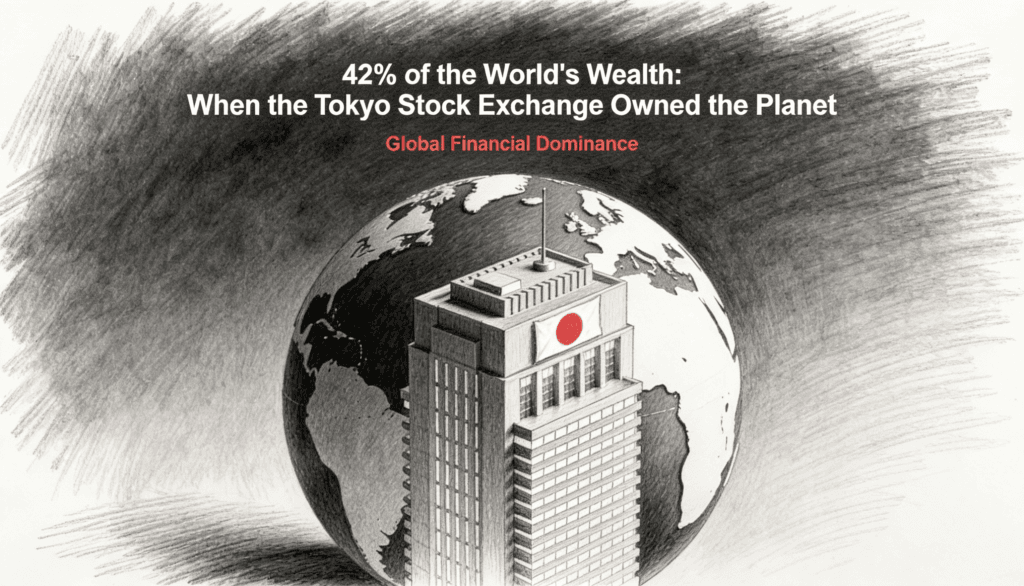
By December 1989, the Tokyo Stock Exchange accounted for roughly 42% of the entire world’s stock market capitalization. Pause on that. A country with about 3% of the world’s land mass and 2% of its population held nearly half of all equity value on earth.
The Imperial Palace grounds in central Tokyo were famously valued at more than all the real estate in California. A single district in Tokyo was worth more than Canada. These comparisons have been repeated so often they have lost their shock value, which is itself part of the problem. When absurdity becomes familiar, it stops functioning as a warning.
But here is what made Japan different from other bubbles. The fundamentals were not fake. Japan really did have extraordinary companies. Toyota really was revolutionizing manufacturing. Sony really was defining consumer electronics. The economy really had grown at remarkable rates for decades. This was not tulip mania, where the underlying asset was decorative and perishable. Japan had substance. And that substance made the insanity harder to see.
This is a pattern worth remembering. The most dangerous bubbles are not built on fraud or fantasy. They are built on a foundation of legitimate achievement that gets extrapolated past the point of reason. The bridge from “this is genuinely impressive” to “therefore prices can never fall” looks short. It is not.
The Bank of Japan and the Art of Pouring Gasoline
Central banks have a remarkable talent for creating problems they will later claim they could not have foreseen. The Bank of Japan in the 1980s is perhaps the finest example.
After the Plaza Accord of 1985, the yen strengthened dramatically against the dollar. This threatened Japanese exports, which were the engine of the entire national mythology. So the Bank of Japan cut interest rates aggressively. Money became cheap. Extraordinarily cheap. And cheap money, in an economy already running on confidence and momentum, does exactly what you would expect. It finds assets and inflates them.
Japanese banks began lending against land values. Land values rose because of lending. Lending increased because land values rose. If this sounds circular, that is because it was. The entire system became a feedback loop with no external reference point. Banks were not evaluating whether loans made economic sense. They were evaluating whether the collateral had gone up since last quarter. It always had. So the loans always got approved.
Companies that made cameras and televisions started behaving like real estate funds. Industrial firms were generating more profit from financial speculation than from their actual products. Mitsubishi Estate bought Rockefeller Center in New York. It was intended as a symbol of Japanese economic supremacy. It ended up as a symbol of something else entirely.
The Psychology of Believing You Are Special
There is a concept in behavioral finance called “this time is different.” It describes the tendency of every generation of investors to believe that the current boom is fundamentally unlike all previous booms and therefore immune to the same ending.
Japan in the late 1980s took this impulse and elevated it into something closer to a national philosophy. There was a widespread and genuinely held belief that Japanese capitalism was structurally superior to Western capitalism. The argument went that cross shareholding between corporations, lifetime employment, and close relationships between banks and industry created a system that was more stable, more long term oriented, and more rational than the messy individualism of American markets.
The irony is thick enough to walk on. The claim was that Japanese markets were more rational. This claim was being made while the market was pricing golf club memberships at millions of dollars and while companies were valued at multiples that assumed decades of impossible growth.
But here is the counterintuitive part. The believers were not stupid. Many of them were sophisticated, well educated, and had decades of experience. The problem was not intelligence. The problem was that intelligence, when combined with a compelling narrative and social consensus, can actually make you more vulnerable to delusion. Smart people are better at constructing arguments for why they are right. That makes them worse at recognizing when they are wrong.
This is something you see across domains far beyond finance. In academic research, the most credentialed experts are sometimes the last to abandon a failing paradigm. In technology, the most experienced engineers sometimes miss disruptive shifts precisely because their expertise is anchored in the old framework. Mastery can become a prison.
The Crash Nobody Planned For
The Bank of Japan eventually realized it had a problem. In late 1989, it began raising interest rates. The logic was sound. The execution was catastrophic.
The Nikkei peaked on December 29, 1989, at 38,957. It would not see that level again for over three decades. By 1992, it had lost nearly half its value. By 2003, it had fallen to around 7,800. That is a decline of roughly 80% from the peak. The real estate market followed a similar trajectory, just slower and more grinding.
What followed was not a recession. It was what economists came to call the Lost Decade, though calling it a decade was generous. It lasted closer to two decades. Some would argue it lasted three.
Japan entered a period of deflation, stagnation, and demographic decline that reshaped the country fundamentally. The government tried everything. Massive fiscal stimulus. Zero interest rates. Quantitative easing before the rest of the world had even heard the term. None of it worked the way it was supposed to.
And here is the detail that should concern anyone who studies markets. Japan did not experience a financial crisis in the dramatic, cinematic sense. There was no single Lehman Brothers moment. No bank run captured on evening news. The destruction was slow, methodical, and grinding. Asset values simply deflated, year after year, while the economy refused to generate the growth that everyone kept expecting was just around the corner.
Slow crises are harder to respond to than fast ones. A sudden crash creates urgency. A slow bleed creates denial. Japan spent years insisting that recovery was imminent. The policy response was always calibrated to a problem that was smaller than the actual problem. By the time the true scale became undeniable, enormous damage had already been done.
What the Rest of the World Learned (and Then Forgot)
The Japanese bubble should have been the definitive cautionary tale for global finance. In many ways, it was. Every economics textbook published after 1990 includes a chapter on it. Every central banker who lived through it swore they had internalized its lessons.
And then, roughly fifteen years later, the United States built a housing bubble on almost identical principles. Cheap credit. Rising asset values used as collateral for more borrowing. A narrative of permanent appreciation. Widespread belief that structural changes in the economy had made the old risks obsolete. The details were different. The architecture was the same.
This is perhaps the most uncomfortable lesson from the Japanese experience. It is not that bubbles are hard to see in real time, although they are. It is that even after you have seen one, studied one, written books about one, and taught courses about one, you can still walk directly into the next one. The knowledge does not protect you. Because bubbles are not fundamentally about knowledge. They are about incentives, social pressure, and the deeply human inability to believe that a good thing will end.
The Longer Shadow
Japan eventually recovered in nominal terms. The Nikkei finally surpassed its 1989 high in early 2024, some 34 years later. But the cultural and economic impact of the bubble and its aftermath reshaped Japanese society in ways that stock charts do not capture.
A generation of Japanese workers entered the labor market during the Lost Decades and never fully recovered their career trajectories. The culture of corporate loyalty and lifetime employment eroded. Birth rates, already low, declined further. The national mood shifted from expansive confidence to cautious conservatism.
There is something worth noting about how Japan handled its long winter compared to how other countries might have. Social cohesion held. Inequality did not spike the way it did in the United States after 2008. The suffering was distributed more evenly, which is either a testament to Japanese social structure or a reflection of the fact that when everyone loses, there are fewer villains to point at.
Why This Still Matters
The Japanese bubble is not ancient history dressed up as a lesson. It is a living template for how sophisticated economies lose their bearings.
Every few years, a new market or asset class attracts the same constellation of forces. Genuine innovation, easy credit, extrapolated growth curves, widespread consensus, and the quiet disappearance of skeptics from the conversation. The specific asset changes. The underlying dynamics do not.
The most valuable takeaway from Japan’s experience might be the simplest one. When everyone agrees that an asset can only go up, that agreement is not evidence of the asset’s value. It is evidence of a blind spot. The moment when a thesis feels most certain is often the moment it is most fragile.
The men and women in Tokyo in 1989 were not fools. They were participants in a collective story that felt, from the inside, like rationality. Every bubble does. That is what makes them so effective. And that is what makes them so devastating when the story finally runs out of believers.